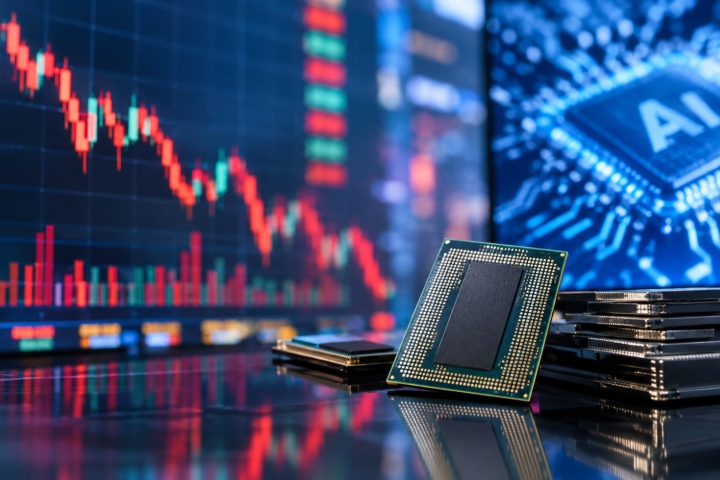
Heavy investment in artificial intelligence hardware and cloud capacity is driving equity performance across the technology sector, even as questions grow about the durability of returns.
Technology stocks continued to be shaped by the scale and direction of artificial intelligence spending, with investors rewarding companies positioned at the center of data-center expansion while scrutinizing those facing rising capital demands. The market’s focus has narrowed from broad enthusiasm for AI to a more selective assessment of who ultimately captures the profits.
Chipmakers remain the clearest beneficiaries. Nvidia (NVDA) has reinforced its status as the backbone of AI computing, with its data-center accelerators effectively setting the pace for capital spending across the industry. The company’s valuation reflects expectations that demand from cloud providers and enterprises will remain strong well into next year, even as customers seek greater pricing leverage and alternative suppliers.
That dynamic has lifted adjacent players as well. Advanced Micro Devices (AMD) has gained traction as customers diversify chip sourcing, while Taiwan Semiconductor Manufacturing Company (TSM) continues to benefit from its role as the primary manufacturer of advanced processors. Investors increasingly view foundry capacity and manufacturing execution as strategic assets rather than commoditized services.
Cloud platforms, however, are presenting a more complex picture. Microsoft (MSFT), Alphabet (GOOGL), and Amazon.com (AMZN) are spending aggressively on AI infrastructure, supporting long-term growth narratives but compressing near-term margins. Equity markets have largely accepted this tradeoff, pricing these companies as utilities of the AI era, though any sign of slowing enterprise demand could quickly shift sentiment.
On the software side, innovation is moving from model development to deployment. Enterprise software firms are racing to integrate AI features that promise productivity gains, but monetization remains uneven. Investors are increasingly skeptical of companies touting AI capabilities without clear revenue impact, contributing to sharper valuation dispersion within the sector.
Hardware outside of data centers has been a laggard. Apple (AAPL) has emphasized on-device AI and custom silicon as differentiators, but investors remain cautious about whether these innovations can reignite consumer upgrade cycles in a slowing global economy.
Overall, technology equities are being driven less by the promise of AI itself and more by confidence in execution, pricing power, and return on invested capital. The sector’s next phase appears likely to reward discipline and scale, rather than ambition alone, as innovation moves from concept to balance-sheet reality.
ChatGPT can make mistakes. OpenAI doesn’t use SmallCap Communications workspace data to train its models.