Even blockbuster fundamentals can’t rescue a stock when expectations, positioning, and policy assumptions have all raced ahead of reality.
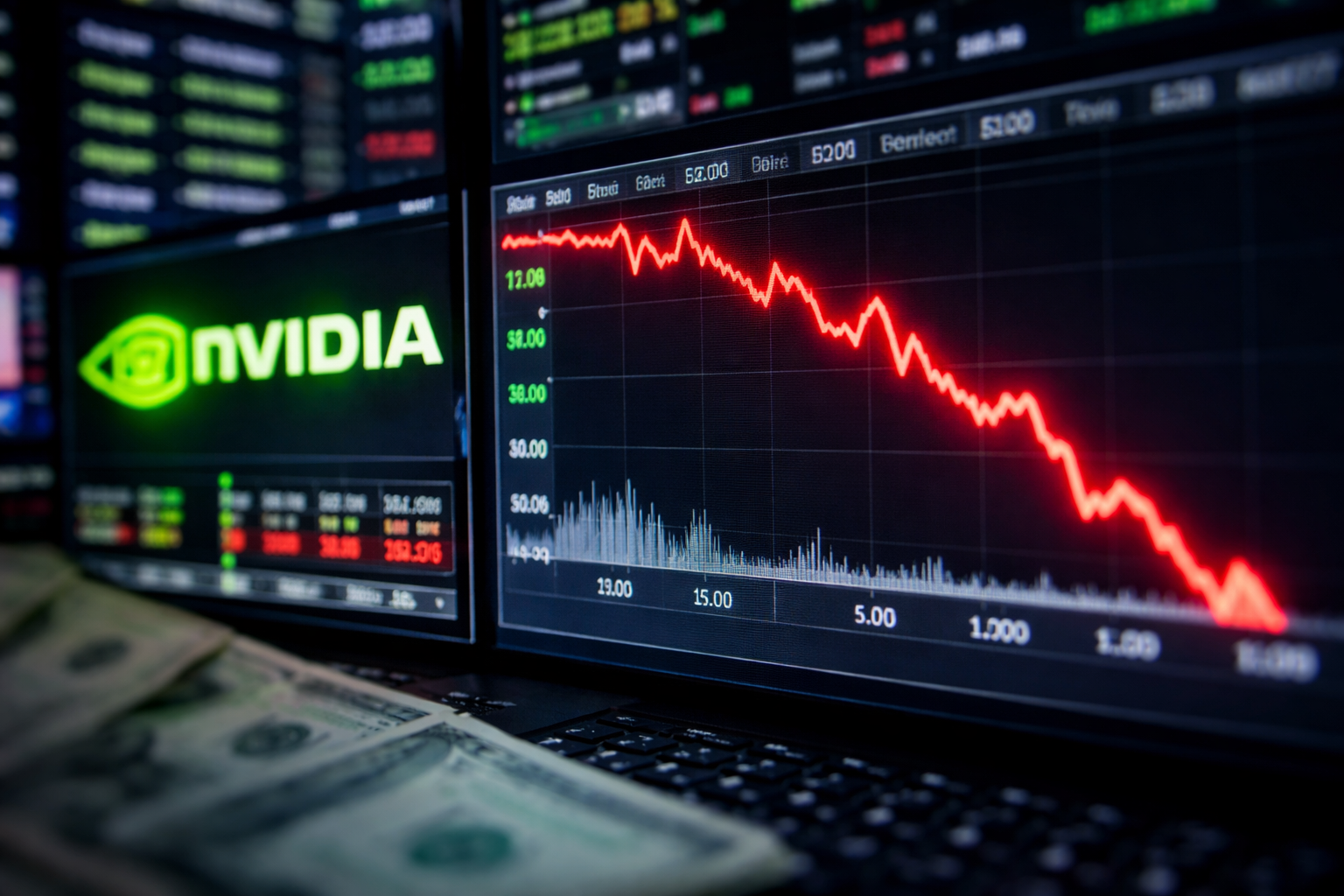
The most important market signal this week was not a surprise miss or an ugly macro print. It was Nvidia (NVDA) delivering what many analysts described as a standout quarter and still watching its shares fall sharply. That kind of “good news is not good enough” price action is rarely about one company. It is about a regime shift in how investors are discounting risk, growth, and policy support.
Nvidia’s results again underscored that the demand side of the AI buildout is real. Revenue and guidance topped consensus estimates, and commentary pointed to customers accelerating investment plans. Yet the stock’s decline wiped out a huge amount of market value in a single session, joining a growing 2026 pattern in which strong earnings do not automatically translate into higher prices.
The simplest explanation is that Nvidia had become a consensus “can’t lose” position, and consensus trades are fragile. When a stock is priced as if its future is already known, investors stop asking whether the company is doing well and start asking whether the company is doing even better than the market has already assumed. The bar rises quietly, quarter after quarter, until management must clear not just expectations but also the market’s imagination. The moment the narrative shifts from “astonishing” to merely “excellent,” the stock can reprice lower even as fundamentals improve.
But that is only half the story. The other half is that the market’s broader scaffolding of assumptions is wobbling: rate cuts, inflation progress, and fiscal realities are no longer lining up neatly with the bullish script. A notable IMF message this week framed the Federal Reserve as nearing the end of its easing cycle, citing resilient growth, fiscal deficits, and tariff-related price pressures that could narrow the room for further cuts. If investors have been relying on lower yields to justify high multiples for long-duration growth assets, the idea that policy easing may be closer to “pause” than “tailwind” matters even for companies with strong cash-generation potential.
This is how equity markets get into trouble: not because the world suddenly collapses, but because too many assets become priced for a world that stays unusually favorable for unusually long. In 2024 and 2025, investors could argue that AI was both a new profit pool and a productivity story that might help contain inflation over time. That thesis still has merit. What is changing is the tolerance for paying any price for that thesis, especially when the capex bill is large, the competitive set is intensifying, and policy rates may not keep falling on command.
Nvidia’s selloff also highlights a subtle but critical rotation in what markets are rewarding. For years, investors have been conditioned to chase growth and momentum because liquidity was abundant and inflation shocks tended to fade quickly. In 2026, the rewards appear more conditional. The market is scrutinizing concentration risk, customer dependence, and whether the next leg of AI revenue will broaden beyond a handful of hyperscalers. When a stock becomes a proxy for an entire theme, it inherits the theme’s uncertainties too.
The uncomfortable truth for bulls is that the “AI trade” is no longer only about technology. It is about capital allocation. The question investors are beginning to ask is not whether AI is transformative, but whether the marginal dollar of spending delivers marginal profit quickly enough to satisfy public-market time horizons. When the largest buyers of AI hardware are also under pressure to demonstrate returns on massive investment programs, the market’s enthusiasm for the upstream beneficiaries becomes more nuanced. That does not mean the growth disappears. It means the valuation debate returns.
This is where policy and politics come back into frame. If deficits remain large and any tariff-driven price pressures persist, central banks may be forced into a more cautious posture. The Bank of England, for instance, has recently shown a split committee around whether to cut or hold, reflecting the same tension: inflation may be easing, but the path back to target is not always smooth. Even when the U.S. economy slows, the Fed has to weigh credibility and inflation expectations, not just asset prices. Markets can hope for rate relief, but hope is not a strategy when multiples are high.
So what does an investor do with this signal?
First, treat Nvidia’s move as a reminder that concentration is a risk factor, not just a feature of recent returns. If a portfolio’s performance depends heavily on one theme, one segment, or one or two mega-cap winners, then the portfolio is implicitly betting on an absence of disappointment. The hard part is that disappointment can take the form of “less upside than imagined,” not an outright miss.
Second, separate the AI thesis from the AI price. It is possible to believe AI spending will keep growing while also believing that the market has already capitalized a large portion of that growth. When the market is saturated with the same trade, the expected return shrinks and the path becomes more volatile.
Third, shift from storytelling to underwriting. Underwriting means asking what a company must deliver for the next three to five years to justify today’s valuation, then stress-testing those assumptions against realistic competitive dynamics, customer bargaining power, and macro conditions. Nvidia can be an exceptional business and still be a challenging stock if the entry price assumes perfection.
Finally, remember that regime changes tend to arrive quietly. They show up first as “weird” price action: great earnings, down stock; strong results, flat index; good data, higher yields anyway. This is how markets communicate that the discount rate and the confidence premium are changing. In that environment, disciplined position sizing, diversification across factors, and a willingness to hold cash or shorter-duration assets are not signs of pessimism. They are signs of respect for a market that is repricing certainty.
Nvidia’s quarter did not break the AI story. It did something more useful. It reminded investors that the story is already widely owned, widely priced, and increasingly judged by a higher standard than last year. That is not bearish. It is simply what mature trades look like when the market stops paying extra for hope and starts charging for risk.