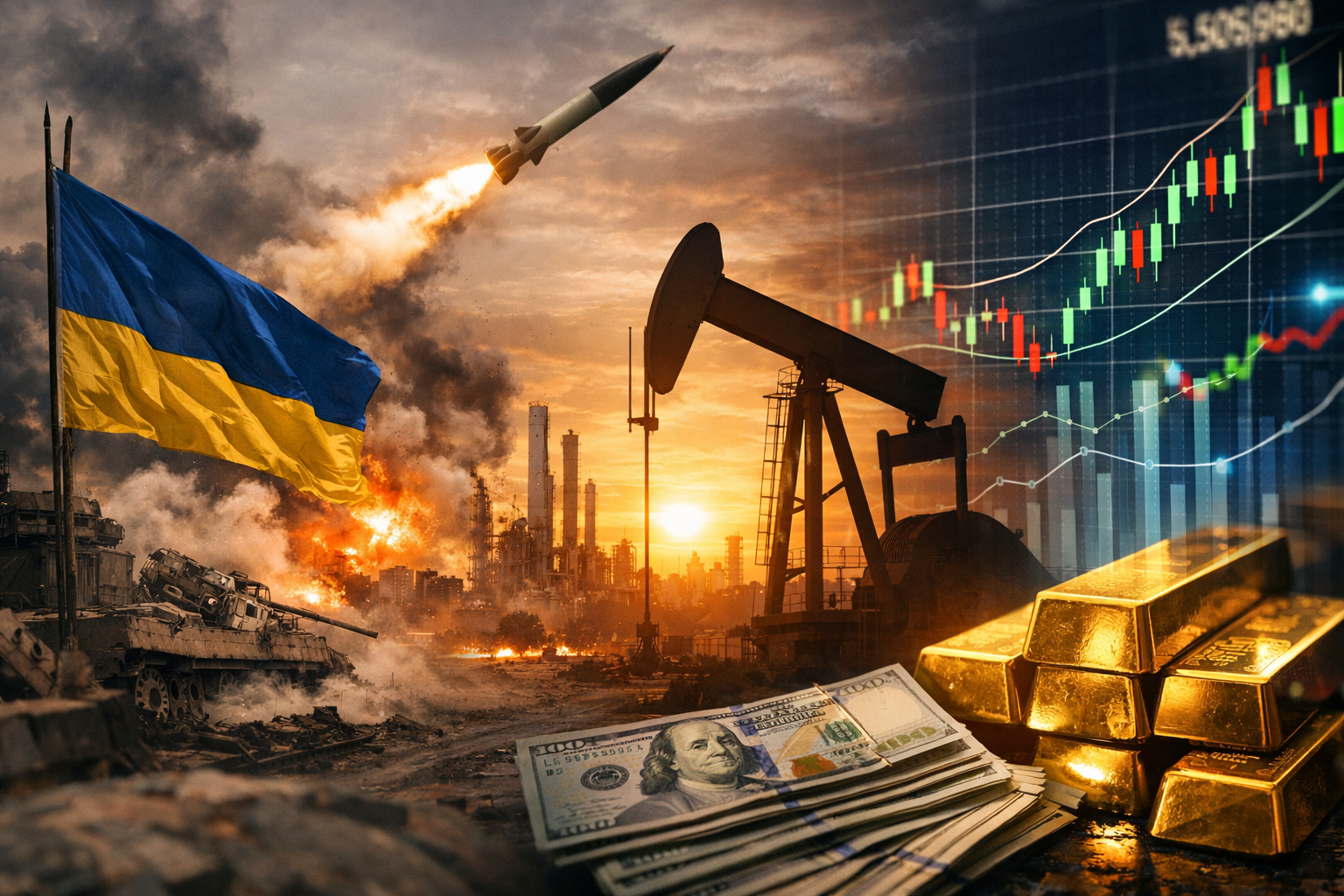
A sharp escalation in Ukraine and renewed uncertainty over US tariff policy are pushing investors back toward defense, energy hedges, and traditional havens.
The fourth year of Russia’s full scale invasion of Ukraine is arriving with a reminder that the conflict can still reprice risk quickly. A broad overnight wave of missiles and drones struck Ukrainian energy and logistics infrastructure across multiple regions, hitting a familiar pressure point for European markets: the cost and reliability of power through the tail end of winter. The attack also landed at an awkward political moment inside the European Union, where unity on sanctions has become harder to sustain as national interests collide with war fatigue, inflation memories, and domestic electoral calendars.
For markets, the immediate channel is not just sympathy volatility in Eastern European assets but the knock on effects through gas and power curves, freight routes, and the broader risk premium attached to Europe’s industrial outlook. Investors have learned to treat the war as a chronic rather than acute shock, yet the energy system remains a high leverage transmission mechanism. When strikes focus on generation and distribution, the concern is less about a single day’s disruption and more about cumulative damage that forces rationing, emergency imports, or fiscal support for households and businesses.
The politics are becoming almost as market relevant as the missiles. Hungary’s threat to block the next EU sanctions package unless oil transit issues are resolved underscores a recurring challenge: sanctions operate through coalitions, and coalitions negotiate. Even the hint of a veto matters because it introduces timing risk. Traders can handle restrictions. What they dislike is uncertainty about whether restrictions will tighten, stall, or be watered down at the last minute. That uncertainty is already visible in the way European risk assets have been trading, with defensive sectors outperforming on days when headlines imply a harder line, and domestic demand names catching a bid when diplomacy looks more plausible.
A second, parallel source of uncertainty is coming from trade policy, where the United States appears headed into another round of tariff brinkmanship that could test global supply chains just as they are rebalancing around friend shoring and industrial policy. Investors do not need a full scale trade war to change behavior. The mere possibility of a broader tariff regime can slow capital expenditure decisions, encourage precautionary inventory building, and lift the cost of hedging currency and commodity exposures. That combination tends to show up first in higher volatility and a rotation toward quality balance sheets.
In that environment, markets have reverted to a familiar pattern: buy protection, trim cyclicals, and pay up for assets that perform when policy becomes noisy. Gold has been the clearest expression of that impulse, but the move is not limited to metals. Defense stocks have also benefited as the war’s persistence becomes harder to ignore and as European governments keep leaning into rearmament and ammunition replenishment. Lockheed Martin (LMT) is one of the obvious global bellwethers for that theme, not because any single headline changes its backlog overnight, but because the direction of travel for allied defense budgets remains supportive.
Europe’s defense story is also increasingly intertwined with industrial policy. The war has accelerated efforts to localize production of drones, air defense components, and secure communications, and that brings in a different class of winners: manufacturers, electronics suppliers, and specialized software firms. The investment case is not simply higher demand but a shift in procurement philosophy, away from peacetime optimization and toward resilience. Resilience, in markets, usually means redundancy, and redundancy tends to mean higher spending.
Still, it is not a one way bet. The same headlines that push money into defense can tighten financial conditions for the broader economy. Elevated energy risk premiums, even if they do not translate into immediate price spikes, can raise the hurdle rate for European industrials and utilities making long duration investments. If policymakers respond with subsidies or price caps, governments can end up carrying more balance sheet exposure, which then feeds into bond supply and term premia. Investors watching European sovereign curves have become sensitive to any sign that fiscal space is narrowing again.
The Ukraine story also has an important forward looking economic angle that is easy to miss amid battlefield updates. Despite sustained attacks, Ukraine’s economy has shown a kind of forced adaptation: firms exporting services, relocating parts of production, and deepening ties with the EU through incremental market access. For investors, the reconstruction narrative is not only about a distant postwar boom. It is already shaping where capacity is being built, where suppliers are locating, and how European corporates position themselves for future contracts. That is one reason why the sanctions debate matters so much. The more durable the EU’s policy framework appears, the easier it is for companies and investors to make multi year plans.
Globally, the interplay between war risk and trade policy is changing correlations. In calmer cycles, the dollar often strengthens when risk appetite fades. In the current setup, the dollar’s response can be more nuanced, especially if markets worry that tariff uncertainty will complicate US growth and inflation dynamics at the same time. That can lead to a more diversified haven bid, where gold, high quality government bonds, and selective defensive equities all attract flows together.
Equity investors, meanwhile, are treating geopolitics less as a tail risk and more as a baseline variable. That shifts portfolio construction. Instead of buying cheap protection only when volatility is already rising, more asset managers are embedding hedges structurally, holding higher cash allocations, and favoring companies with pricing power and robust supply chain optionality. Broad index exposure like SPDR S&P 500 ETF Trust (SPY) is still the default for many, but within that exposure the leadership tends to tilt toward mega cap quality and sectors that can defend margins if input costs rise again.
Commodities remain the market’s fastest truth teller in these moments. The Middle East is not currently the main driver in today’s story, but it still sits in the background as a potential amplifier. When investors are already jumpy about war in Europe and tariff threats in the US, it takes less additional news to spark a larger move in oil or refined products. That is why options markets and freight indicators matter as much as spot prices. They capture the price of uncertainty, not just the price of barrels.
The near term outlook is therefore less about forecasting a single headline and more about watching whether policymakers can reduce variance. In Europe, that means whether the EU can keep sanctions policy coherent while supporting Ukraine’s energy system and managing domestic political constraints. In the United States, it means whether trade actions become a negotiating tool with clear endpoints or an open ended regime that forces companies to treat tariff levels as a permanent cost line.
For investors, the practical implication is to expect a market that remains quick to de risk on geopolitical surprises and slow to reward cyclical optimism unless there is genuine policy clarity. The war in Ukraine is not new information, but the latest escalation is a reminder that the premium for security, energy resilience, and supply chain control is not going away. In 2026, those are not niche themes. They are becoming the core of global macro investing.