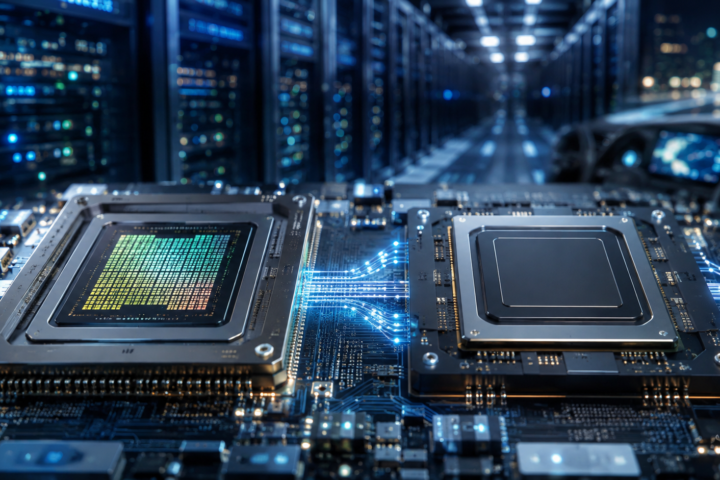
Heavy capital investment in artificial intelligence is redrawing competitive lines across cloud, semiconductor, and enterprise software markets.
The global technology sector is entering a new phase of capital intensity as artificial intelligence infrastructure spending accelerates, forcing companies to recalibrate strategy, margins, and long-term positioning. What began as a race to deploy large language models has evolved into a broader contest over compute capacity, energy access, and enterprise integration, with implications that extend far beyond Silicon Valley.
At the center of this shift are hyperscale cloud providers, led by Microsoft Corp. (MSFT), Amazon.com Inc. (AMZN), and Alphabet Inc. (GOOGL), all of which are committing tens of billions of dollars annually to expand data center capacity and secure advanced chips. These investments, once viewed as discretionary growth bets, are now increasingly treated as essential infrastructure spending, akin to utilities in the digital economy.
Microsoft has emerged as an early leader by tightly integrating OpenAI’s models into its Azure cloud and enterprise software suite. The company’s aggressive rollout of AI copilots across Office, GitHub, and Dynamics has driven a measurable uptick in cloud demand, though it has also placed pressure on margins due to the high cost of inference workloads. Executives have acknowledged that AI services currently carry lower margins than traditional cloud offerings, but argue that scale efficiencies and pricing power will improve over time.
Amazon, through AWS, is taking a more diversified approach by offering a range of foundation models and emphasizing flexibility for enterprise clients. Its Bedrock platform allows companies to choose between proprietary and third-party models, a strategy that reflects Amazon’s historical preference for being an infrastructure provider rather than a vertically integrated platform. Still, AWS faces growing competition as Microsoft’s early mover advantage in generative AI translates into enterprise adoption.
Alphabet, meanwhile, is balancing internal innovation with external commercialization. Its Gemini models represent a significant technical leap, but the company has been more cautious in monetization compared to peers. Google Cloud is gaining traction, yet the company’s broader business model remains tied to advertising, where AI is being deployed to enhance targeting and search relevance. This dual focus creates both opportunity and complexity, particularly as regulatory scrutiny intensifies.
Underlying all of these efforts is an unprecedented demand for advanced semiconductors, dominated by Nvidia Corp. (NVDA). The company’s GPUs have become the backbone of AI training and inference, giving it extraordinary pricing power and market share. Nvidia’s revenue growth has outpaced nearly every large-cap technology firm, and its valuation reflects expectations that AI demand will remain structurally elevated for years.
However, the concentration of supply has prompted customers to explore alternatives. Advanced Micro Devices Inc. (AMD) and Intel Corp. (INTC) are investing heavily to close the performance gap, while cloud providers are developing custom silicon to reduce dependence on Nvidia. Amazon’s Trainium and Inferentia chips, as well as Google’s Tensor Processing Units, represent early attempts to internalize critical components of the AI stack.
This vertical integration trend is one of the most significant structural shifts in the technology sector. Companies that once relied on a modular ecosystem of hardware and software vendors are increasingly bringing key capabilities in-house. The rationale is straightforward: controlling more of the stack can improve performance, reduce costs, and create differentiation. Yet it also requires substantial capital and engineering expertise, raising barriers to entry for smaller players.
Energy consumption has emerged as another critical constraint. AI workloads are significantly more power-intensive than traditional computing tasks, leading to a surge in electricity demand from data centers. This has implications for both cost structures and sustainability goals. Technology companies are signing long-term power agreements, investing in renewable energy projects, and exploring nuclear options to secure reliable supply. The intersection of AI and energy is likely to become a defining theme in the coming decade.
For enterprise customers, the rapid evolution of AI capabilities presents both opportunity and uncertainty. Companies are eager to deploy AI tools to improve productivity, automate workflows, and gain insights from data. At the same time, concerns around data privacy, model reliability, and integration complexity remain significant barriers. Vendors that can offer secure, scalable, and easy-to-deploy solutions are likely to capture the largest share of this emerging market.
Software companies are already adapting their business models to reflect this shift. Subscription pricing is increasingly being supplemented by usage-based fees tied to AI consumption. This creates a more variable revenue stream but also aligns pricing more closely with value delivered. It also introduces new challenges in forecasting and cost management, particularly as compute expenses fluctuate.
The competitive dynamics are further complicated by geopolitical factors. Export controls on advanced chips, particularly those affecting sales to China, have reshaped supply chains and market access. U.S.-based companies must navigate a complex regulatory environment while maintaining global competitiveness. At the same time, other regions are investing heavily in domestic AI capabilities, raising the prospect of a more fragmented global technology landscape.
Investor sentiment toward the sector remains broadly positive, but expectations are high. The strong performance of technology indices and vehicles such as the SPDR S&P 500 ETF Trust (SPY) has been driven in large part by AI-related optimism. However, the sustainability of this trend will depend on the ability of companies to translate investment into durable revenue growth and margin expansion.
There are early signs of divergence. Companies with clear monetization pathways and strong ecosystem positioning are being rewarded, while those with less defined strategies face greater scrutiny. The market is increasingly distinguishing between AI as a narrative and AI as a business.
Looking ahead, the pace of innovation shows little sign of slowing. Advances in model efficiency, multimodal capabilities, and edge deployment are likely to expand the addressable market for AI applications. At the same time, the cost curve will be a critical factor. If companies can reduce the expense of training and inference, adoption could accelerate significantly, unlocking new use cases and revenue streams.
The current phase of heavy investment may ultimately resemble earlier infrastructure buildouts in technology, such as the expansion of broadband or cloud computing. In those cases, initial capital intensity gave way to periods of high-margin growth once the infrastructure was in place. Whether AI follows a similar trajectory will depend on a combination of technological progress, competitive dynamics, and regulatory outcomes.
For now, the sector is defined by a willingness to spend at scale in pursuit of long-term advantage. The companies that can balance investment with execution, while navigating a rapidly evolving landscape, are likely to emerge as the dominant players in the next era of technology.