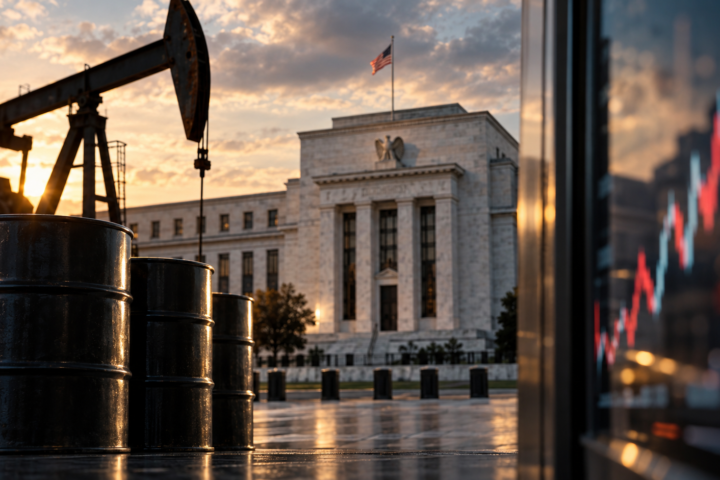
A sharp retreat in crude from its recent spike and a fresh run higher in gold are showing how commodities markets are shifting from panic over supply disruption toward a more selective pricing of war risk, inflation pressure and slowing demand.
Commodities markets entered Tuesday in a more discriminating mood than they showed at the start of the week. Oil, which had surged above $100 a barrel after the latest escalation around the Strait of Hormuz, slipped back below that threshold as traders responded to signs that diplomacy had not fully collapsed. Brent crude was recently around $98.56 a barrel, while West Texas Intermediate traded near $96.49, a notable reversal from Monday’s jump. The move did not erase the shock. It did, however, suggest that the market is no longer pricing only the worst-case scenario of a prolonged blockade and sustained loss of Gulf supply.
That distinction matters because the oil market is now balancing two powerful and opposing forces. On one side is an unmistakable supply threat. The Strait of Hormuz remains one of the most important chokepoints in global energy trade, and recent disruptions have already contributed to a historic decline in OPEC production and a violent repricing in freight, refining margins and prompt crude contracts. On the other side is a weakening demand backdrop. The International Energy Agency’s April oil market report cut its outlook and warned that demand is softening just as the conflict has made supply assumptions unusually fragile. In practical terms, traders are asking not only how many barrels may be at risk, but also how much economic damage a prolonged price spike would inflict on consumption.
That helps explain why the oil curve has begun to tell a more nuanced story than the headlines. Spot prices remain elevated enough to keep inflation worries alive and to support the shares of major producers such as Exxon Mobil (XOM) and BP (BP), both of which stand to benefit from stronger upstream realizations and trading volatility. But the market’s willingness to let crude fall back under $100 on even tentative signs of renewed talks implies that traders still see the present disruption as severe but potentially temporary. For investors, that is an important difference. A temporary shock tends to reward integrated energy companies, refiners and traders. A durable supply break would hit consumers harder, deepen recession fears and ultimately threaten oil demand itself.
Gold is telling a different story. While oil backed away from the highs, bullion climbed again, rising to roughly $4,800 an ounce as the dollar softened and investors continued to pay for insurance against both geopolitical escalation and a renewed inflation pulse. Gold’s resilience suggests the market still wants a hedge, even if it is less convinced that the most acute oil disruption will persist unchanged. Unlike oil, gold does not need a lasting physical supply emergency to rally. It only needs a mix of policy uncertainty, falling confidence in real yields and a sense that central banks may face an uglier trade-off between inflation control and growth support. That mix is plainly visible now.
The latest U.S. inflation data reinforce that case. March consumer prices accelerated sharply, driven in large part by energy, reminding investors that commodities can reassert themselves quickly as a macro force even after long stretches in which services inflation and labor markets dominated the discussion. For central banks, an oil-driven inflation burst is especially difficult because tighter policy cannot create more barrels, yet it can weaken already fragile demand. That asymmetry is one reason gold has stayed firm even as crude retreats from its recent extremes. The market appears to be betting that policymakers will be slower and more cautious in responding to any growth slowdown if inflation expectations begin to drift higher again.
Industrial metals are reinforcing the sense that this is no longer a one-theme commodities tape. Copper rose again to around $6.03 a pound, extending a run that has left it materially above year-ago levels. Copper’s strength reflects a structural story that is different from oil’s crisis premium and gold’s haven appeal. The market is contending with persistent supply tightness and expectations of a refined deficit this year, even as the global economy loses momentum. That combination is awkward but not unprecedented. It means traders can be worried about growth at the same time they remain constructive on a metal central to power grids, electrification and industrial policy.
For portfolio managers, the broader message is that commodities are fragmenting again after a period in which energy geopolitics threatened to overwhelm everything else. Oil remains the headline market because it touches inflation, freight, airlines, petrochemicals and household budgets almost immediately. But the more durable investment opportunities may lie in understanding where the temporary shock ends and the structural shortage begins. Gold is benefiting from distrust in the macro outlook. Copper is benefiting from a tighter medium-term industrial balance. Oil is caught in between, trading as both a war asset and a cyclical asset.
That leaves the commodities complex at an unusually delicate juncture. If diplomacy advances, crude could ease further without eliminating the inflation damage already done. If talks fail and supply losses deepen, the market may revisit the idea that $100 oil was only a waypoint. In either case, the spillover into consumer prices, corporate margins and rate expectations is already large enough to keep commodities at the center of cross-asset strategy. Tuesday’s price action was not a sign that the danger has passed. It was a sign that markets are trying to separate immediate panic from lasting scarcity, and that process is likely to create more volatility, not less, in the weeks ahead.