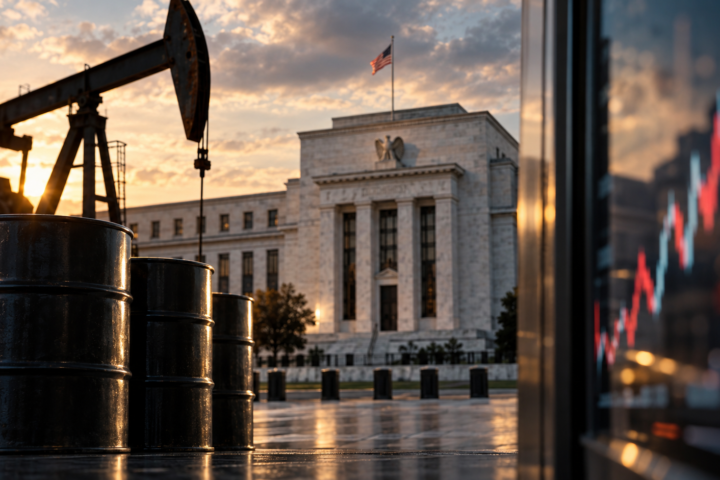
Investor optimism is rising, but underlying risks in policy, earnings, and geopolitics remain underpriced.
Financial markets have entered a phase that feels deceptively calm. Equity indices hover near highs, credit spreads remain tight, and volatility gauges suggest a broad expectation that the worst macroeconomic shocks have passed. The SPDR S&P 500 ETF Trust (SPY), a widely followed proxy for U.S. equities, has continued to trend upward even as economic data sends mixed signals. Beneath that surface stability, however, lies a more fragile foundation than current valuations imply.
The prevailing narrative is straightforward. Inflation, while not fully subdued, has moderated enough to give central banks room to pause or gradually ease policy. Growth has slowed but not collapsed, supporting a “soft landing” scenario. Corporate earnings, particularly among large-cap technology firms, have proven resilient. Together, these factors have created a sense that risks are balanced and manageable.
But markets rarely misprice risk by accident. Today’s optimism appears less a reflection of resolved uncertainties and more a collective willingness to look past them.
One area of concern is monetary policy itself. While investors increasingly expect rate cuts in major economies, central banks have offered little firm guidance that easing will proceed quickly or smoothly. Inflation remains uneven across regions and sectors, particularly in services, where wage pressures persist. If policymakers are forced to keep rates higher for longer, equity valuations that depend on lower discount rates could face renewed pressure.
The experience of the past two years underscores how quickly expectations can shift. Markets moved from anticipating prolonged tightening to pricing aggressive easing within months. That volatility in expectations has not disappeared; it has simply been suppressed by a period of relative data stability. Should inflation surprise to the upside or labor markets remain tighter than expected, the current consensus could unravel.
Corporate earnings present another layer of complexity. Large multinational firms, including Apple Inc. (AAPL), have benefited from strong balance sheets, pricing power, and global diversification. Their performance has helped sustain broader market indices, masking weaker trends in smaller companies and more cyclical sectors. This concentration risk is not new, but it has intensified.
When a narrow group of companies drives a disproportionate share of market gains, the system becomes more sensitive to shocks affecting those firms. A slowdown in consumer demand, regulatory pressures, or supply chain disruptions could have outsized effects on indices that appear diversified on paper. Investors often acknowledge this risk in theory, but market pricing suggests it is not fully incorporated.
Geopolitical uncertainty further complicates the outlook. Conflicts, trade tensions, and shifting alliances continue to influence commodity markets, supply chains, and currency dynamics. Yet these risks are notoriously difficult to quantify, leading markets to discount them until they materialize. The result is a recurring pattern of sudden repricing rather than gradual adjustment.
Energy markets offer a clear example. Oil prices can remain stable for extended periods despite underlying tensions, only to spike sharply when disruptions occur. Those price movements then feed into inflation expectations and monetary policy decisions, creating second-order effects that ripple across asset classes. Investors positioning portfolios based on current stability may find themselves exposed to these abrupt shifts.
There is also a behavioral dimension at play. After a period of heightened volatility and uncertainty, investors often gravitate toward narratives that promise clarity and control. The “soft landing” story fits that need, providing a coherent framework that aligns with recent data trends. But narratives can become self-reinforcing, leading market participants to downplay contradictory signals.
This dynamic is evident in credit markets, where spreads remain compressed despite rising corporate leverage in certain sectors. The assumption appears to be that default risks will remain contained, supported by steady growth and manageable financing conditions. Yet if interest rates stay elevated or growth slows more than expected, refinancing pressures could increase, challenging that assumption.
Currency markets tell a similar story. Exchange rates have moved within relatively narrow ranges, reflecting expectations of synchronized policy shifts among major central banks. But divergence in economic performance or policy timing could quickly disrupt that equilibrium. Such shifts often occur faster than investors anticipate, particularly when driven by unexpected data releases or political developments.
None of this suggests that markets are on the brink of a downturn. The global economy has shown resilience, and many of the feared worst-case scenarios have not materialized. Household balance sheets in key economies remain relatively strong, and corporate profitability, while uneven, has not collapsed. These factors provide a genuine आधार for optimism.
The issue is not that markets are wrong to be positive; it is that they may be too confident in a narrow range of outcomes. Pricing reflects a high probability of stability and a relatively low probability of adverse scenarios. Historically, such asymmetry tends to resolve through increased volatility rather than a smooth continuation of current trends.
For investors, the challenge is not to predict the exact catalyst that could disrupt markets but to recognize the limits of current assumptions. Diversification, often treated as a basic principle, becomes more meaningful in this context. Exposure across asset classes, regions, and sectors can help mitigate the impact of unexpected developments, even if it comes at the cost of slightly lower returns in stable periods.
Risk management also requires a reassessment of time horizons. Short-term market movements may continue to reflect optimism, particularly if economic data remains supportive. But longer-term valuations depend on factors that are far less certain, including policy trajectories, structural economic shifts, and geopolitical dynamics.
Ultimately, the current environment illustrates a familiar tension in financial markets. Stability breeds confidence, and confidence can lead to complacency. The absence of immediate shocks does not eliminate underlying risks; it often delays their recognition.
The path forward is unlikely to be defined by a single dramatic event. More often, market corrections emerge from a gradual accumulation of smaller discrepancies between expectations and reality. Investors who acknowledge that possibility are better positioned than those who assume that today’s calm will persist indefinitely.
Markets are not ignoring risks entirely, but they are assigning them a lower probability than recent history might justify. Whether that proves to be a reasonable judgment or a costly oversight will depend on how the next phase of economic and policy developments unfolds. For now, the balance of evidence suggests that caution, rather than complacency, remains the more prudent stance.