A fresh wave of AI infrastructure commitments and new product launches is sharpening the market’s focus on who can turn spending into durable profit.
Wall Street’s technology narrative is snapping back into a familiar rhythm: massive checks for compute on one side, and the promise of a new device cycle on the other. The difference in early March is that investors are no longer rewarding “AI exposure” on faith. They want proof that demand is broadening beyond a handful of hyperscalers, that supply chains are normalizing rather than tightening, and that the next generation of software can actually monetize the automation it enables.
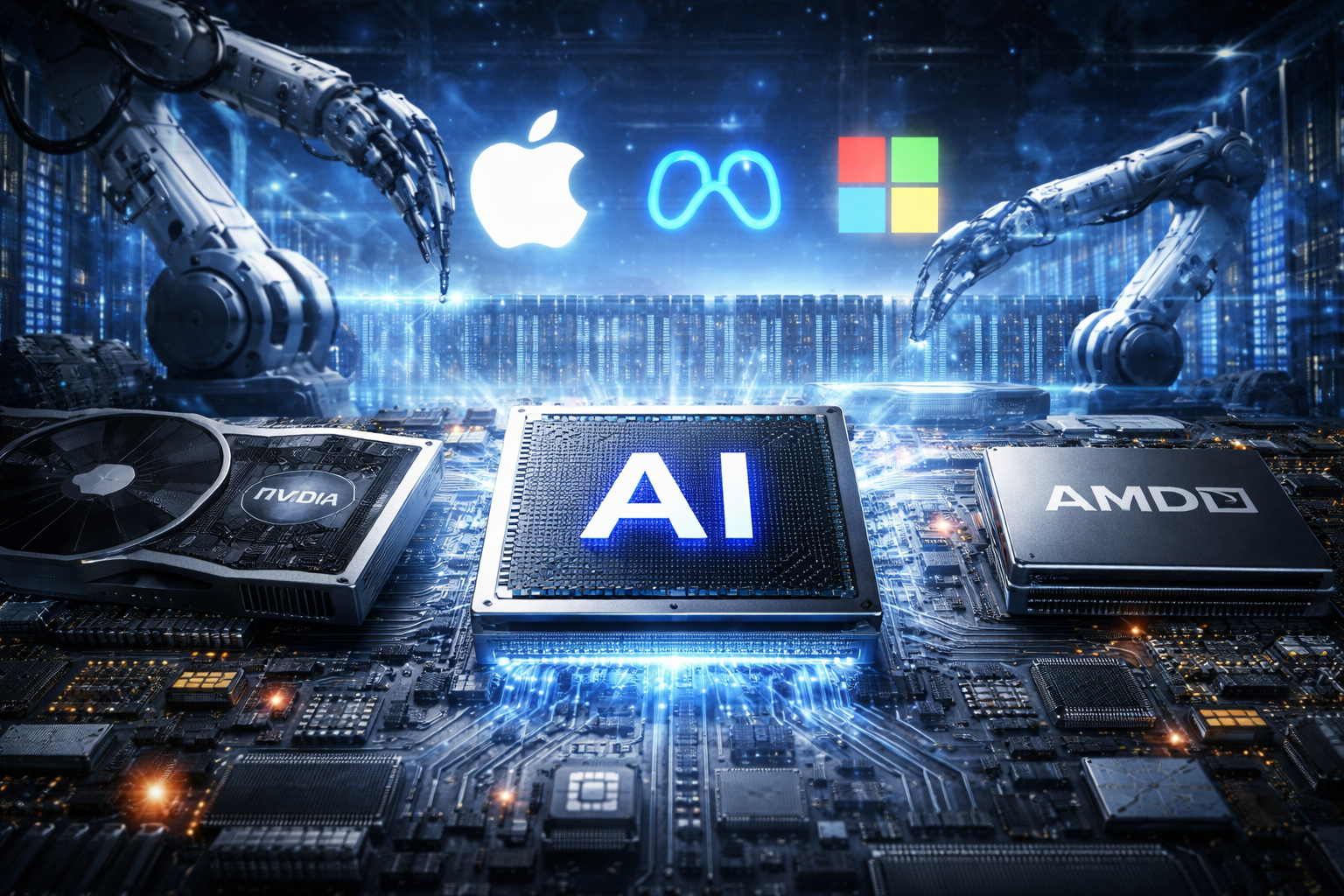
The strongest signal on the infrastructure front has been the escalation of long-term procurement. Meta Platforms (META) has moved to lock in multi-year supplies of advanced AI silicon from Advanced Micro Devices (AMD), a reminder that the competition to secure compute is shifting from spot buying to capacity reservation. For AMD, these types of deals matter in two ways. First, they validate the company’s push to become a credible alternative in data-center accelerators, an area long dominated by Nvidia (NVDA). Second, they help compress the adoption timeline for AMD’s newest platforms by giving customers a clear ramp plan that can justify software porting and systems integration.
For Meta, the strategy reads like insurance. Even as the company builds its own internal silicon efforts, it cannot afford to have model development constrained by bottlenecks in GPUs, networking, packaging, and power availability. By diversifying supply, it reduces operational risk and gains negotiating leverage, but it also takes on a new financial risk: committing capital before monetization is fully proven. That tension is at the heart of the broader market’s AI debate. Investors have become more sensitive to the possibility that the industry overbuilds data-center capacity, pushing returns lower just as depreciation costs rise.
Nvidia’s latest results have, for now, kept the bullish thesis intact. The company is still delivering extraordinary revenue growth in data center, underscoring that demand for training and inference capacity remains intense. Yet even with blockbuster numbers, the stock reaction has shown a change in tone. A company can beat expectations and still disappoint if guidance suggests the growth rate is merely moderating from “historic” to “very strong.” That may sound like a trivial distinction, but it matters in a market where valuations have already priced in years of outsized expansion. The message investors are sending is straightforward: it is not enough to be the best house in a hot neighborhood. The neighborhood must stay hot.
That is why second-order beneficiaries like Broadcom (AVGO) are drawing heightened scrutiny ahead of earnings. The AI buildout is not just GPUs. It is also the networking gear that moves data across racks and clusters, the custom silicon that optimizes specific workloads, and the software that manages sprawling infrastructure. Broadcom sits at that intersection, with exposure to high-end networking and data-center components as well as enterprise software through VMware. Investors are watching whether AI-linked revenue growth can offset rising costs and whether enterprise customers are renewing software on terms that support margins. In the current environment, a clear demand signal can still spark a rally, but any hint of inventory digestion or deferred orders can lead to a swift repricing.
While the market debates the durability of infrastructure demand, a quieter theme is emerging in enterprise software: customers are paying more, not less, even as AI threatens to commoditize certain functions. Many companies are increasing software spend as they adopt copilots, agents, and governance tools that promise productivity gains but require new licenses, more security layers, and expanded cloud usage. Microsoft (MSFT) is positioned to benefit from that trend because it can bundle AI features into familiar workflows. The company’s ongoing integration of AI into collaboration and content management, including the next evolution of SharePoint, reflects the same strategy it has used across Office, Teams, and Azure: make AI feel like an upgrade to existing work rather than a separate product category.
The enterprise angle matters for the entire tech complex because it broadens the revenue base beyond the largest AI labs and consumer platforms. If AI-driven price increases become a standard feature of corporate budgets, the market can justify continued capital spending on data centers. If not, the risk is that infrastructure investments outpace monetization, forcing a shift from growth narratives to efficiency narratives. That is also where regulation and governance enter the story. Enterprises do not just need models that work. They need models that are auditable, secure, and compliant. The vendors that can deliver those assurances, and charge for them, will likely command premium valuations even if the broader software category remains volatile.
On the consumer side, attention is turning to Apple (AAPL) as it prepares a cluster of product announcements that could reinvigorate a hardware cycle that has been uneven across the industry. Investors will be listening for two things. The first is demand: whether new iPhone and Mac updates are compelling enough to drive upgrades in a market where consumers are keeping devices longer. The second is Apple’s approach to on-device intelligence and “visual” features, which would deepen the company’s pitch that privacy and performance can coexist if more processing happens locally. If Apple can translate AI features into reasons to buy new hardware, it could provide a counterweight to the market’s anxiety that AI is primarily a cloud story that benefits only a narrow set of chipmakers and hyperscalers.
The near-term investment question is not whether AI is real. It is whether the next phase of AI spending becomes more diversified and more rational. Deals like Meta’s commit the biggest buyers to sustained capacity expansion, supporting suppliers like AMD and reinforcing Nvidia’s centrality. Earnings from companies like Broadcom will help answer whether the networking and infrastructure layer is seeing a smooth ramp or early signs of churn. Meanwhile, Apple’s product push and Microsoft’s enterprise integration highlight a parallel path to monetization: embedding AI into devices and workflows that already have distribution.
For investors, the takeaway is that technology is moving from a one-factor trade to a multi-factor market. The winners will be those who can prove demand resilience, defend margins, and show that AI is not just a cost center but a catalyst for recurring revenue. The market is still willing to pay for growth, but it is increasingly unwilling to pay for ambiguity.