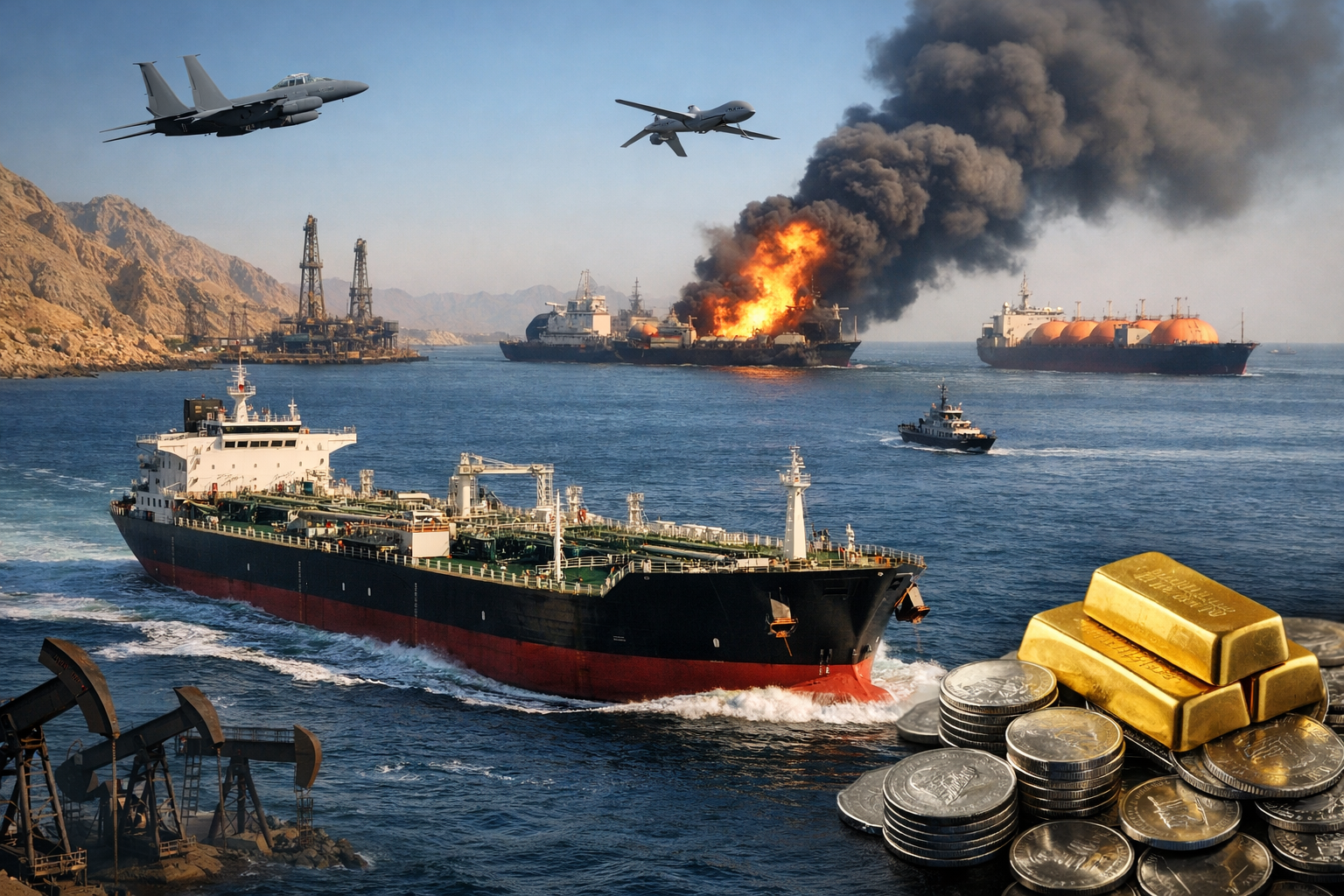
A widening Middle East conflict has pushed crude and refined fuels higher and reignited safe-haven demand across precious metals, forcing commodity traders to weigh geopolitical tail risks against a still-uneven global growth outlook.
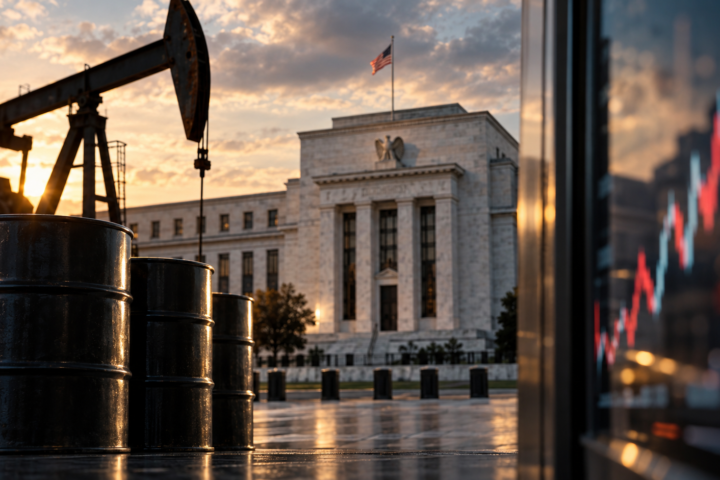
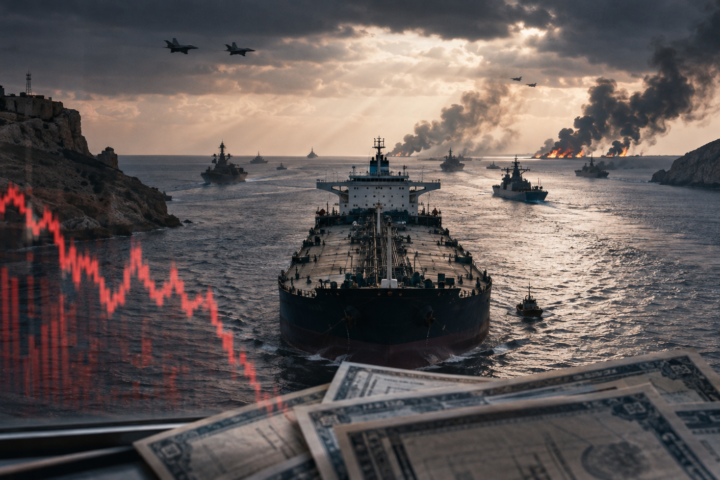
Energy led the complex. Brent crude surged as shipping risk in and around the Strait of Hormuz, a critical chokepoint for global crude and liquefied natural gas flows, became the market’s dominant variable. The speed of the move matters as much as the level: when freight, insurance, and routing assumptions change abruptly, physical crude differentials can gap higher before futures fully re-equilibrate, and that tends to ripple into diesel and jet fuel spreads with a lag. For equity investors, the near-term beneficiaries are upstream-heavy producers and integrated majors such as Exxon Mobil (XOM), which typically see cash-flow leverage when benchmark prices rise faster than input and operating costs.
The price shock is also an energy-security story, particularly for import-dependent Asia. Refiners and utilities from Japan to India have long treated Hormuz risk as a low-probability, high-impact scenario. When the probability distribution shifts, even modestly, buyers scramble for contingency barrels: West African grades, US crude, and incremental cargoes from the Atlantic Basin can all reprice. The result is that “Brent up” becomes only the headline. The bigger economic consequence is “delivered energy up,” once the market adds freight, risk premia, and the possibility of delays.
OPEC+ policy, meanwhile, is trying to look through the noise. The producer group has emphasized market stability and pointed to low inventories and “healthy” fundamentals while keeping its framework intact, signaling it still prefers to manage supply gradually rather than chase daily volatility. That stance can be interpreted two ways by traders: either OPEC+ is confident it has spare capacity and optionality if disruption persists, or it is comfortable letting prices do more of the balancing work in the short run. Either way, the market’s message is clear: geopolitical risk is back in the front contract.
The second major leg of Thursday’s commodity narrative was precious metals. Gold and silver strengthened as investors reloaded hedges against both market turbulence and policy uncertainty. In episodes like this, precious metals can behave like “insurance assets” that reprice quickly when the perceived odds of broader financial stress rise. Silver’s move has been particularly eye-catching, helped by both safe-haven flows and its dual role as an industrial input. That combination can make silver more volatile than gold: it tends to overreact on the way up in risk-off bursts, then give back more if the macro tone stabilizes.
For portfolio managers, the gold rally also intersects with currencies and rates. When the dollar softens, dollar-priced metals often catch a bid because they become cheaper for non-US buyers; when real yields fall, the opportunity cost of holding non-yielding gold declines. The complication this week is that geopolitics can push markets in conflicting directions: oil strength can revive inflation worries, while risk aversion can pull yields down. The net effect has been choppy cross-asset signals, with metals trading more on the “fear” channel than on any single macro variable.
Industrial commodities are reacting in a more nuanced way. On one hand, higher energy costs raise production and transport expenses for everything from aluminum to chemicals. On the other, if the energy shock tightens financial conditions or dents consumer demand, the growth-sensitive side of the complex can soften. This is where copper, often treated as a proxy for global manufacturing momentum, becomes a useful barometer: it can lag the initial panic and then reflect whether the shock is likely to be transient or economically damaging. The next few sessions should reveal whether industrial metals follow oil higher on cost-push dynamics, or drift lower on growth anxiety.
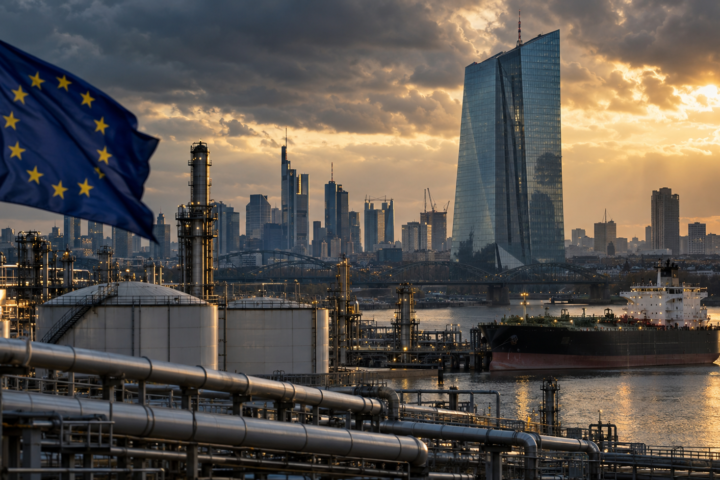
Natural gas and LNG deserve separate attention because the Strait of Hormuz is not only an oil artery. LNG trade is far more “route constrained” than crude because cargo flexibility depends on regas capacity, contract terms, and seasonal demand. Any credible threat to shipping can widen regional price spreads, with Asia typically paying the premium when marginal supply tightens. That matters for power prices, fertilizer costs, and energy-intensive manufacturing, and it helps explain why equity markets in import-heavy regions can feel commodity shocks faster than markets in net-exporting economies.
The physical market mechanics are also worth watching. In a geopolitical squeeze, the first stress point is often logistics: tanker availability, port congestion, and insurance. The second stress point is inventory behavior. Commercial inventories can be drawn quickly when buyers choose certainty over optimization, while governments weigh whether to tap strategic reserves to smooth domestic price spikes. These dynamics can temporarily decouple futures from local spot realities, which is why crack spreads and regional differentials can tell a truer story than the headline Brent print during disruptions.
Longer term, the World Bank and other macro forecasters have argued that commodity prices were expected to cool through 2026 after a multi-year cycle, reflecting softer demand growth and easing supply constraints in several categories. The geopolitical shock complicates that trajectory. It does not automatically reverse the downtrend in every commodity, but it raises the variance around the forecast path, especially for energy and energy-linked inputs. For investors, this is the key shift: commodities may not need a booming global economy to rally if supply-side risk is doing the heavy lifting.
For corporate balance sheets, the message is similarly mixed. Higher oil and refined product prices can support earnings for producers and service firms, but they act like a tax on transport, airlines, chemicals, and consumers. That divergence is why energy equities can outperform during supply shocks even if the broader market stumbles. For households, the channel is more direct: pump prices, utility bills, and the cost of goods with energy-intensive supply chains. The timing matters too. If the shock persists into key consumption periods, it can alter inflation prints and influence how central banks talk about the tradeoff between growth support and price stability.
In the near term, commodity markets will trade the same set of questions: How durable is the disruption risk? Are there credible de-escalation pathways, or is the tail risk rising? Will OPEC+ adjust its messaging or volumes if prices overshoot? And how quickly do physical buyers rebuild buffers? Until those answers clarify, the commodity complex is likely to stay headline-driven, with oil setting the tempo, metals providing the risk hedge, and industrial inputs waiting for confirmation on whether the shock is simply a volatility event or the start of a broader macro tightening.