Big technology’s artificial-intelligence boom is shifting from model hype to the harder question of whether chips, networking, power and cloud demand can produce durable returns for investors.
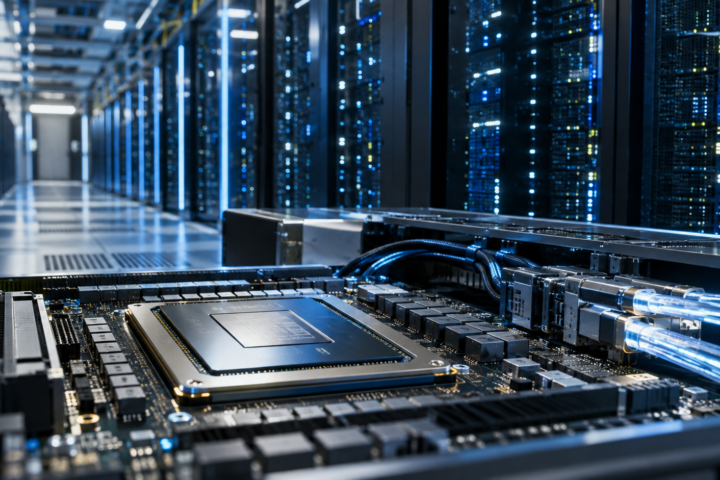
The technology sector’s latest market signal is not coming from a chatbot launch or a consumer-device cycle. It is coming from the plumbing of artificial intelligence. Investors are increasingly looking past the first wave of AI enthusiasm and asking which companies can profit from the next constraint: data-center infrastructure.
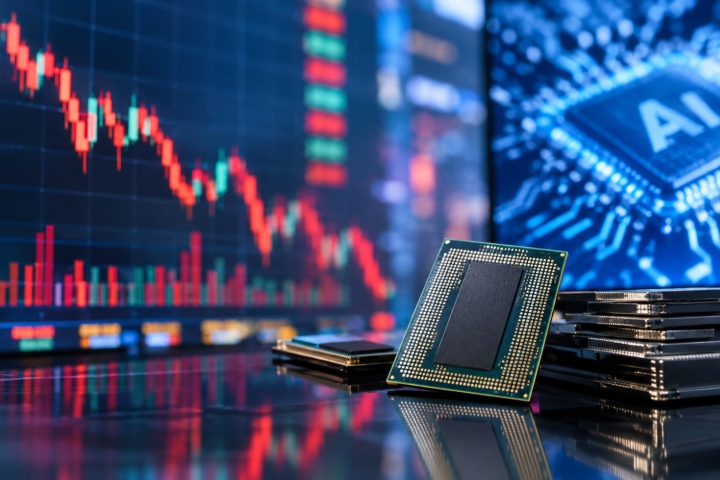
That question has moved sharply into focus as semiconductor demand accelerates, hyperscale capital spending remains elevated and smaller suppliers begin to attract attention alongside the usual megacap leaders. Nvidia (NVDA) remains the central stock in the AI hardware trade, but the broader market is beginning to distinguish between companies merely attached to the AI narrative and those with measurable exposure to compute, memory, networking, optics and cloud capacity.
The scale of the cycle is difficult to overstate. The Semiconductor Industry Association said global chip sales reached $298.5 billion in the first quarter of 2026, up 25% from the fourth quarter of 2025, while March sales rose 79.2% from a year earlier. Gartner has projected worldwide semiconductor revenue will exceed $1.3 trillion in 2026, citing demand for AI processing, data-center networking and memory pricing as key drivers.
That backdrop helps explain why investors are treating technology earnings less as isolated company events and more as a referendum on the entire AI supply chain. Nvidia’s most recent quarterly report showed revenue of $68.1 billion for the quarter ended Jan. 25, up 73% from a year earlier, with data-center revenue of $62.3 billion. Full-year revenue rose 65% to $215.9 billion. Those numbers reinforced Nvidia’s position as the dominant supplier of accelerated computing, but they also raised the valuation burden. The market is no longer debating whether AI demand exists. It is debating how long growth can remain extraordinary before competition, custom chips or customer spending discipline narrows returns.
That is why recent attention has shifted to companies below the most obvious AI leaders. Lattice Semiconductor (LSCC) reported first-quarter revenue of $170.9 million and adjusted earnings of 41 cents a share, beating analyst expectations, and guided for stronger second-quarter results. The company also announced a $1.65 billion cash-and-stock deal to acquire AMI, a firmware and infrastructure-management company tied to cloud and AI computing. The transaction suggests that even specialized chip companies see value in moving closer to the control layer of AI infrastructure, where hardware, firmware and systems management increasingly overlap.
GlobalFoundries (GFS) has drawn similar attention from investors looking for AI-adjacent beneficiaries that are not direct competitors in advanced GPUs. Its shares rose after analysts highlighted opportunities in silicon photonics, 5G infrastructure and higher factory utilization. The company also introduced SCALE, a copackaged optics platform intended to improve data movement by bringing chips and optical transceivers closer together. That matters because AI performance is increasingly limited not only by compute but by the ability to move data efficiently across vast clusters of processors.
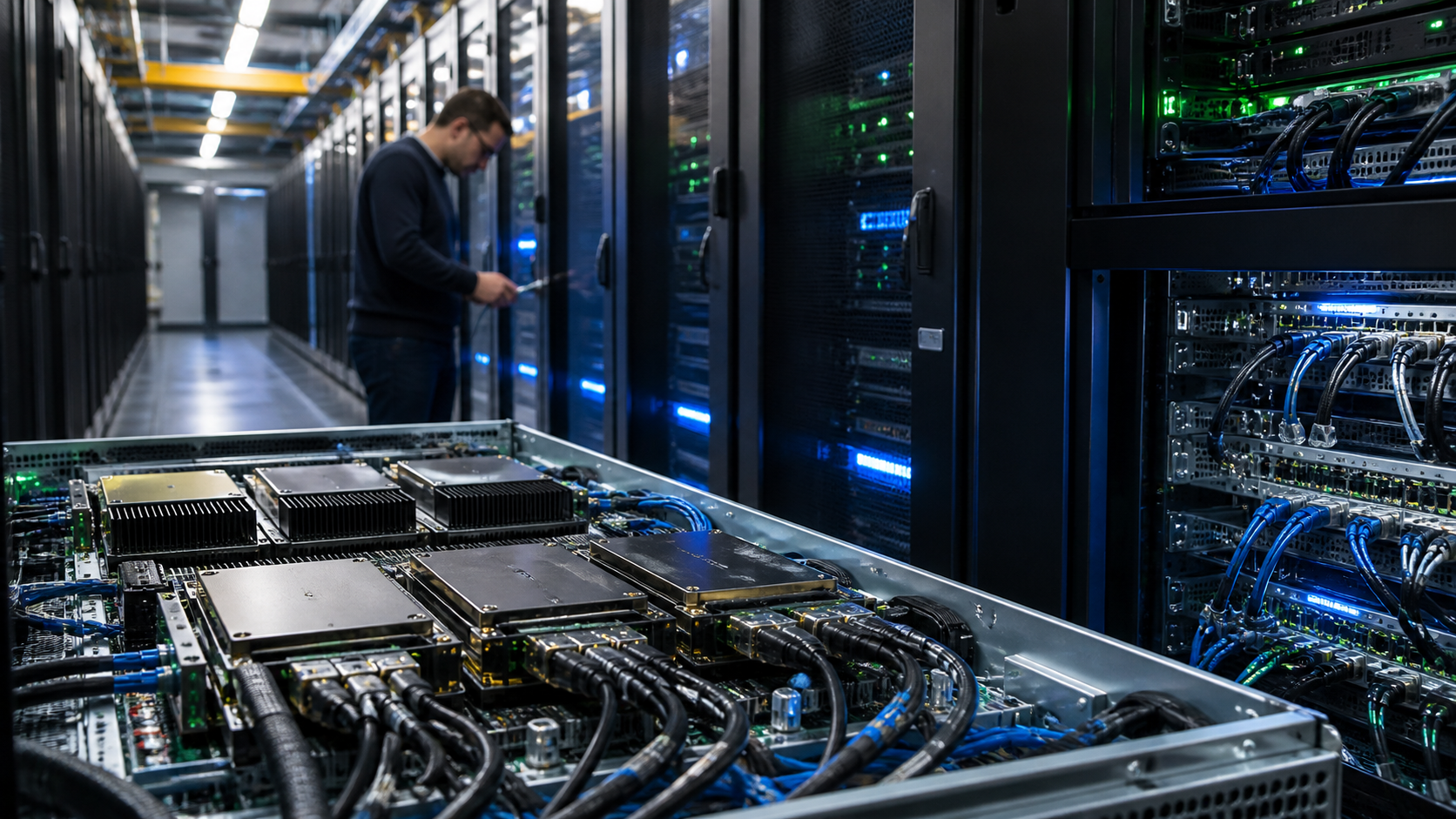
The optics theme is especially important. AI data centers require enormous bandwidth between chips, servers and storage systems. Copper interconnects remain widely used, but as clusters scale, power consumption and signal integrity become larger constraints. Optical networking and copackaged optics are therefore moving from a niche engineering topic to a mainstream investment theme. For companies such as Broadcom (AVGO), Advanced Micro Devices (AMD), Nvidia and GlobalFoundries, the opportunity is not only in processing the model, but in making the infrastructure around the model faster and more energy-efficient.
For the megacap platforms, the challenge is more complicated. Microsoft (MSFT), Alphabet (GOOGL), Amazon (AMZN) and Meta Platforms (META) are spending heavily to secure AI capacity, but investors are becoming more selective about which spending appears likely to earn an attractive return. Alphabet has recently been viewed more favorably by some market participants because it owns a broader internal AI stack, including models, cloud services, custom processors and consumer distribution. Meta, by contrast, has faced more scrutiny over whether its heavy AI investment will translate into enough incremental advertising, engagement or product utility to justify the cash outlay.
This selectivity marks a healthier, though more demanding, phase of the technology rally. In 2023 and 2024, the market rewarded many companies for simply having credible AI exposure. In 2026, investors are asking more precise questions. Does a company have pricing power? Is demand visible beyond one or two large customers? Can margins hold as capacity expands? Are capital expenditures producing revenue growth, or merely defending market position? Those questions are now central to valuations across cloud computing, semiconductors, networking equipment and enterprise software.
The software side of the sector faces a different pressure. AI adoption could improve productivity and expand the market for automation tools, but it can also compress the value of traditional software features. If generative AI makes coding, analytics, customer support or workflow automation cheaper, incumbent vendors may need to prove that their platforms remain indispensable. That creates a divide between infrastructure suppliers, which benefit from rising compute intensity, and software companies whose products may be disrupted by the same technology.
For households and long-term investors, the key implication is that technology remains a growth sector, but not a single trade. The AI boom is broadening, yet the winners are likely to be more uneven. Nvidia still carries the clearest link to accelerator demand. Microsoft and Alphabet offer diversified exposure through cloud, productivity tools, search and enterprise AI services. Broadcom and AMD provide exposure to custom silicon and networking. GlobalFoundries and Lattice show how investors are reaching into more specialized parts of the infrastructure chain.
The risk is that capital spending runs ahead of monetization. Data centers are expensive, power-hungry and slow to build. If enterprise AI adoption disappoints, or if model efficiency reduces demand for brute-force compute, today’s infrastructure race could pressure free cash flow and margins. Trade restrictions, energy constraints and supply-chain concentration add further uncertainty. Semiconductor executives may be optimistic, but the sector remains cyclical, and the current cycle is unusually dependent on a small group of very large buyers.
Still, the evidence so far points to continued demand rather than an abrupt pause. Chip sales are accelerating, cloud operators are still expanding capacity, and the market is beginning to price new bottlenecks such as optics, memory and power management. The AI story is becoming less speculative and more industrial. That may make it less glamorous, but it also makes it more investable for those willing to follow the infrastructure.
For technology investors, the next phase will be won not by the loudest AI claims, but by the companies that control scarce capacity, reduce system costs and convert massive spending into cash flow. The market’s message is clear: artificial intelligence is still driving technology stocks, but the easy part of the trade is over.