The semiconductor selloff is less a verdict on artificial intelligence than a warning that even transformative technologies cannot justify unlimited prices.
The sharp retreat in semiconductor shares should not be mistaken for evidence that the artificial-intelligence investment cycle has run its course. It is better understood as a long-overdue reassessment of what investors are willing to pay for growth whose eventual scale remains uncertain.
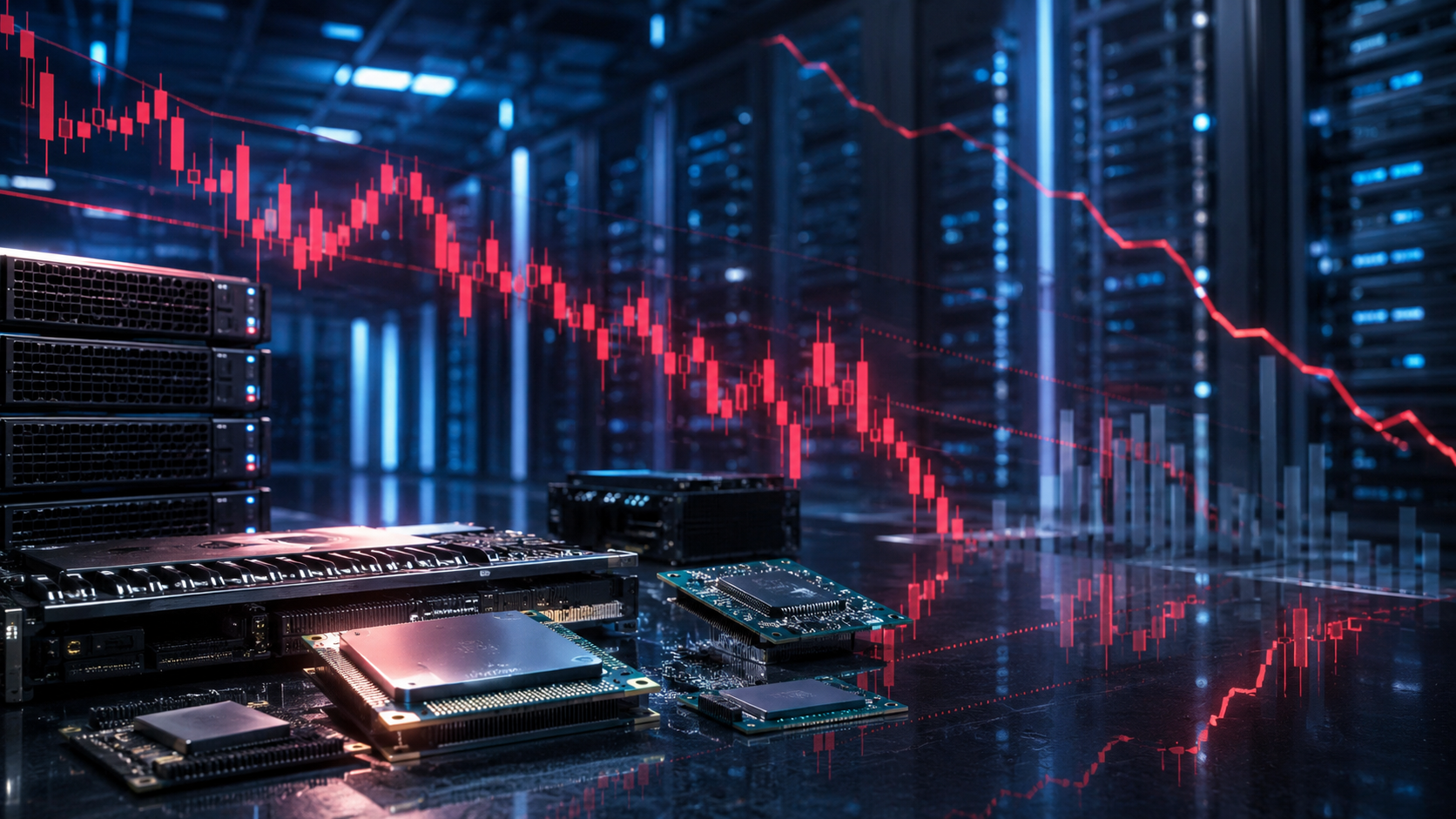
That distinction matters. The Philadelphia Semiconductor Index has fallen into bear-market territory after a steep monthly decline, while Nvidia (NVDA), Advanced Micro Devices (AMD) and other prominent beneficiaries of the AI boom have suffered heavy selling. The Nasdaq Composite dropped 1.5% on Thursday, substantially more than the broader market, even though more individual stocks in the S&P 500 rose than fell. This was not a generalized collapse in corporate confidence. It was a concentrated repricing of the market’s most crowded theme.
For much of the past several years, investors treated AI exposure as a substitute for valuation discipline. Companies associated with data centers, advanced chips, networking equipment and cloud computing were rewarded not merely for delivering strong earnings, but for belonging to a narrative that appeared capable of overwhelming normal business-cycle constraints. When demand exceeded already elevated expectations, share prices rose. When companies announced larger capital budgets, markets often interpreted the spending as proof that the opportunity was growing.
That logic eventually becomes circular. Chipmakers justify higher valuations because cloud companies are spending more. Cloud companies justify spending more because demand for AI services is expected to rise. Rising share prices then reduce the perceived cost of capital, encouraging further investment. The cycle can remain productive for years, but it becomes vulnerable when investors begin asking whether each additional dollar of spending will generate an adequate return.
Taiwan Semiconductor Manufacturing (TSM) remains central to that question. The company’s rising capital requirements demonstrate the extraordinary industrial effort required to support the AI economy. Yet greater investment does not automatically translate into greater value for shareholders across the supply chain. It can also mean higher depreciation, larger financing needs, more intense competition and a greater risk that capacity arrives before profitable demand.
The current selloff may therefore be healthy. Markets work best when they distinguish between technological importance and investment merit. Railways transformed commerce, the internet remade communication and smartphones reorganized daily life. None of those developments prevented investors from overpaying for the companies involved. A technology can change the world while producing disappointing returns for buyers who enter at inflated valuations.
The more serious concern is not that AI spending disappears. It is that future growth may become less profitable, less concentrated and more difficult to forecast. The first phase of the boom rewarded companies selling scarce computing capacity. The next phase will depend on whether businesses can use that capacity to increase revenue, reduce labor costs or create products customers are willing to pay for. That transition moves the burden of proof from hardware demand to economic productivity.
Investors should welcome that shift. A market that rewards measurable returns rather than ambitious expenditure will allocate capital more effectively. It may also expose a divide between companies with durable competitive advantages and those whose fortunes depend primarily on industry-wide enthusiasm.
Nvidia remains exceptionally well positioned, with a powerful software ecosystem, leading hardware and deep relationships across the data-center industry. But even dominant companies face valuation risk. A stock does not need to lose its strategic importance to deliver poor performance. It only needs earnings growth to fall below the expectations embedded in its price.
The implications reach beyond technology. Wall Street’s recent strength has been supported by a revival in mergers, underwriting and trading activity, much of it linked directly or indirectly to AI investment. Major banks have benefited from equity issuance, debt financing and corporate transactions associated with the technology boom. If capital spending slows, the effect could spread to firms such as Goldman Sachs (GS), Morgan Stanley (MS) and JPMorgan Chase (JPM), whose recent results have reflected robust dealmaking and market activity.
Higher bond yields add another constraint. When investors can obtain attractive returns from government securities, the justification for paying extreme multiples for distant corporate profits becomes weaker. That is especially true when geopolitical tensions are pushing energy prices higher and reviving inflation concerns. A market facing both expensive equities and elevated yields cannot rely indefinitely on enthusiasm alone.
None of this argues for abandoning technology stocks. The stronger conclusion is that investors should separate the AI economy from the AI trade. The economy may continue expanding even as the trade becomes less forgiving. Semiconductor demand can remain historically strong while share prices fall. Corporate spending can rise while profit margins narrow. AI adoption can accelerate while the companies enabling it produce uneven returns.
The selloff also offers a reminder that diversification is not an admission of weak conviction. Investors who believe deeply in AI may still benefit from exposure to utilities, industrial equipment, power infrastructure, cybersecurity and financial services. The buildout requires electricity, cooling systems, construction, financing and network protection. Some of the most durable beneficiaries may sit outside the group of stocks that first captured the market’s imagination.
A genuine market turning point would require evidence that customers are delaying deployments, hyperscalers are cutting budgets or chip inventories are building rapidly. The present correction does not yet establish that case. It does, however, show that investors are becoming less willing to treat spending announcements as an automatic guarantee of future profits.
That is not the end of the AI boom. It is the beginning of a more demanding phase, one in which execution matters more than association and valuation matters as much as vision. The technology may still exceed expectations. The stocks no longer have the luxury of doing so only eventually.