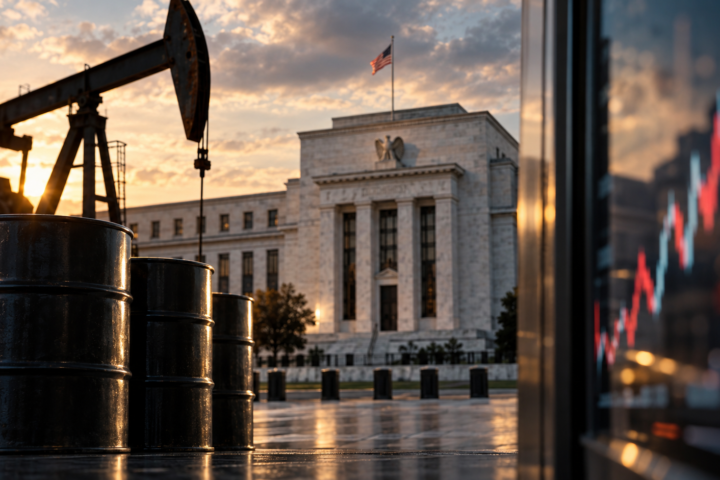
Crude’s geopolitical premium is lifting energy shares and inflation risks even as copper and precious metals retreat from recent highs.
Oil prices extended their advance Wednesday, keeping Brent crude above $90 a barrel as investors weighed persistent uncertainty around the Strait of Hormuz and the absence of a clear diplomatic path toward easing the conflict with Iran. Brent futures traded near $91.26 a barrel in early European dealing, while West Texas Intermediate was around $84.37, marking a fourth consecutive session of gains. The resilience of crude prices reflects a market that is increasingly treating disruption in one of the world’s most important energy corridors as a prolonged risk rather than a temporary shock.
The immediate driver remains the security of shipping through Hormuz. Negotiations aimed at reducing tensions have stalled, while uncertainty over the extent and durability of maritime access continues to force traders to price in the possibility of interrupted crude and fuel flows. The latest escalation has included attacks directed at maritime traffic and damage to a commercial vessel, reinforcing concerns that even when tankers can transit the region, the risk attached to those journeys remains unusually high. That uncertainty is supporting freight costs, insurance expenses and the broader geopolitical premium embedded in benchmark oil prices.
For energy companies, that premium has translated quickly into stronger equity performance. The S&P 500 energy sector rose 1.8% Tuesday to a record, extending a rebound that has lifted the group roughly 21% from its July 1 low. Exxon Mobil (XOM) gained 2.5% Tuesday to $165.56, while Chevron (CVX) rose 1.5% and ConocoPhillips (COP) added 1.7%. The contrast with the broader market was notable, with the S&P 500 declining 0.7% during the session. Investors are effectively using large energy producers as a partial hedge against the economic consequences of sustained Middle East instability.
The earnings backdrop helps explain that enthusiasm. Exxon and Chevron entered the current phase of the oil rally with powerful cash-generation profiles after benefiting from higher crude prices and unusually strong refining margins during the second quarter. Exxon reported quarterly profit of $14.5 billion, while Chevron earned $12.1 billion. Those results illustrate why a sustained Brent price around or above $90 can have an outsized effect on integrated producers, particularly when refining margins are also elevated. Higher prices flow rapidly into upstream cash generation while giving well-capitalized companies more flexibility to fund dividends, buybacks and investment.
The risk for the broader market is that the same conditions supporting energy stocks could slow progress on inflation. Oil is not merely another commodity input. It affects transportation, aviation, petrochemicals and logistics throughout the economy, making prolonged price increases capable of filtering into consumer and corporate costs. That relationship is especially relevant as investors assess the Federal Reserve’s next steps. A renewed energy-driven inflation impulse could limit the central bank’s room to ease policy even if labor-market indicators weaken, leaving bond yields and rate-sensitive assets vulnerable to further volatility.
That tension is already visible in precious metals. Gold edged lower Wednesday ahead of the Federal Reserve’s July meeting minutes, with New York futures around $4,410 an ounce in early trading. The metal remains supported by geopolitical uncertainty, physical demand and central-bank buying, but elevated Treasury yields are restraining the upside. Investors have recently reduced expectations for further rate increases after softer U.S. economic data, creating an unusual push and pull in which geopolitical risk favors gold while the possibility of persistent energy inflation keeps monetary-policy uncertainty elevated.
Copper is sending a different signal. Three-month London Metal Exchange copper slipped below $14,000 a metric ton to around $13,898 after warehouse inventories increased by 20,025 tons in a single day. The rise in available stocks eased some of the immediate supply pressure that had helped propel copper toward record levels earlier in August. Even after Wednesday’s decline, however, the longer-term backdrop remains tight, supported by demand from power infrastructure, electric transportation and the rapid expansion of data centers needed for artificial-intelligence computing.
That creates a particularly important distinction for mining investors. Freeport-McMoRan (FCX), one of the world’s largest publicly traded copper producers, fell 3.0% Tuesday to $66.32 as commodity markets pulled back and broader equities weakened. The decline came only days after copper traded near record territory, highlighting the sensitivity of mining shares to shifts in inventories and short-term positioning even when structural demand remains strong. Copper’s next phase may depend less on whether long-run electrification demand exists and more on whether mine supply and exchange inventories can respond quickly enough to prevent repeated shortages.
The divergence across commodities is becoming increasingly important for investors. Oil is being driven principally by geopolitical supply risk. Gold is caught between haven demand and the interest-rate consequences of energy inflation. Copper remains supported by structural consumption but is showing how rapidly prices can correct when visible inventories improve. Those different forces mean the commodity complex is no longer moving as a single inflation trade.
For markets, crude remains the most consequential variable. A sustained Brent price above $90 would reinforce the earnings advantage enjoyed by major energy producers while raising costs for transportation companies, manufacturers and consumers. A credible reopening of energy routes and easing of regional tensions could remove part of that premium quickly, creating the opposite trade. Until the political outlook becomes clearer, commodity investors are likely to continue paying close attention not only to barrels, inventories and production data, but also to every development affecting the security of the shipping lanes connecting Middle Eastern energy supplies with the global economy.