Boeing’s $8.4 billion acquisition of Spirit AeroSystems is exposing costly liabilities even as the plane maker tries to stabilize production and rebuild its financial footing.
Boeing (BA) brought Spirit AeroSystems back under its control last December to solve one of the most persistent weaknesses in its manufacturing network. Less than a year later, the transaction is demonstrating how expensive that repair may become.
The aircraft maker completed the Spirit acquisition for roughly $8.4 billion on Dec. 8, 2025, absorbing a supplier that had become deeply intertwined with Boeing’s production system while struggling with financial pressure, quality problems and unfavorable contracts. Boeing’s latest regulatory filings show that the accounting value assigned to the acquisition has continued to change as the company examines Spirit’s assets and obligations more closely.
The most striking figure is goodwill. Boeing provisionally assigned about $10.28 billion of goodwill to the Spirit acquisition as of June 30, up from roughly $10 billion at the end of 2025. That amount exceeds Boeing’s $6.1 billion of shareholder equity at midyear. Goodwill is an accounting asset representing value that cannot be tied directly to identifiable physical or financial assets, including expected synergies and strategic benefits. Its size does not mean Boeing faces an immediate cash charge, but it illustrates how much of the purchase price depends on future improvements rather than assets that can be readily valued.
Boeing also increased the value of accrued liabilities associated with the acquired business. Spirit’s preliminary accrued liabilities were valued at about $2.2 billion at June 30, compared with about $1.8 billion in Boeing’s initial year-end purchase accounting. Included within that figure was approximately $1.52 billion related to contracts whose terms were less favorable than those that could have been negotiated under current market conditions.
Those contracts are particularly important because aerospace manufacturing programs can run for years or decades. A supplier locked into uneconomic pricing may continue producing components while generating weak margins or losses. Once Boeing owns the supplier, those economics effectively move inside the company. The acquisition therefore eliminates some supplier risk but also transfers Spirit’s financial burdens directly onto Boeing’s balance sheet.
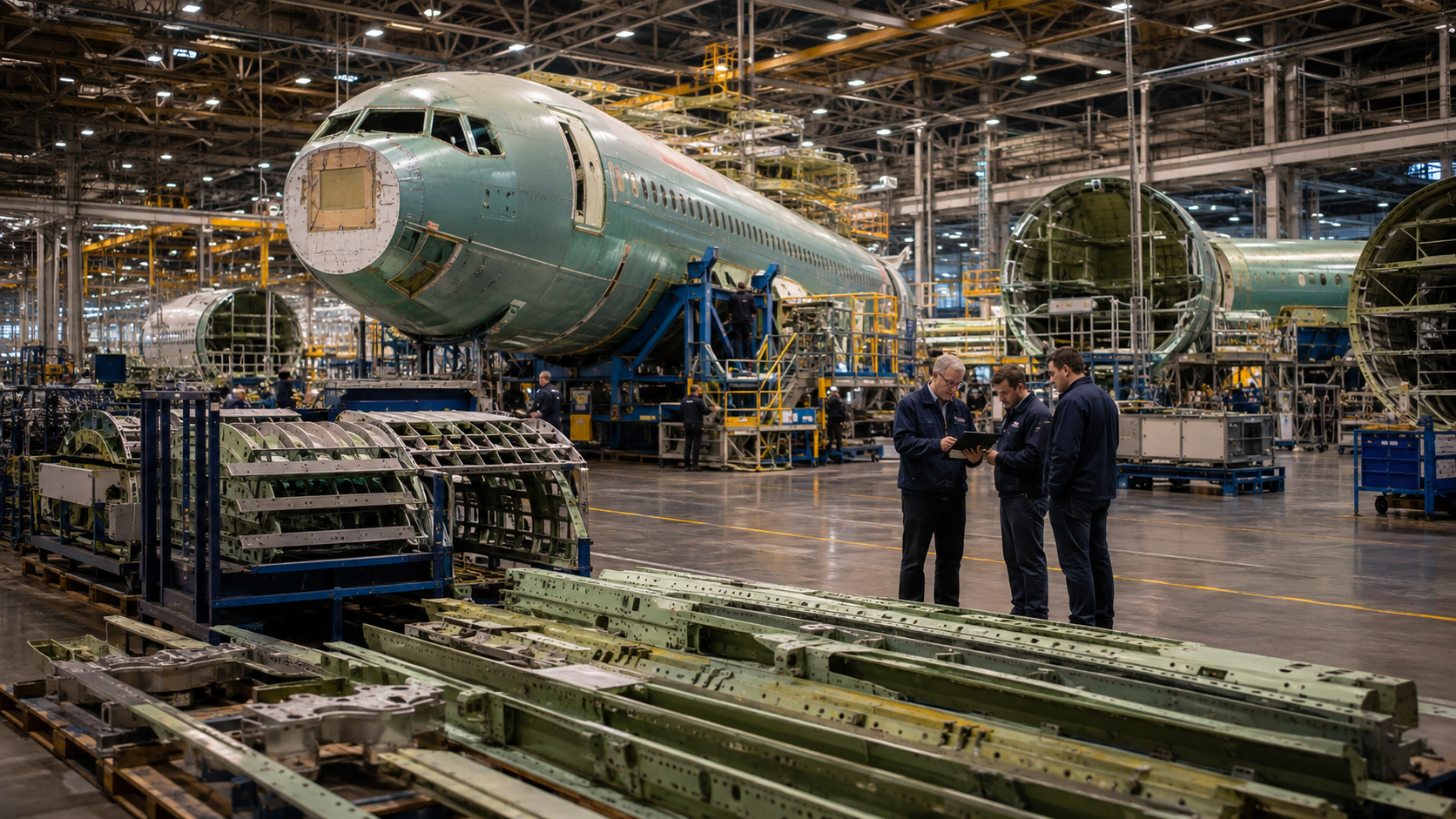
That trade-off was central to the logic of the transaction. Spirit manufactures major structures for several Boeing aircraft, including fuselages for the 737 as well as components for the 767, 777 and 787 programs. After years of production disruptions and quality concerns, Boeing concluded that controlling more of the manufacturing process could improve accountability and reduce the coordination problems that had developed between the companies.
For investors, the key question is whether the operational benefits eventually justify the financial cost.
Boeing is already carrying substantial debt while attempting to increase aircraft output. At June 30, the company reported $41.3 billion of long-term debt and another $4.6 billion of short-term debt and current maturities. Cash and cash equivalents stood at $7.2 billion, while short-term investments totaled about $12.8 billion. The company nevertheless generated approximately $1.19 billion of operating cash flow during the first half, an improvement from a cash outflow during the same period a year earlier.
The earnings picture remains more fragile. Boeing reported a pretax loss of $339 million for the first six months of 2026 and a net loss attributable to shareholders of $448 million. Commercial Airplanes generated $20.95 billion of revenue during the period but posted an operating loss of $885 million. Those figures show why production stability matters so much. Increasing deliveries can produce substantial revenue, but inefficient factories, supplier disruptions and abnormal costs can prevent that revenue from translating into meaningful profit.
Spirit’s integration could eventually help change those economics. Bringing fuselage production closer to Boeing’s internal quality and manufacturing systems may reduce rework, improve production sequencing and give management greater visibility into bottlenecks. Boeing has said the acquisition is intended to strengthen safety, quality and supply-chain stability, particularly as the company works toward higher production rates.
The downside is that vertical integration removes some of the financial insulation that outsourcing once provided. When Spirit was independent, Boeing could pressure the supplier over pricing, delivery schedules and quality while keeping Spirit’s balance sheet separate. Ownership means Boeing now bears the cost of fixing factories, renegotiating contracts and funding operations directly.
That makes the acquisition less like a conventional growth deal and more like an industrial restructuring. Boeing was not buying a fast-growing competitor or entering a new market. It was purchasing a critical piece of its own manufacturing system because allowing that supplier to remain financially weak created risks for Boeing’s larger recovery.
The broader commercial backdrop remains favorable. Aircraft manufacturers continue to face demand that exceeds available supply, while airlines have large multiyear order books and limited alternatives for replacing aging fleets. That gives Boeing an opportunity to recover financially if production becomes reliable. It also raises the cost of execution failures because every delayed aircraft represents revenue and cash that cannot be collected on schedule.
For Boeing shareholders, Spirit’s rising liabilities should therefore be viewed alongside manufacturing progress rather than in isolation. The acquisition may appear increasingly expensive on the balance sheet, but its ultimate value will depend on whether Boeing can turn tighter control of the supply chain into higher deliveries, better margins and sustained cash generation.
The accounting is revealing the price of repairing Boeing’s production system. The next phase will determine whether that price buys the operational stability management intended.