A sharp retreat in semiconductor shares is testing whether artificial-intelligence spending can continue growing fast enough to justify the technology sector’s elevated valuations.
The artificial-intelligence trade is entering a more demanding phase as investors shift their attention from the scale of spending on computing infrastructure to the returns that spending can ultimately produce.
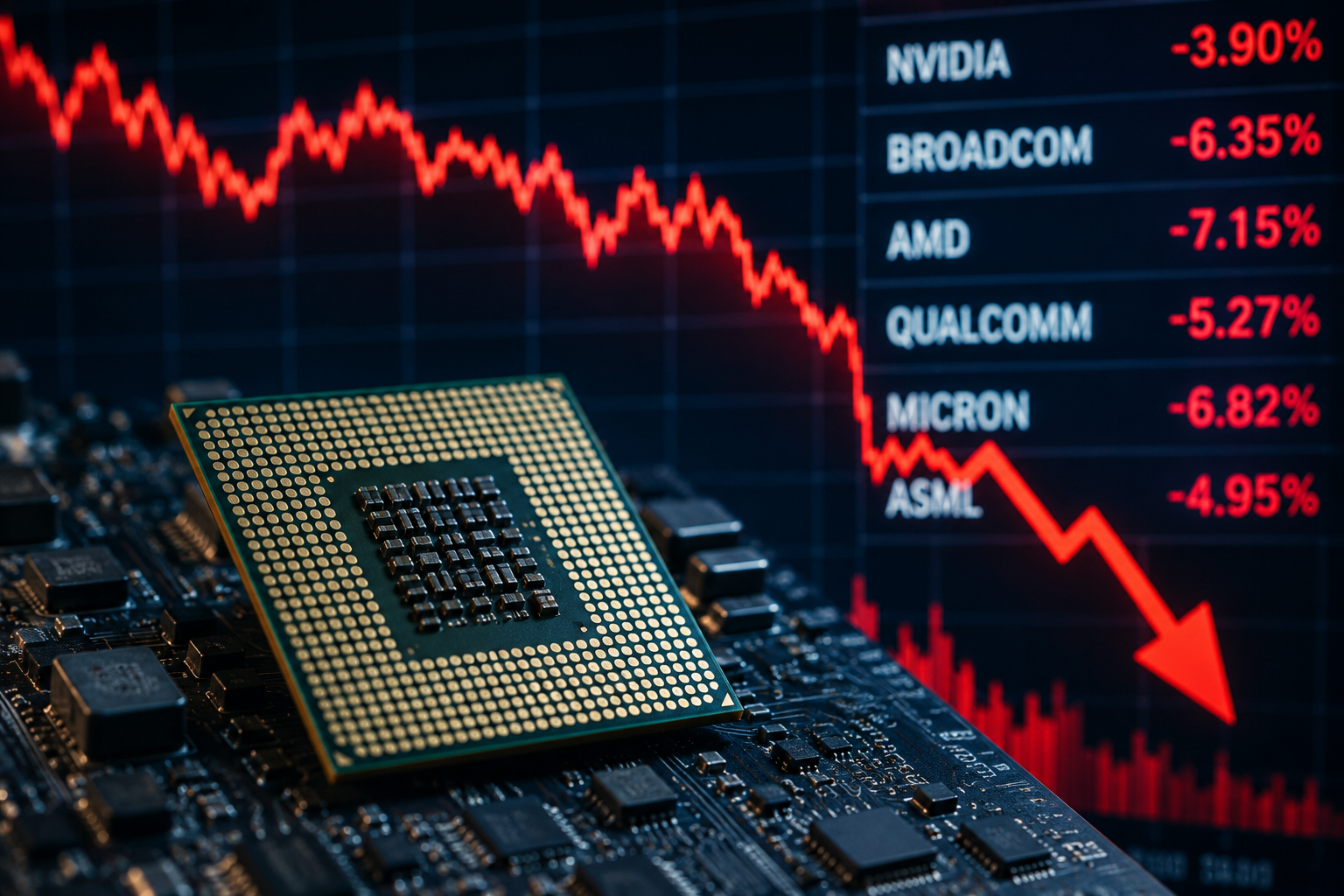
Semiconductor stocks suffered heavy losses last week, with the Philadelphia Semiconductor Index falling about 10% as investors reassessed the durability of the industry’s extraordinary expansion. Nvidia (NVDA), Advanced Micro Devices (AMD), Broadcom (AVGO) and several memory-chip producers came under pressure, while weakness spread to Asian technology markets on Monday. South Korea’s Kospi dropped 4.5%, weighed down by declines in Samsung Electronics and SK Hynix, two major suppliers to the global AI hardware ecosystem.
The retreat does not yet suggest that demand for AI computing has collapsed. Cloud providers, internet platforms and enterprises are still investing heavily in data centers, graphics processors, networking equipment and memory. Instead, the selloff reflects a change in the market’s threshold for success. Strong revenue growth and expanding order books may no longer be sufficient when valuations already assume years of rapid adoption.
Nvidia remained relatively steady in early Monday trading after declining 3.9% last week, compared with the broader chip index’s much steeper fall. The difference highlights the market’s effort to separate companies with dominant competitive positions from those whose earnings depend more heavily on cyclical pricing or continued scarcity.
The immediate catalyst was the unveiling of a new artificial-intelligence model from Beijing-based Moonshot AI. The model renewed concerns that increasingly capable systems may be developed with fewer computing resources than investors previously expected. Similar fears have emerged before: if developers can train or operate advanced models more efficiently, demand for the most expensive processors could grow more slowly than hardware forecasts imply.
That conclusion remains far from certain. More efficient software can reduce the cost of individual AI tasks while also encouraging wider use, potentially increasing total computing demand. Lower inference costs may make it economical to deploy AI across customer service, advertising, healthcare, financial analysis and industrial automation. The technology industry has repeatedly shown that efficiency improvements can expand markets rather than shrink them.
The challenge for investors is that this outcome may benefit different companies at different stages of the value chain. Chipmakers gain when customers purchase more processors. Cloud providers benefit when computing becomes cheaper and easier to sell. Software developers can gain if lower infrastructure costs improve margins or accelerate adoption. The economic value created by AI may therefore continue rising even if semiconductor companies capture a smaller share of it.
That possibility helps explain why some Wall Street strategists are favoring large cloud platforms over chip stocks. Morgan Stanley has argued that hyperscalers may offer better near-term opportunities than semiconductor producers, while JPMorgan believes the recent decline could create a buying opportunity because earnings remain strong and industry supply expansion is limited. The disagreement reflects a broader debate over whether the selloff is a temporary correction or the beginning of a longer rotation away from AI hardware.
Upcoming earnings from Alphabet (GOOGL), Intel (INTC), International Business Machines (IBM) and Tesla (TSLA) will provide an important test. Investors will be watching Alphabet’s capital-spending plans and the growth of its cloud division, where AI workloads are expected to contribute to demand. They will also look for evidence that generative AI is supporting advertising revenue, productivity tools and enterprise services rather than simply increasing operating expenses.
Intel faces a different challenge. The company must demonstrate that its manufacturing investments and product roadmap can compete in a market increasingly shaped by specialized AI processors. While Nvidia has built a powerful position around its chips, networking products and software ecosystem, Intel is attempting to regain manufacturing leadership while expanding its presence in accelerators and contract chip production. The strategy requires substantial capital at a time when investors are becoming less tolerant of distant payoffs.
Rising component prices add another layer of uncertainty. Prices for high-performance memory and other AI-related chips have surged as manufacturers struggle to keep pace with demand. South Korean export prices for dynamic random-access memory reportedly increased 370% from a year earlier. Such increases support earnings for suppliers, but they also raise costs for companies building data centers and could slow adoption if customers cannot translate infrastructure spending into revenue quickly enough.
The industry is therefore confronting a paradox. Tight supply and rising prices confirm that demand remains powerful, yet the same conditions may reduce the financial attractiveness of new projects. Technology companies can absorb higher costs while profit growth is strong, but investors will become more cautious if capital expenditures rise faster than cloud revenue, advertising sales or software subscriptions.
Recent results from ASML Holding (ASML) provide evidence that the semiconductor investment cycle remains active. The Dutch chip-equipment maker reported record orders and raised its sales forecast, supported by demand for advanced manufacturing tools used to produce cutting-edge processors. Its performance suggests that the largest chipmakers and foundries are still preparing for substantial long-term capacity needs, even as listed semiconductor shares undergo a valuation reset.
The market’s next phase is likely to reward companies that can demonstrate both technological leadership and financial discipline. Nvidia’s position remains formidable, but its future returns will depend increasingly on sustained earnings growth rather than repeated valuation expansion. Cloud providers must show that AI services can generate revenue at a scale that justifies their infrastructure budgets. Software companies must prove that new products create additional spending instead of merely replacing existing tools.
For investors, the recent volatility marks a transition from a broad thematic rally to a more selective market. During the first stage of the AI boom, almost every company associated with processors, memory, data centers or advanced manufacturing benefited. The next stage will require clearer evidence of pricing power, durable margins and measurable customer demand.
The artificial-intelligence buildout is unlikely to end because of a single new model or a week of falling share prices. However, the market is beginning to distinguish between technological progress and shareholder returns. That distinction could make the technology sector more volatile, but it may also produce a healthier investment environment in which earnings, competitive advantages and capital efficiency matter more than exposure to the AI narrative alone.