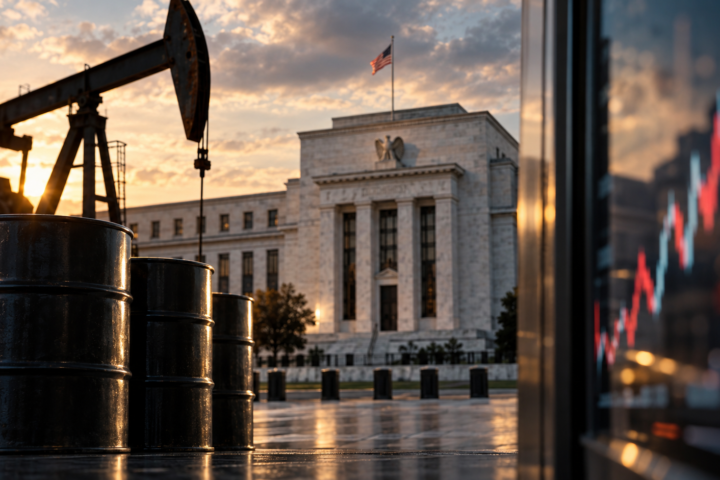
Easing Middle East tensions sent crude prices sharply lower and revived risk appetite, but central-bank policy and technology earnings will determine whether the rebound lasts.
Global equities advanced on Monday as a steep fall in oil prices eased immediate fears that the Middle East conflict would produce a prolonged inflation shock. The relief rally spread from Asian and European exchanges into Wall Street, helping investors recover part of the ground lost during a volatile week dominated by energy security, trade policy and concerns about the cost of artificial-intelligence investment.
The S&P 500 rose about 0.8% in early trading, while the technology-heavy Nasdaq gained roughly 1.3% and the Dow Jones Industrial Average climbed more than 1%. European shares also strengthened, with Germany’s DAX outperforming as lower energy prices improved the outlook for manufacturers and consumers. Asian markets finished broadly higher, including gains in China, Japan and India.
The catalyst was a pause in US strikes against Iran, which created space for renewed diplomatic efforts and reduced the market’s estimate of an immediate disruption to global petroleum supplies. Brent crude fell nearly 7% to about $85 a barrel, while West Texas Intermediate dropped towards $83. The move reversed part of the previous week’s surge, when escalating conflict and concerns about shipping through the Strait of Hormuz pushed Brent above $100.
Lower crude prices produced a familiar split across equity sectors. Airlines, cruise operators, transport companies and other fuel-intensive businesses gained as investors anticipated lower operating costs. Energy producers moved in the opposite direction, with shares of Chevron (CVX), Exxon Mobil (XOM), BP (BP) and Shell (SHEL) pressured by the retreat in expected oil revenues.
The shift was also visible in government bonds. Treasury yields edged lower as investors reduced the inflation premium attached to the recent energy shock. A sustained decline in oil would give the Federal Reserve more flexibility, but policymakers are unlikely to treat one session’s reversal as evidence that price pressures have disappeared. Tariffs, wage growth and the possibility of renewed geopolitical disruption remain important complications for the inflation outlook.
The Federal Reserve’s policy decision on Wednesday therefore represents the week’s first major test. Markets broadly expect the central bank to keep its benchmark rate within the current 3.5% to 3.75% range, although recent swings in oil and inflation expectations have increased uncertainty around the policy path. Investors will focus less on the decision itself than on whether officials describe the energy shock as temporary or warn that it could become embedded in household and business prices.
A cautious message could limit the bond rally and revive pressure on rate-sensitive equities. A more reassuring assessment, particularly if paired with confidence that underlying inflation is moderating, would support growth stocks and longer-duration assets. The Fed’s June projections and July monetary-policy report maintained the central bank’s longer-run commitment to 2% inflation, while acknowledging that measures of expected price increases have produced mixed signals.
The second test will come from mega-cap technology earnings. Microsoft (MSFT) and Meta Platforms (META) are due to report on Wednesday, followed by Apple (AAPL) and Amazon (AMZN) on Thursday. Together, these companies carry enough index weight to shape the direction of the broader US market, particularly after recent selling in semiconductor and artificial-intelligence shares.
Investors are no longer rewarding AI investment merely because it is large. They are increasingly demanding evidence that spending on data centres, specialised chips and cloud infrastructure can translate into durable revenue and cash flow. That change has made capital-expenditure guidance almost as important as quarterly profit. Companies that announce higher spending without faster monetisation risk the kind of valuation pressure recently seen across parts of the technology sector.
Monday’s rebound in Nvidia (NVDA), Advanced Micro Devices (AMD), Intel (INTC) and Broadcom (AVGO) showed that investors remain willing to buy the AI theme after sharp declines. Yet the recovery also highlighted the market’s dependence on a narrow group of companies. A strong set of results from Microsoft, Meta, Amazon and Apple could restore confidence in technology leadership. Disappointing guidance could instead expose the vulnerability created by elevated valuations and crowded positioning.
Apple was among the strongest large-cap performers, rising more than 3%, while the wider technology sector attempted to recover from the previous session’s weakness. The company’s earnings will be examined for signs of demand resilience, progress in services and evidence that its artificial-intelligence strategy can support the next hardware-upgrade cycle.
The global nature of Monday’s rally also reflected the economic importance of energy costs beyond the United States. India’s Sensex gained about 1% as lower oil improved the outlook for an economy heavily dependent on imported fuel. European manufacturers benefited from reduced concern about input costs, while consumer-facing companies gained from the prospect that petrol and utility prices may ease.
Currency markets showed a more measured response. The dollar was mixed as falling Treasury yields reduced some of its rate advantage, while the euro and several commodity-linked currencies strengthened modestly. The restrained moves suggested that foreign-exchange traders remain reluctant to commit before the Fed’s announcement and other major central-bank decisions.
The market’s immediate reaction assumes that diplomacy will prevent a prolonged supply disruption. That assumption remains fragile. The Strait of Hormuz is central to global energy flows, and any renewed threat to shipping could quickly restore the geopolitical premium in crude prices. The nearly 7% fall in oil demonstrates how rapidly risk can be removed, but also how quickly it could return.
For equity investors, the decline in crude offers genuine relief because it reduces pressure on inflation, household purchasing power and corporate margins. It does not, however, resolve the market’s broader challenges. The next durable move will depend on whether the Fed can remain patient without appearing complacent and whether Big Tech can show that unprecedented AI expenditure is producing equally exceptional commercial returns.
Monday’s advance was therefore less a declaration that risk has disappeared than a repricing of its immediate probability. Oil provided the spark, but central banks and corporate earnings will decide whether the rally becomes a trend.