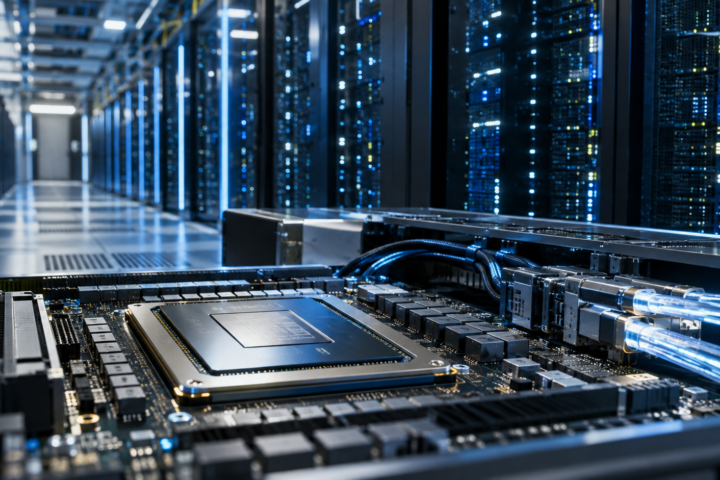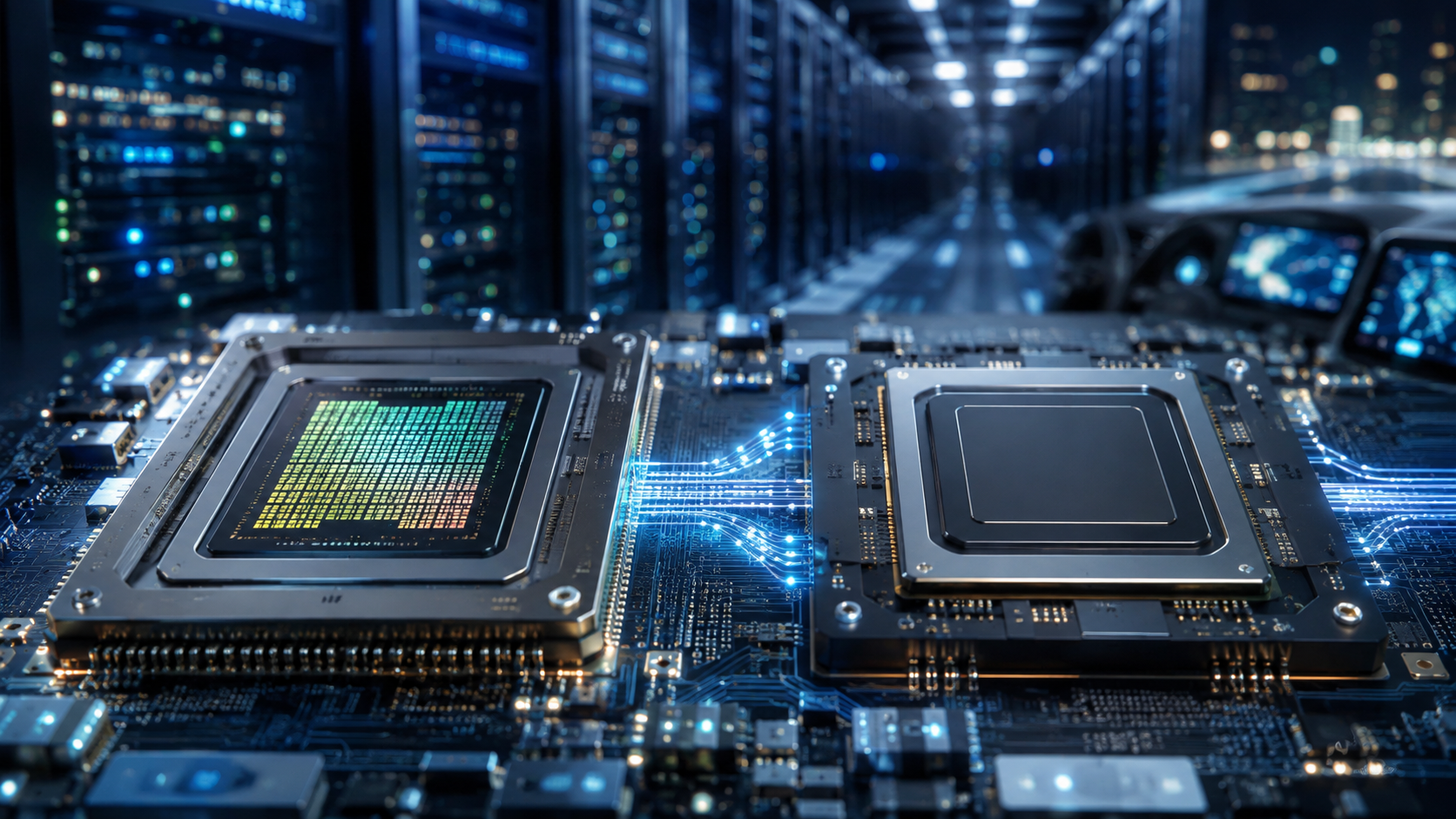
Nvidia’s investment in MediaTek extends its influence beyond graphics processors, positioning its interconnects, software and computing architecture to remain central as customers increasingly design their own AI chips.
Nvidia (NVDA) is investing $3.5 billion in Taiwanese semiconductor designer MediaTek, a deal that illustrates how the world’s dominant artificial-intelligence chip supplier is adapting to one of the biggest long-term threats to its position: customers building more specialized processors of their own.
The investment will take the form of convertible bonds issued by MediaTek and represents Nvidia’s largest direct investment outside the United States. MediaTek shares surged 10% in Taipei trading Tuesday, reaching the market’s daily limit, as investors assessed the potential for the company to become a more important supplier of custom artificial-intelligence silicon.
The significance extends beyond the size of the check. Nvidia and MediaTek plan to deepen their cooperation across data-center infrastructure, personal computing and automotive technology. MediaTek will work with Nvidia’s NVLink Fusion ecosystem, which allows custom processors to connect more closely with Nvidia graphics processors, networking equipment and rack-scale computing systems. The companies also intend to continue developing chips for Nvidia’s RTX Spark and DGX Spark systems and platforms for software-defined vehicles.
For Nvidia, the strategy offers a way to participate in the shift toward custom silicon without insisting that every AI workload run exclusively on its own GPUs. Large technology companies increasingly want processors designed specifically for their workloads, partly to reduce computing costs and partly to lessen dependence on Nvidia. Alphabet (GOOGL), Amazon (AMZN), Microsoft (MSFT), OpenAI and other major AI operators have been pursuing custom chip programs as the cost of training and operating advanced models rises.
That trend poses a nuanced challenge. Nvidia remains the central supplier of accelerated computing hardware and software, but customers capable of spending tens of billions of dollars on data centers have strong incentives to develop alternatives. Broadcom (AVGO) has emerged as a major beneficiary of this movement by helping large technology companies design specialized AI accelerators, while Marvell Technology (MRVL) has also targeted the custom computing market.
MediaTek now has an opportunity to compete more aggressively in the same field. The company built much of its reputation supplying smartphone processors and competing against Qualcomm (QCOM), particularly in Android devices. More recently it has expanded its custom silicon capabilities and positioned itself for workloads stretching from edge devices to data centers. Nvidia’s financial backing gives that effort greater strategic weight.
For Nvidia, helping MediaTek succeed may appear counterintuitive. A stronger custom-chip industry could reduce demand for general-purpose AI GPUs. But Nvidia’s broader objective increasingly appears to be making its architecture indispensable even when customers use processors designed by somebody else.
NVLink Fusion is central to that strategy. By allowing custom CPUs and accelerators to operate alongside Nvidia hardware inside its computing ecosystem, Nvidia can potentially preserve control over the networking, software and infrastructure layers surrounding AI workloads. A hyperscale customer might buy fewer Nvidia GPUs for a particular application while still relying on Nvidia technology to connect processors, move data and manage a large computing cluster.
That approach resembles a platform strategy more than a traditional semiconductor strategy. Nvidia’s competitive advantage has long rested partly on CUDA, the software environment that made its GPUs easier for developers to use. The company is now extending that principle to entire AI factories, including processors, networking, memory connectivity and software.
The MediaTek investment also highlights Nvidia’s increasingly expansive use of its balance sheet. The chipmaker has been deploying capital across companies connected to AI infrastructure, including semiconductor suppliers, cloud-computing providers and developers. Its financial strength allows it to reinforce an ecosystem in which Nvidia technology remains deeply embedded even as the industry becomes more diversified.
That strategy carries risks. Investors have become more attentive to arrangements in which Nvidia provides capital to companies that may ultimately purchase or support Nvidia-related infrastructure. Critics argue that extensive financial relationships can make it harder to distinguish independently generated demand from growth supported indirectly by Nvidia’s own investments. Nvidia has rejected characterizations of such arrangements as circular financing, arguing that investments accelerate development of the broader AI market.
The MediaTek structure offers Nvidia some protection because the investment is being made through convertible bonds rather than an outright equity purchase. Nvidia gains exposure to MediaTek’s potential appreciation while initially holding a debt instrument. MediaTek, meanwhile, receives substantial capital and a closer relationship with the company that defines much of today’s AI infrastructure market.
The deal may also broaden Nvidia’s reach outside data centers. MediaTek already has extensive experience producing power-efficient system-on-chip designs for consumer devices, while Nvidia wants more artificial-intelligence processing to occur locally on PCs, workstations and vehicles. Combining Nvidia graphics technology with MediaTek processors could create a wider family of devices capable of running advanced AI models without relying entirely on remote cloud infrastructure.
Automotive computing provides another long-term opportunity. Nvidia has spent years developing platforms for autonomous driving and software-defined vehicles, while MediaTek supplies connectivity and computing technology across consumer electronics. Their expanded partnership suggests that Nvidia sees AI inference spreading into physical devices and machines as another major leg of growth beyond hyperscale data centers.
For technology investors, the transaction reinforces a broader shift in the semiconductor industry. The next phase of artificial intelligence may not be defined by a single winning processor. Instead, increasingly complex computing systems could combine GPUs, custom accelerators, CPUs, high-bandwidth memory and specialized networking equipment.
Nvidia’s answer is to make sure that, whichever chips customers choose, its technology helps tie those components together.
That could ultimately prove as important as maintaining overwhelming GPU market share. The MediaTek investment shows Nvidia preparing for an AI market in which custom silicon becomes more common while attempting to ensure that the surrounding ecosystem continues to speak Nvidia’s language.