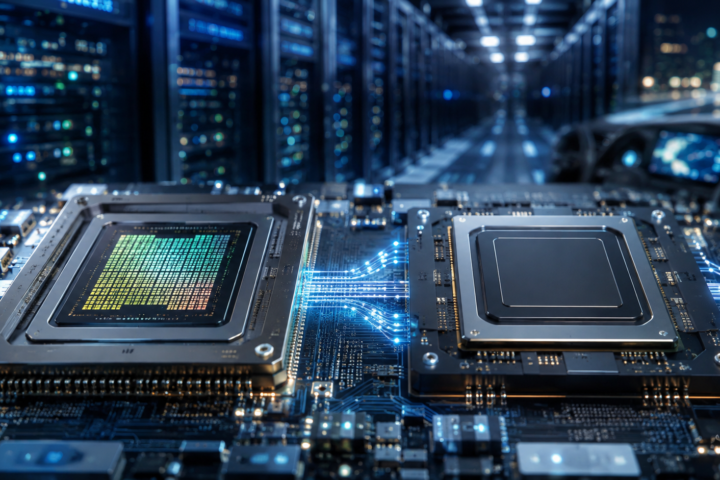
Qualcomm’s expanded Amazon partnership gives the mobile-chip veteran a credible path into hyperscale AI infrastructure, where inference, custom silicon and energy efficiency are becoming increasingly important competitive battlegrounds.
Qualcomm (QCOM) is making its clearest attempt yet to escape the gravitational pull of the smartphone market. A multi-generation agreement with Amazon.com (AMZN) will put Qualcomm technology inside large-scale artificial-intelligence data centers, giving the chip designer a marquee customer as it tries to establish a new growth engine alongside handsets, automotive and connected devices. The arrangement focuses on customized silicon for AI inference and advanced optical connectivity, areas that are growing more important as cloud operators seek alternatives to increasingly expensive, power-hungry general-purpose accelerator systems.
Investors responded quickly. Qualcomm shares rose about 3.2% in Tuesday trading after gaining considerably more earlier in the session, even as the broader U.S. market declined. The reaction reflects more than enthusiasm about a new customer. For Qualcomm, the deal provides commercial validation for a data-center strategy that was largely theoretical only a few months ago. The company has spent years trying to reduce its dependence on smartphones, where growth has matured and Apple increasingly designs more of its own communications silicon. A substantial Amazon relationship gives that diversification effort greater credibility.
The financial structure is unusually significant. Qualcomm issued Amazon an option to acquire as many as 25 million Qualcomm shares at an exercise price of $161.26 each. Those shares vest in stages linked to commercial agreements, purchase orders and actual purchases of Qualcomm server products and related technology. The milestones extend to as much as $60 billion in payments over the agreement, while 3.75 million shares vested at issuance because of initial purchase commitments. The $60 billion figure should not be interpreted as guaranteed revenue. It represents the maximum commercial threshold connected to the warrant structure rather than a firm near-term sales commitment.
Even so, Qualcomm says revenue from Amazon should begin in the December quarter. Chief Financial Officer Akash Palkhiwala has indicated that the company now has very high confidence in its goal of roughly $5 billion in data-center revenue during fiscal 2027, with a longer-term target of more than $15 billion in fiscal 2029. Qualcomm said in June that non-handset businesses could generate $40 billion of revenue by fiscal 2029, making data centers one of the central pillars of a broader transformation rather than a speculative side project.
The technological focus is also important. Much of the first phase of the generative-AI boom revolved around training increasingly large models, a market dominated by Nvidia (NVDA). The next stage is likely to involve rapidly expanding inference workloads, where already-trained models process prompts, generate answers and operate AI agents continuously. Inference places a premium on cost per query, memory bandwidth and power efficiency. Those characteristics overlap closely with Qualcomm’s traditional strengths in designing processors for devices operating under tight energy constraints.
That does not mean Qualcomm is about to displace Nvidia. Nvidia remains deeply entrenched through its accelerator hardware, software ecosystem and relationships with the world’s largest cloud providers. Broadcom (AVGO) is also a formidable competitor in custom AI silicon and networking. Instead, Qualcomm is trying to capture a portion of a market that may become large enough to support several specialized architectures. Hyperscalers increasingly want chips tailored to specific workloads, partly to lower costs and partly to reduce dependence on any single semiconductor supplier.
Amazon’s involvement reinforces that trend. Amazon Web Services already develops its own chips, including processors designed for AI workloads, so its willingness to expand collaboration with an outside semiconductor designer illustrates how complicated the AI infrastructure stack has become. Data centers increasingly require not only compute accelerators but also CPUs, memory systems, networking components and optical links capable of moving enormous amounts of information between servers. Qualcomm and Amazon plan to work on optical connectivity reaching 1.6 terabits per second, with future generations expected to push performance further.
Qualcomm is assembling the rest of that platform at the same time. Its Dragonfly data-center roadmap includes CPUs, AI inference accelerators, high-bandwidth computing technology and networking products. Meta Platforms (META) has already agreed to use Qualcomm data-center CPUs in future server deployments, while the company has outlined an annual cadence for new AI accelerator generations. These relationships suggest Qualcomm’s ambition is broader than selling a single custom chip. It wants to become a supplier across several layers of the AI data-center architecture.
Execution remains the central risk. Data-center customers have demanding qualification standards, long product cycles and enormous purchasing leverage. Qualcomm must also prove that its software tools can attract developers accustomed to Nvidia’s ecosystem. Hardware efficiency alone rarely determines semiconductor winners. Developers, cloud operators and enterprise customers generally favor platforms that minimize the cost and complexity of deploying applications at scale.
For investors, however, the Amazon agreement changes the probability distribution around Qualcomm’s strategy. The company no longer has to persuade the market that hyperscale customers might eventually adopt its technology. Amazon has attached purchase milestones and an equity incentive to the relationship, while Qualcomm says production is already underway. That does not guarantee the company will reach its fiscal 2029 targets, but it makes the data-center opportunity more measurable.
Qualcomm’s transformation is therefore becoming less about replacing smartphone revenue and more about applying its power-efficient computing expertise across a much larger technology landscape. If AI inference grows into the enormous recurring workload that chipmakers expect, the industry may need more architectures, more custom silicon and far more efficient networking. Qualcomm now has a major customer willing to test that proposition at hyperscale. The next question is whether Amazon becomes the beginning of a broader customer roster or remains the exceptional deal that defines the company’s data-center ambitions.