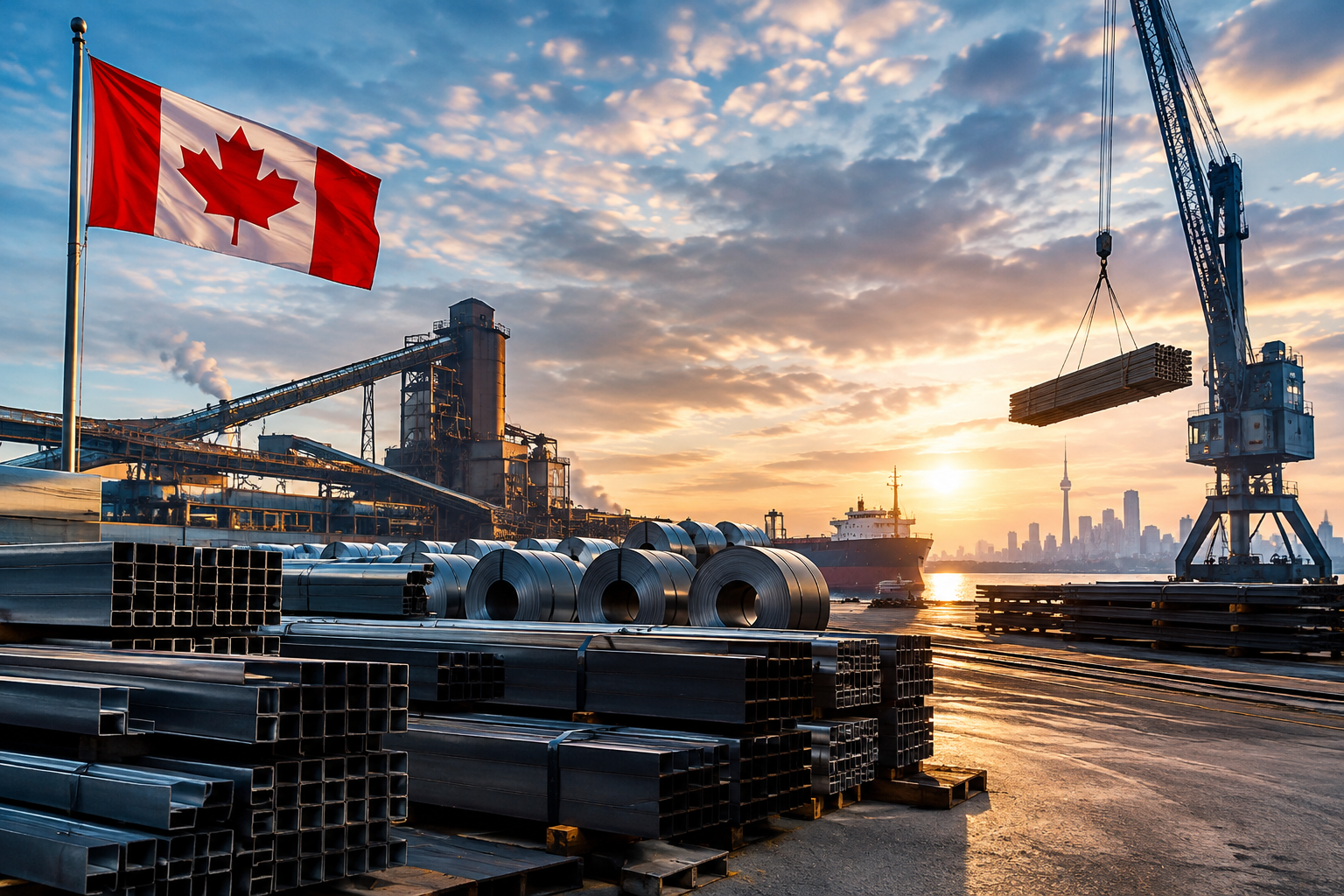
Canada’s steel industry is facing a defining test: can domestic investment and infrastructure demand compensate for the loss of access to its largest export market? For investors, the answer could reveal opportunities extending beyond steel producers to mining, energy, construction, transportation and the expanding network of artificial intelligence data centers.
U.S. tariffs have disrupted traditional North American steel trade, forcing Canadian producers to rethink where they sell their products and how they protect profitability. Yet the outlook is not entirely negative. Demand from domestic infrastructure projects, energy developments and industrial investment is creating alternative sources of business, while government support is helping the sector navigate a difficult transition.
According to Reuters reporting published on October 16, 2026, Canadian steelmakers are increasingly relying on domestic customers to offset tariff-related pressure. The shift highlights a broader investment theme: companies with diversified markets and exposure to long-term infrastructure spending may be better positioned to withstand trade uncertainty than businesses dependent on a single export destination.
U.S. Tariffs Reshape Canada’s Steel Industry
The United States has historically been a critical destination for Canadian steel, supported by closely integrated manufacturing networks and cross-border industrial supply chains. Tariffs have challenged that relationship by increasing the cost of accessing the U.S. market and making Canadian steel less competitive for some American buyers.
The impact extends beyond individual steel shipments. Steelmakers must consider customer relationships, production schedules, transportation expenses and pricing power when deciding how to respond. A producer that loses export volume may struggle to maintain factory utilization, while weaker demand can put additional pressure on selling prices and operating margins.
Reuters reported that U.S. steel tariffs rose to 50% in June 2025. Canadian steel shipments to the United States subsequently fell by 60% during 2025, illustrating the scale of the disruption described in the report.
For investors, these figures help explain why Canadian steel companies are looking beyond their traditional export markets. However, lower U.S. shipments do not automatically translate into an equivalent decline in every company’s revenue or earnings. The financial impact depends on product mix, contract structures, operating costs and the ability to secure replacement customers.
Domestic Demand Offers a Potential Recovery Path
Canada’s domestic market is becoming increasingly important as producers adjust their strategies. According to the Reuters report, the proportion of steel consumed in Canada that was produced domestically increased from 41% in 2024 to 51% in 2025.
This change suggests that Canadian producers have made progress in capturing a greater share of their home market. It does not, by itself, prove that total Canadian steel consumption has increased or that every producer has benefited equally. Nevertheless, it points to a potentially important shift in the industry’s competitive landscape.
Several areas could support demand.
Infrastructure and construction: Roads, bridges, public facilities and other infrastructure projects require substantial quantities of steel. Projects that move from planning to active construction could provide producers with a more predictable source of orders.
Energy investment: Pipelines, processing facilities, power infrastructure and industrial energy projects can generate demand for specialized steel products. The scale of this opportunity will depend on project approvals, financing conditions and construction timelines.
Mining and industrial development: Mining operations and associated infrastructure can require steel for equipment, structural applications and transportation facilities. New projects may help offset weakness in export-oriented markets.
AI data centers: The rapid expansion of digital infrastructure is creating demand for buildings, structural materials, electrical systems and supporting energy infrastructure. Steelmakers may benefit indirectly, although the opportunity varies by product specification and project design.
The central question is whether these demand sources can grow quickly enough to absorb available production capacity without forcing producers to cut prices.
Government Support Provides a Financial Cushion
Government intervention is another factor investors should monitor. Reuters reported that Canada announced C$1 billion in loans for the steel, aluminum and copper industries, providing potential financial support as companies adjust to trade restrictions and changing market conditions.
Such assistance can help eligible businesses address financing needs and maintain investment during periods of uncertainty. It may also support industrial capacity and employment while companies pursue new customers.
However, government loans are not equivalent to grants or guaranteed profits. Their benefits depend on eligibility, financing terms, the use of funds and each company’s financial position. Investors should examine official program announcements and individual corporate disclosures before estimating the impact on earnings or balance sheets.
Government policy can also create uncertainty. Changes to trade measures, domestic procurement rules or industrial support programs may alter the competitive position of different producers. Companies that rely heavily on policy protection could face renewed pressure if support changes.
Which Companies Should Investors Watch?
Investors following the Canadian steel industry should distinguish between direct exposure to Canadian steel production and broader exposure to North American steel demand.
Algoma Steel (ASTL.TO) is a key company to monitor because of its Canadian steelmaking operations. Investors should assess production volumes, operating costs, product demand, capital spending and progress in adapting to market conditions. The timing and economics of major operational changes can materially influence financial results.
Cleveland-Cliffs (CLF) provides another perspective on the North American steel market. Its results can help investors evaluate broader industry conditions, including pricing, demand from industrial customers and the effect of trade policy. It should not be treated as a pure-play Canadian steel investment.
Tenaris (TS) offers exposure to steel-related products used in energy markets, including tubular products. Its performance is influenced by energy-sector investment, customer demand and international operations, making it a different proposition from a traditional Canadian flat-steel producer.
These companies are not interchangeable investments. Their business models, geographic exposure, financial structures and sensitivity to steel prices differ. Investors should review their latest earnings releases, annual filings and management commentary rather than assuming that improving domestic demand will benefit every company equally.
Why This Matters for Investors
The Canadian steel industry’s adjustment offers three important lessons.
First, market diversification can reduce trade concentration risk. Producers that establish reliable domestic customers may become less vulnerable to sudden changes in U.S. trade policy. The quality and profitability of replacement sales, however, matter as much as the volume.
Second, infrastructure spending can create opportunities across multiple industries. Steel producers are one potential beneficiary, but mining companies, engineering contractors, equipment suppliers and energy infrastructure businesses may also gain from sustained project activity.
Third, revenue growth does not guarantee earnings growth. If domestic competition intensifies or producers accept lower prices to secure orders, higher sales volumes may not translate into stronger margins. Energy costs, labor expenses, freight rates and maintenance spending remain important variables.
Investors should also consider valuation. Even a company benefiting from an improving industrial outlook can be an unattractive investment if its share price already reflects optimistic assumptions. Cash flow, debt, capital expenditure and the resilience of earnings deserve close attention.
Risks and Future Trends to Watch
The industry’s recovery remains subject to several uncertainties. The first is the future of U.S.-Canada trade relations. Any easing of tariffs could improve export opportunities, while additional restrictions could prolong market disruption.
The second is the strength of Canadian construction and industrial investment. Delayed infrastructure projects or weaker business confidence could limit domestic steel demand. Higher interest rates and tighter financing conditions could also make capital-intensive projects less attractive.
The third is international competition. Canadian producers must compete with imported steel while managing their own cost structures. If imports increase or domestic demand weakens, pricing pressure could undermine the benefits of a larger home-market share.
Finally, investors should watch upcoming company earnings, steel prices, production volumes, order backlogs and management guidance. These indicators can help establish whether domestic demand is translating into sustainable financial improvement rather than simply replacing one uncertain market with another.
Key Investment Insight
Canada’s steel sector presents a potential industrial recovery opportunity, but investors should focus on evidence rather than headlines. The most important signals will be stronger order books, sustainable margins, improving cash flow and disciplined capital spending.
For a balanced approach, investors can compare direct steel producers with businesses exposed to Canadian infrastructure, mining and energy investment. Diversifying across related industries may reduce dependence on the performance of a single producer, although it cannot eliminate broader economic or market risk.
The central takeaway is clear: domestic demand is helping Canadian steelmakers adapt to U.S. tariff pressure, but the durability of that adjustment will depend on project execution, competitive pricing and the industry’s ability to generate profitable sales.
Stay with Stockmarket-news for daily business developments, market analysis and investor-focused insights that help you understand the forces shaping North American industries and identify the trends worth watching.