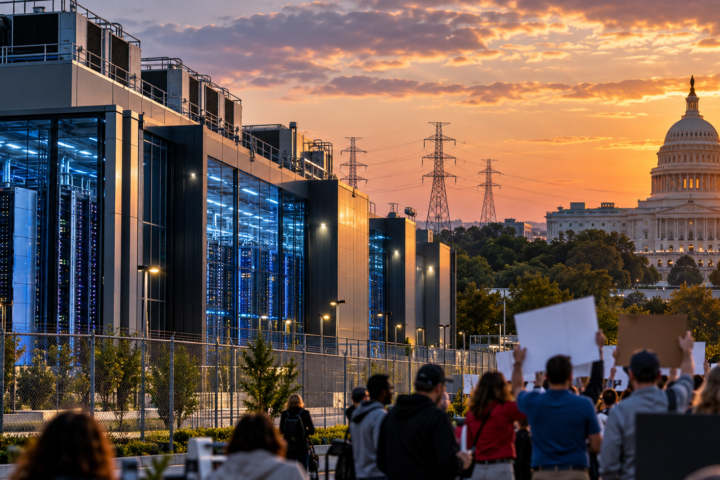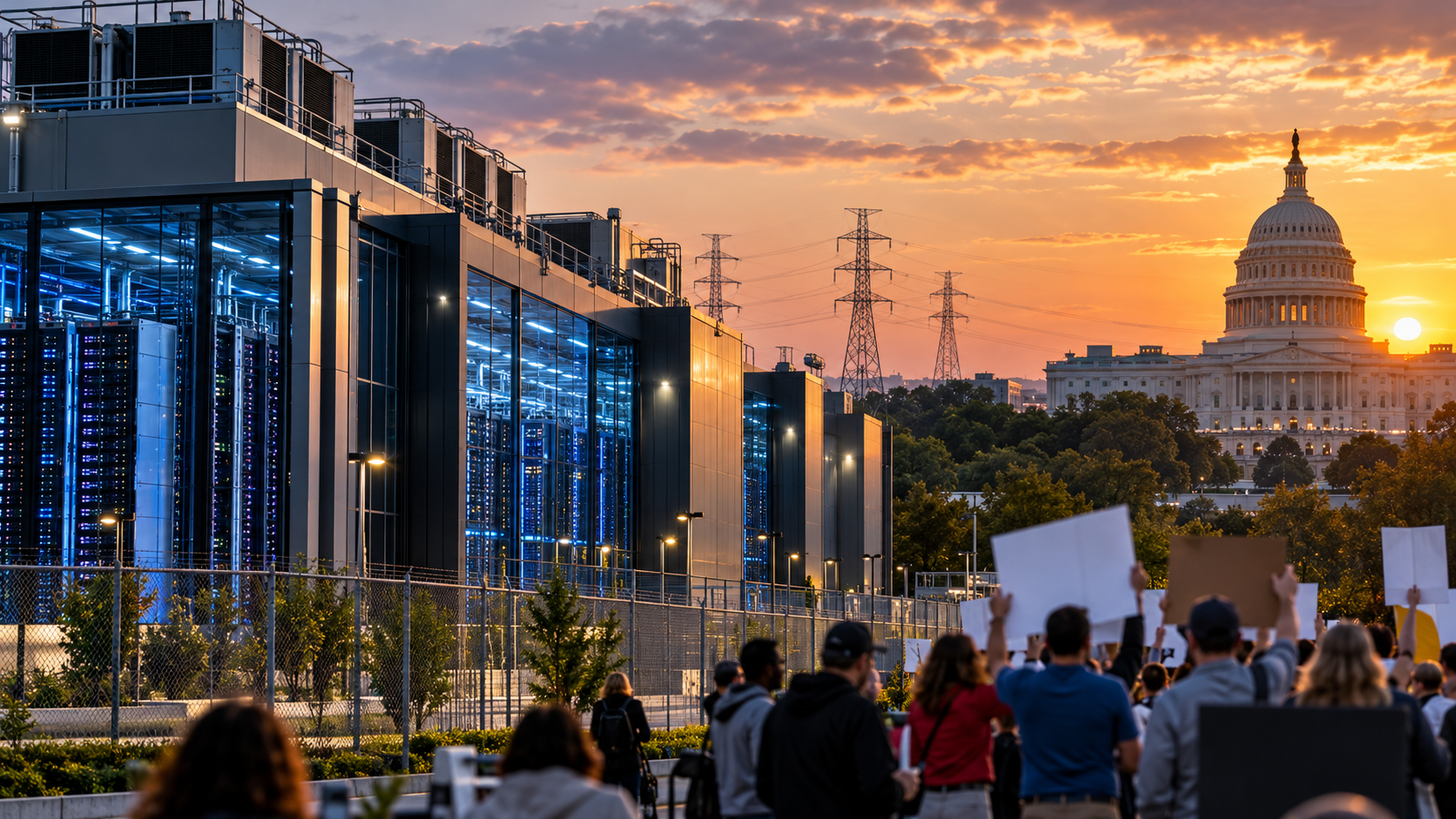
America’s artificial intelligence boom is entering a new phase in which technological ambition must contend with a growing challenge: public resistance to the infrastructure powering the industry. As technology companies commit enormous resources to AI computing capacity, opposition over electricity costs, environmental concerns and local development is emerging as a potential obstacle to continued expansion.
Investors are increasingly watching the political implications of data center development ahead of the November 3 U.S. midterm elections. Although sweeping restrictions on new projects remain uncertain, greater regulatory scrutiny could affect construction schedules, operating costs and investment decisions across the technology sector.
For investors, the issue is becoming more complicated than simply identifying which companies will benefit from growing AI demand. The next phase of the boom may depend equally on whether businesses can secure affordable electricity, obtain permits and maintain public support for their expansion plans.
Why Data Centers Have Become a Critical Investment Issue
Data centers are essential to the AI economy. They house the processors, networking equipment, storage systems and cooling infrastructure required to train and operate increasingly sophisticated AI models. Major technology companies, including Alphabet and Amazon, have invested heavily in expanding this capacity as businesses and consumers adopt AI-powered services.
However, these facilities require substantial amounts of electricity and infrastructure. Their expansion can put pressure on local power grids, increase demand for new energy generation and raise questions about who ultimately pays for upgrades to electricity networks.
Research from Lawrence Berkeley National Laboratory highlights the scale of the challenge. Its June 2026 update to the U.S. Data Center Energy Usage Report estimates that data centers could consume approximately 11.8% of total U.S. electricity by 2030 in its reference scenario. Alternative scenarios place the share between 9.5% and 15.3%.
These estimates demonstrate why energy availability has become a strategic consideration for the technology industry. As electricity demand grows, securing power at predictable prices could become an important competitive advantage.
For investors, the implications extend beyond data center operators. Electricity suppliers, utilities, semiconductor manufacturers, cooling-equipment providers and construction companies all have exposure to the infrastructure investment cycle.
Political Pressure Adds Uncertainty Ahead of the Midterms
The November 3 midterm elections are adding another dimension to the debate. Reuters reports that opposition to data center development could influence local and state political decisions, particularly in areas where electricity affordability, environmental concerns and large infrastructure projects have become contentious issues.
States such as Texas, Ohio and Georgia are important to watch because of their roles in data center development and the potential influence of state and local authorities over permitting and infrastructure decisions.
A change in political leadership does not automatically mean that projects will be blocked. Data centers can bring investment, construction activity, jobs and tax revenue to local economies. Policymakers must weigh those benefits against concerns about power costs, land use, water consumption and the capacity of existing infrastructure.
Nevertheless, additional hearings, investigations, permitting requirements or negotiations with utilities could increase uncertainty for developers.
Even without a broad legislative crackdown, delays can affect project economics. A facility that takes longer to complete may generate revenue later than expected, while construction costs and financing expenses continue to accumulate.
Investors should therefore distinguish between the risk of a complete project cancellation and the more immediate possibility of slower development, higher costs or reduced returns.
Electricity Costs Could Reshape the AI Investment Landscape
Energy availability is becoming one of the most important variables in the economics of AI infrastructure.
The U.S. Department of Energy has identified data center expansion and the growth of AI applications as significant contributors to rising electricity demand. Meeting that demand will require a combination of grid improvements, new generation capacity, energy efficiency and other solutions.
For technology companies, the challenge is not simply obtaining enough electricity. They must also secure reliable power at prices that allow their investments to generate attractive returns.
If electricity costs rise faster than expected, data center operators may face pressure on margins. Companies could respond by negotiating long-term power agreements, investing in onsite generation, improving cooling efficiency or locating facilities in regions with more favorable energy economics.
These responses could create opportunities for businesses supplying power infrastructure, energy storage, grid equipment and advanced cooling systems. However, the benefits will depend on actual project demand, competitive conditions and the ability of suppliers to convert orders into profitable revenue.
The investment implications are therefore mixed. Higher infrastructure spending can support suppliers, but it can also increase the capital requirements and financial risks facing the companies building and operating data centers.
What This Means for AI Stocks and Technology Valuations
The latest concerns do not necessarily signal the end of the AI investment boom. Demand for computing power could continue to expand even if individual projects encounter political or logistical obstacles.
Instead, the emerging risk is that the market may need to differentiate more carefully between companies with strong long-term demand and those whose financial performance depends on aggressive expansion assumptions.
Semiconductor manufacturers could continue benefiting from demand for advanced processors, while cloud computing companies may gain from increased AI adoption. Yet both groups remain exposed to the pace at which customers deploy infrastructure and generate returns from their investments.
A delay in data center construction could shift equipment purchases and revenue recognition between quarters. A prolonged slowdown could have broader consequences if technology companies begin reconsidering their capital expenditure plans.
Valuations are another consideration. When investors expect AI-related earnings to grow rapidly, even a modest deterioration in growth expectations can put pressure on share prices. Companies trading at elevated valuations may be particularly sensitive to disappointing guidance or evidence that infrastructure spending is generating weaker returns than anticipated.
Investors should examine cash flow, debt levels, capital expenditure commitments and management commentary alongside revenue growth. Strong sales alone may not be sufficient if a company must continually increase investment to sustain its competitive position.
Investment Opportunities Beyond the Biggest Technology Companies
The debate also highlights potential opportunities across the wider infrastructure ecosystem.
Power generation and utilities: Companies capable of delivering reliable electricity may benefit from rising demand. Investors should assess regulatory frameworks, infrastructure investment requirements and the risk that costs cannot be passed on to customers.
Grid equipment and electrical infrastructure: Transformers, switchgear, power-management systems and grid upgrades could become increasingly important as new facilities connect to electricity networks. However, lengthy project cycles and supply constraints can affect profitability.
Cooling and energy efficiency: Advanced cooling systems and more efficient data center designs could help operators manage electricity consumption and operating costs. Businesses offering measurable efficiency improvements may be well positioned if cost pressures intensify.
Semiconductors and cloud infrastructure: Demand for AI computing remains a key long-term growth driver, but investors should monitor whether customer spending translates into sustainable profits and whether planned capacity is being utilized effectively.
These categories should not be treated as guaranteed winners. Competition, valuations, execution risks and changes in infrastructure spending can influence returns across the entire supply chain.
Key Investment Insight: Focus on Execution, Not Just AI Hype
The most important question for investors is whether AI infrastructure projects can be completed on schedule and deliver acceptable financial returns.
Three developments deserve close attention in the coming weeks.
First, watch the outcome of the U.S. midterm elections and any subsequent state or local policy changes affecting data center permitting, energy costs or infrastructure development.
Second, monitor earnings reports and capital expenditure guidance from major cloud and technology companies. Changes in spending plans could provide an early indication of whether infrastructure demand is strengthening or becoming more selective.
Third, follow electricity-demand forecasts, utility investment announcements and agreements between data center operators and power providers. These developments may reveal which regions and companies are best positioned to accommodate further expansion.
Investors should also compare companies on valuation, balance-sheet strength and cash-flow generation rather than relying exclusively on exposure to artificial intelligence.
The central lesson is that the AI investment opportunity increasingly depends on more than technological progress. Access to electricity, public acceptance, regulatory certainty and disciplined capital allocation could help determine which companies ultimately capture the greatest economic benefits.
The Road Ahead for America’s AI Economy
The growing backlash against data centers represents a significant issue for an industry that has become a major focus of investor attention. It introduces additional uncertainty into a capital-intensive expansion cycle, but it does not, by itself, establish that AI demand is weakening or that widespread project cancellations are inevitable.
For investors, the distinction matters. Companies with strong balance sheets, reliable power arrangements, efficient infrastructure and credible returns on investment may be better equipped to navigate a more demanding regulatory environment.
As the U.S. midterm elections approach, developments in energy policy and local permitting could become increasingly important signals for technology markets. The ability to build AI infrastructure efficiently may prove just as important as the ability to develop more advanced AI technology.
Stay informed with Stockmarket-news for daily investor-focused reporting, market analysis and actionable insights into the technology trends shaping the future of global markets.