Sandisk and Western Digital delivered booming results, but restrained outlooks showed how little room remains for disappointment across the AI infrastructure trade.
Technology investors received another reminder Thursday that exceptional demand does not guarantee a rising share price when expectations are already extreme. Sandisk (SNDK) and Western Digital (WDC) fell sharply in premarket trading after both storage companies reported strong quarterly results, extending pressure across memory and data-center hardware stocks. The reaction was less a verdict on artificial-intelligence demand than a reassessment of how much future growth investors had already priced into the sector.
Sandisk produced the more dramatic numbers. Fiscal fourth-quarter revenue reached $8.97 billion, increasing 51% from the preceding quarter and 372% from a year earlier. Adjusted earnings were $39.25 a share, while gross margin climbed to 84.6%. Data-center revenue more than doubled sequentially to nearly $3 billion, demonstrating how quickly flash storage has become part of the infrastructure required to train, deploy and operate increasingly data-intensive AI models.
Yet the company’s forecast did not deliver the additional acceleration investors appeared to expect. Sandisk projected fiscal first-quarter revenue between $10.3 billion and $10.8 billion, adjusted earnings of $44 to $46 a share and gross margin between 83% and 85%. Those figures still imply substantial growth and profitability, but the revenue range stopped slightly below prevailing market forecasts at its upper end, while the margin guidance suggested that the extraordinary pricing benefits of the latest quarter may not continue expanding indefinitely.
Western Digital’s results carried a similar message. The hard-drive manufacturer reported quarterly revenue of $3.75 billion, up 44% from a year earlier, with adjusted earnings of $3.56 a share and a 54.4% adjusted gross margin. Free cash flow reached $1.28 billion. Management expects current-quarter revenue of about $4.1 billion, adjusted earnings near $4 a share and gross margin of roughly 55.5% at the midpoint of its forecast. Those are robust numbers for a business that was once treated mainly as a mature supplier of commodity storage.
The market’s response suggests that investors are no longer asking whether AI spending is supporting demand. The earnings reports make that connection increasingly difficult to dispute. Instead, shareholders are asking whether each supplier can expand faster than already elevated forecasts, preserve unusually high margins and maintain a technology advantage while customers commit tens of billions of dollars to data-center construction. Meeting estimates may protect an ordinary technology stock. For companies viewed as essential AI infrastructure, it can now be interpreted as evidence that momentum is approaching a peak.
Storage has also moved closer to the center of the AI investment debate. Graphics processors perform the most visible computational work, but large models depend on a broader hierarchy that includes high-bandwidth memory, conventional server memory, fast solid-state drives and mass-capacity hard drives. Longer context windows, agent-based applications and sustained inference generate substantial quantities of information that must be stored, retrieved and transferred efficiently. Micron Technology (MU) has argued that memory bandwidth and capacity are becoming increasingly important constraints on system performance as AI workloads expand beyond initial training.
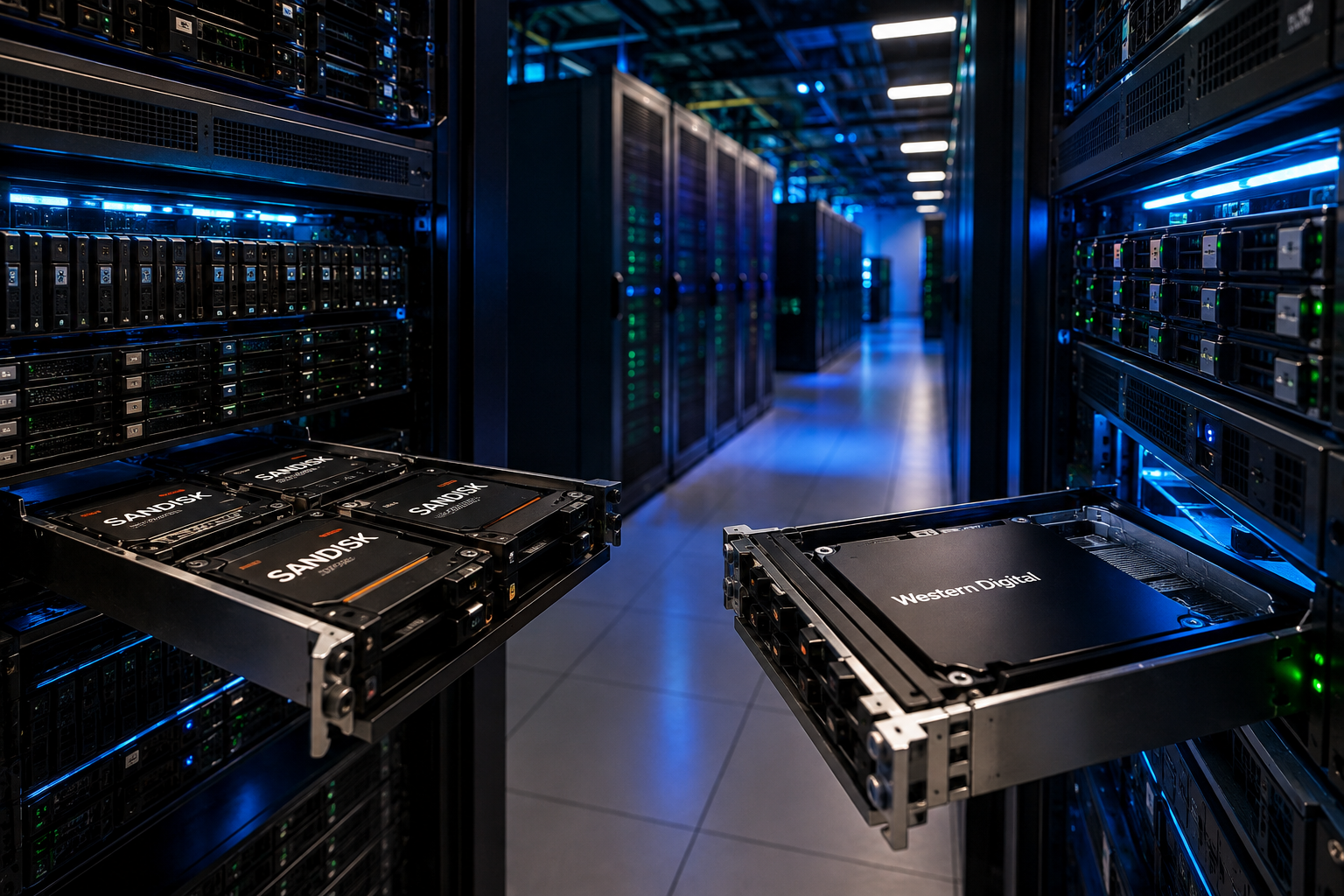
The 2025 separation of Western Digital’s flash operation into Sandisk has given investors a clearer view of how this demand reaches different parts of the storage market. Sandisk provides NAND flash used in solid-state drives and other high-speed products, while Western Digital is now primarily exposed to hard drives that offer lower-cost capacity for enormous data sets. Their simultaneous earnings reports showed that both layers are benefiting, but also that the economics differ. Flash suppliers can capture explosive pricing and margin gains during periods of scarcity, while hard-drive manufacturers depend more heavily on capacity transitions, customer qualification schedules and disciplined production.
Sandisk is attempting to make the historically cyclical flash business more predictable through longer-term customer arrangements. The company said it has added five agreements since its previous earnings call, taking the recently announced total to 10. It also authorized another $14 billion of share repurchases, leaving $15.5 billion available. These measures improve revenue visibility and demonstrate confidence in cash generation, but they also raise the importance of pricing floors, contracted volumes and customers’ willingness to honor aggressive capacity plans if the pace of AI deployment moderates.
Western Digital faces a different competitive test. Seagate Technology (STX) reported fiscal fourth-quarter revenue of $3.63 billion, adjusted gross margin of 52.7% and free cash flow of $1.1 billion a week before Western Digital’s release. Seagate has emphasized its heat-assisted magnetic recording technology as a way to increase drive capacity, and its earlier report established a demanding benchmark for Western Digital. Investors are therefore evaluating not only industry demand but also which manufacturer can deliver the highest-capacity products, secure cloud qualifications and convert shipment growth into superior margins.
The broader implication reaches beyond storage. Suppliers of networking equipment, optical components, servers, power systems and semiconductors have benefited from the same AI capital-spending cycle. Their next phase of performance may depend less on confirming that demand remains strong and more on showing that growth can continue accelerating from an already extraordinary base. Earnings beats will matter, but order visibility, supply discipline, competitive positioning and the durability of margins are likely to carry greater weight.
For investors, the decline in Sandisk and Western Digital is not necessarily evidence that the AI infrastructure expansion is ending. It is evidence that the market has become more selective about how much it will pay for that expansion. The companies are generating real revenue, substantial cash flow and sharply higher profits. The risk is that their share prices have been responding to a still more ambitious assumption: that scarcity, pricing power and hyperscale spending can all remain near peak levels simultaneously. Thursday’s selloff shows that even a small question about one of those conditions can overwhelm an otherwise impressive quarter.