Berkshire Hathaway’s new chief is putting more of the conglomerate’s enormous financial reserves to work, offering investors an early look at how capital allocation may evolve after Warren Buffett’s transition from the CEO role.
Berkshire Hathaway (BRK.B) entered the second half of 2026 with a notably different financial posture. The conglomerate’s operating earnings rose about 16% in the second quarter to nearly $13 billion, while its cash and Treasury holdings fell to roughly $365.5 billion from almost $400 billion three months earlier. The decline marked an important shift for a company whose growing liquidity had become one of Wall Street’s most closely watched signs of management’s difficulty finding investments large enough and attractive enough to matter.
The change comes as Greg Abel settles into his first year as chief executive after succeeding Buffett at the beginning of 2026. Buffett remains chairman, but Abel now holds ultimate responsibility for operating and capital-allocation decisions. That transition has made every major acquisition, stock purchase and repurchase more significant than it otherwise might be. Investors are not simply evaluating whether Berkshire can generate satisfactory returns. They are studying whether Abel will preserve Buffett’s unusually patient investment culture while becoming more willing to deploy the company’s accumulated capital.
So far, the evidence points toward greater activity without a wholesale change in philosophy. Berkshire purchased more than $20 billion of equities during the second quarter while selling substantially less, reversing the net-selling pattern that had characterized several recent periods. Among the most notable investments was a roughly $10 billion position in Alphabet (GOOGL), giving Berkshire meaningful exposure to one of the world’s largest artificial-intelligence and digital-advertising businesses.
The Alphabet investment is striking partly because Berkshire historically approached large technology companies cautiously. Its highly successful Apple investment eventually became one of the defining positions of Buffett’s later years, but much of Berkshire’s operating empire remains concentrated in insurance, transportation, energy, manufacturing and consumer businesses. Alphabet gives the portfolio another large technology franchise with substantial free cash flow, a dominant advertising operation and rapidly expanding AI infrastructure spending. The move suggests Berkshire is increasingly willing to classify certain technology platforms as durable cash-generating businesses rather than speculative technology bets.
Berkshire also resumed substantial purchases of its own shares, spending roughly $4.5 billion on repurchases during the quarter and billions more in July. Buybacks are particularly important at Berkshire because management has traditionally treated them as an investment decision rather than a routine method of supporting earnings per share. Repurchases therefore provide investors with an indirect signal that leadership believes Berkshire shares are trading below a reasonable estimate of intrinsic value.
That judgment arrives after Berkshire shares lagged the broader U.S. market during much of the year. Berkshire’s Class B shares were trading near $522 on Monday, while the SPDR S&P 500 ETF Trust (SPY), a broad market proxy, remained supported by strength in technology and other growth-oriented sectors. Berkshire’s more defensive mix of insurance, railroads, utilities and industrial holdings has provided diversification but has offered less direct participation in the market’s enthusiasm for artificial intelligence.
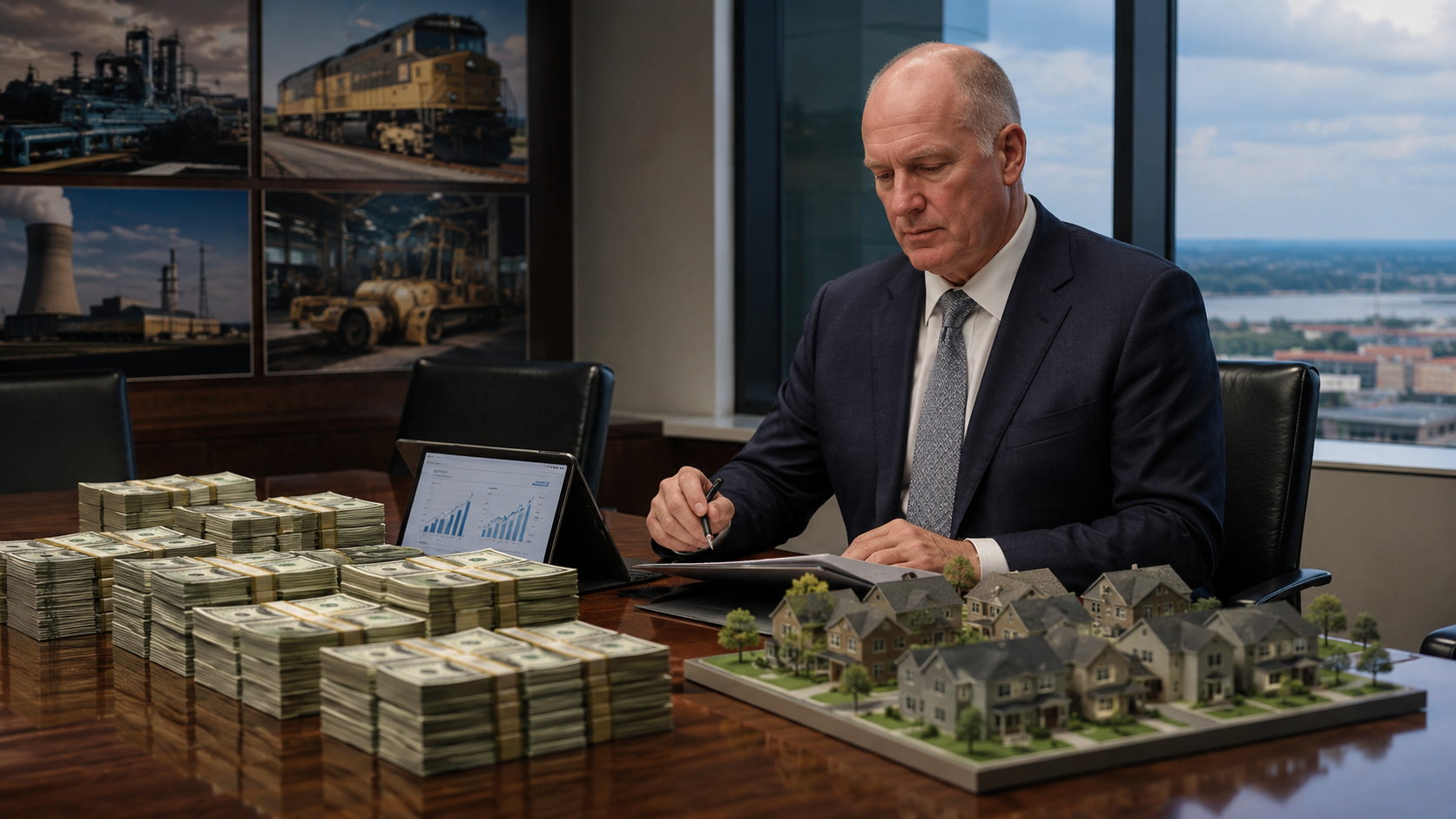
Abel is also deploying capital through acquisitions. Berkshire completed its purchase of Taylor Morrison Home Corporation in July, paying $72.50 a share in cash. The transaction valued Taylor Morrison’s equity at approximately $6.8 billion and the enterprise at about $8.5 billion. The acquired business is being combined strategically with Berkshire’s existing site-built homebuilding operations, creating a platform that delivered nearly 23,000 site-built home closings in 2025 and operates across dozens of U.S. housing markets.
The acquisition fits comfortably within Berkshire’s traditional model. Homebuilding is cyclical and sensitive to mortgage rates, employment and consumer confidence, but the sector also offers long-duration exposure to U.S. population growth and chronic housing supply constraints in many regions. Berkshire’s enormous balance sheet gives its operating subsidiaries the ability to endure weaker economic periods without depending heavily on short-term capital markets. That advantage can become particularly valuable during housing downturns, when less well-capitalized competitors may be forced to slow development or sell assets.
Underlying operating results also give Abel room to maneuver. Strength at businesses including BNSF Railway, Berkshire Hathaway Energy and several manufacturing and service operations helped offset weaker insurance results during the quarter. Geico’s underwriting performance softened significantly from a year earlier, illustrating why Berkshire’s diversification remains essential even when one of its largest businesses experiences pressure. Operating earnings are a more useful indicator of Berkshire’s underlying performance than reported net income, which can swing sharply because accounting rules require unrealized gains and losses in the equity portfolio to flow through earnings.
The central question for shareholders is whether the recent spending represents the beginning of a sustained decline in Berkshire’s cash mountain or merely an opportunistic quarter. Even after the latest investments, the conglomerate retains hundreds of billions of dollars in liquidity. That reserve gives Abel extraordinary flexibility, but it also creates an unusually demanding capital-allocation challenge. A $1 billion investment that would transform many companies barely moves Berkshire’s overall results. Future deals increasingly need to be measured in the billions, while still satisfying the company’s preference for understandable businesses, strong economics and sensible prices.
For investors, the early Abel era therefore appears less revolutionary than evolutionary. Berkshire is buying businesses, adding equities and repurchasing its own shares, but it has not abandoned the financial conservatism that defined Buffett’s tenure. The importance of the second quarter lies in demonstrating that the cash pile is not untouchable. If attractive opportunities emerge, Berkshire’s new CEO appears prepared to act. The success of the transition will ultimately depend not on how quickly Abel spends Berkshire’s money, but on whether the returns generated from today’s deployments justify the patience that produced that capital in the first place.