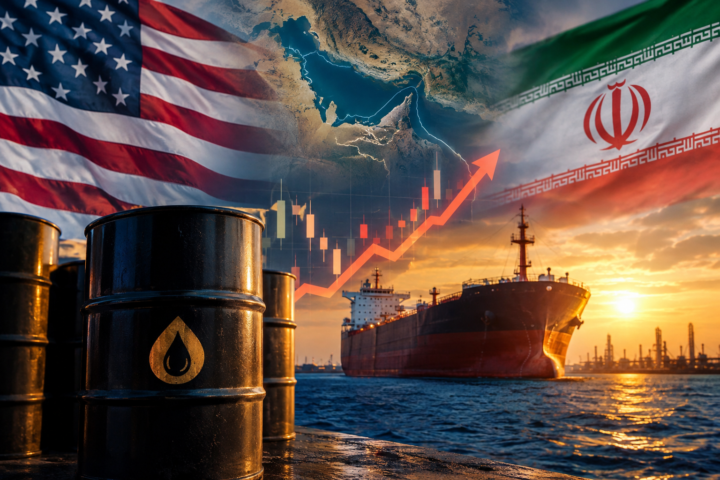
A tentative U.S.-Iran agreement has eased immediate energy-market pressure, but investors remain focused on whether lower oil prices can cool inflation without masking deeper global-growth risks.
Global markets entered Wednesday with a rare sense of relief after signs of a U.S.-Iran arrangement reduced fears of a prolonged disruption to oil flows through the Strait of Hormuz, one of the world’s most strategically important energy corridors. Brent crude traded below $80 a barrel after a sharp retreat earlier in the week, helping lift risk appetite across parts of Asia and steadying U.S. futures ahead of the Federal Reserve’s policy decision. The immediate market reaction was straightforward: lower oil prices soften the inflation shock, ease pressure on central banks and improve the outlook for energy-intensive industries. The harder question is whether that relief is durable.
For investors, the ceasefire optimism has changed the tone of global trading without eliminating the underlying risks. Japan’s Nikkei 225 and South Korea’s Kospi reached record highs, helped by technology shares and export-linked optimism, while European markets were more cautious and U.S. futures were mixed before the Fed decision. The pattern suggests that markets are not treating the geopolitical development as a clean all-clear signal. Instead, investors are recalibrating from crisis pricing toward a more familiar debate over inflation, rates and earnings resilience.
The most important transmission channel remains energy. A sustained fall in crude prices would provide relief to consumers, airlines, chemicals producers, freight operators and manufacturers, while reducing the likelihood that headline inflation forces another round of rate increases. Shares of companies such as United Airlines Holdings (UAL) tend to benefit when fuel-cost expectations fall, though the effect depends on demand, hedging and broader economic conditions. The same logic applies across Europe and Asia, where energy import dependence makes oil prices a larger macroeconomic variable than in the United States.
Yet the relief is incomplete. Even with Brent below $80, oil markets are still pricing logistical uncertainty, damaged trade routes and the possibility that political implementation lags diplomatic statements. The Associated Press reported that economists expect normalization of oil flows to take time, even if the interim agreement holds. That matters because inflation expectations can be slow to reverse. Businesses may delay price cuts, shipping schedules may remain disrupted and central banks may prefer to see several months of calmer energy data before changing course.
That caution is especially visible in monetary policy. The Federal Reserve is expected to hold interest rates steady at its first meeting under Chair Kevin Warsh, with investors watching for any indication that lower oil prices have reduced the need for tighter policy. In the U.K., the Bank of England is also expected to remain cautious, while the European Central Bank has already been dealing with renewed inflation pressure. For markets, this creates a narrow path: oil relief supports equities, but central banks may not validate the rally quickly if services inflation, wages or currency weakness remain problematic.
The Reserve Bank of Australia offered a useful example of that restraint. It held its cash rate steady at 4.35%, but Governor Michele Bullock continued to warn that inflation remains too high. Australian inflation was reported at 4.2%, unemployment at 4.5% and markets still assigned meaningful odds to further tightening by year-end. That mix shows how a geopolitical improvement can help the global inflation outlook while still leaving domestic policymakers uncomfortable.
The global-growth backdrop also argues against excessive optimism. The United Nations has projected world economic growth of 2.7% in 2026, below the pre-pandemic average of 3.2%, pointing to a world economy still expanding but lacking strong momentum. Fitch recently cut its 2026 global growth forecast to 2.4% to reflect the impact of the Middle East shock, including higher energy costs and supply disruptions. If the oil-price decline holds, some of those downgrades may look less severe, but the episode has reminded investors how quickly geopolitical risk can spill into household budgets, corporate margins and sovereign bond markets.
Equity markets are also being pulled by a second force: artificial intelligence. Technology-heavy markets in South Korea, Japan and the United States continue to benefit from AI-related capital spending, semiconductor demand and investor enthusiasm for companies such as Nvidia (NVDA). That support has helped offset macro concerns, but it has also made market leadership narrower. When AI shares rise, global indices can look healthier than the average company beneath the surface. When they weaken, the broader risk rally can quickly lose momentum.
That divergence is visible across regions. Asian export markets have responded strongly to the combination of oil relief and tech momentum. Europe has been more restrained, reflecting weaker growth, energy sensitivity and industry-specific concerns, including pressure on automakers. Australia’s ASX rally has drawn skepticism from strategists who point to persistent inflation, property-market concerns and earnings downgrades. In other words, the global reaction is positive but uneven, shaped by each region’s exposure to oil, technology, rates and domestic demand.
Currencies and bonds show similar hesitation. The dollar was broadly stable, U.S. Treasury yields edged higher and eurozone yields eased, suggesting investors are not fully embracing a risk-on narrative. If oil prices continue to fall, bond markets may price lower inflation risk. But if central banks stress that underlying inflation remains sticky, yields could stay elevated even as crude declines. That would limit the valuation benefit for equities and keep pressure on rate-sensitive sectors such as real estate, utilities and smaller companies.
The central lesson for investors is that the geopolitical risk premium has narrowed, not disappeared. A durable reopening of energy routes would improve the outlook for inflation, corporate costs and consumer spending. But markets have already moved quickly to price that possibility, leaving less room for disappointment. The next phase will depend on confirmation: physical oil flows, central-bank language, inflation data and whether corporate guidance begins to reflect lower input costs.
For now, the world economy has been handed a reprieve at a critical moment. It is meaningful because oil shocks can rapidly undermine confidence. It is fragile because the inflation fight is not over, growth remains modest and equity leadership is concentrated. Markets may be right to welcome the easing of immediate energy stress. They may be premature if they treat it as the end of the world’s economic uncertainty.