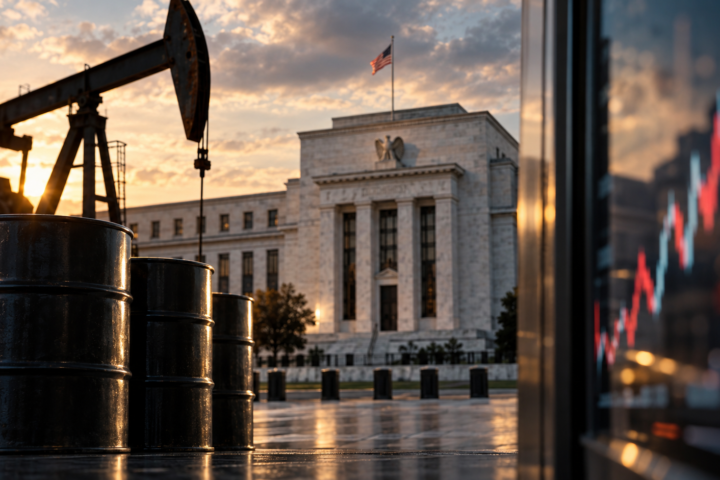
Crude prices climbed sharply as renewed U.S.-Iran friction clouded hopes for normalized Gulf exports, reviving inflation risks across global commodity markets.
Oil markets are again pricing diplomacy by the hour. Brent crude briefly pushed above $90 a barrel on Tuesday before retreating toward $87 to $88, while West Texas Intermediate traded near $82. The reversal followed a gain of more than 5% in crude prices on Monday, underscoring how quickly expectations for Middle East supply can shift as negotiations surrounding Iran and the Strait of Hormuz encounter fresh obstacles.
The immediate catalyst is renewed uncertainty over the conditions required to restore more dependable shipping through the Strait of Hormuz. The waterway has become the central variable in the 2026 oil market after months of conflict disrupted tanker movements, reduced Gulf production and forced refiners and importers to seek alternative barrels. Earlier efforts to stabilize traffic had helped pull Brent sharply below its spring highs, but the latest political demands between Washington and Tehran have reminded traders that the recovery remains vulnerable to reversal.
That vulnerability matters because the scale of the disruption has been unusually large. Before the conflict intensified, roughly 20 million barrels a day of crude oil, condensate and petroleum products regularly moved through Hormuz. EIA estimates show that flows had already fallen to 14.6 million barrels a day in the first quarter of 2026, while subsequent fighting forced significant production shutdowns across the Gulf. Brent traded as high as $118 a barrel in the second quarter before collapsing to a low near $72 as shipping conditions improved, one of the widest quarterly ranges in recent oil-market history.
The broader market had recently begun positioning for a more comfortable supply outlook. Following a June agreement intended to reduce hostilities and reopen the strait, the U.S. Energy Information Administration projected that global crude production and trade flows could move toward pre-conflict levels by the end of 2026. Its July forecast anticipated Brent averaging roughly $74 a barrel during the third quarter and declining further as inventories rebuilt. Renewed tensions now make those assumptions more difficult to rely on, even if they have not yet invalidated the longer-term case for improving supply.
The International Energy Agency had also identified a substantial rebound in Gulf exports during June, when total regional oil shipments jumped by 6.5 million barrels a day to 16.1 million. Even after that recovery, exports remained well below the roughly 24 million barrels a day recorded before the war, leaving the market with a thinner buffer against renewed shipping disruptions. The current rally therefore reflects not only fears of lost barrels but the limited margin for another prolonged setback.
For energy equities, elevated crude prices provide immediate support to upstream earnings expectations while introducing more complicated effects for integrated producers. Exxon Mobil (XOM) traded around $160 Tuesday and Chevron (CVX) near $195, with both shares relatively steady after energy stocks strengthened during Monday’s oil rally. Higher benchmark prices improve realizations for producers, but the same geopolitical instability can raise shipping, insurance and operating costs while complicating refinery feedstock availability.
Refining may remain one of the most important parts of the commodity story. Fuel markets have not fallen as rapidly as crude during periods of geopolitical easing because global refining capacity has been strained by disruptions in the Middle East and Russia alongside tight inventories. That has allowed unusually wide margins on products such as diesel, creating a favorable environment for refiners even as consumers face stubbornly expensive fuel.
American households are already feeling the consequences. The national average gasoline price was about $4.09 a gallon at the end of July, nearly one dollar higher than a year earlier, and prices remained above $4 as of Tuesday. A sustained return of Brent toward $90 would threaten the seasonal easing in pump prices normally associated with the end of the summer driving period. It would also complicate the inflation outlook by feeding transportation, logistics and production costs throughout the economy.
That inflation channel is increasingly important for investors because commodities are now interacting directly with expectations for U.S. monetary policy. Markets are awaiting Wednesday’s consumer-price data, and another energy-driven inflation scare could challenge expectations that the Federal Reserve will be able to adopt a more accommodative stance. Oil therefore represents more than an energy trade. Its path could influence Treasury yields, the dollar and equity valuations across rate-sensitive sectors.
Gold is reflecting the same uncertainty from a different direction. The metal climbed to a two-month high near $4,435 an ounce before easing toward $4,418, extending a weekly advance of more than 6%. Gold is benefiting from renewed demand for defensive assets and expectations that softer economic data could limit further monetary tightening, although higher oil prices create a competing risk by keeping inflation and bond yields elevated.
Copper provides another contrast. Prices remain above $14,000 a metric ton after a powerful rally supported by supply constraints, electrification investment and rising demand associated with data centers and power infrastructure. The metal has gained roughly 14% this year, suggesting that investors continue to distinguish between short-term geopolitical volatility and the longer-term structural scarcity facing key industrial materials.
For commodity investors, the central question is now whether Tuesday’s oil spike represents another temporary geopolitical premium or the beginning of a more durable supply repricing. If shipping through Hormuz continues to normalize, the combination of recovering Gulf production and softer global demand could eventually pull crude lower. If negotiations deteriorate further, however, a market that has already experienced Brent at both $72 and $118 within a single quarter has shown how quickly scarcity can overwhelm forecasts.