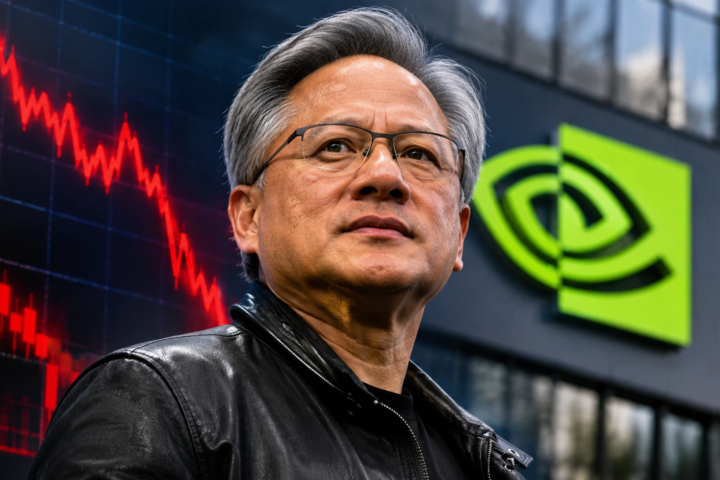
The artificial intelligence boom that powered some of Wall Street’s biggest technology gains is facing one of its most important reality checks yet. After months of extraordinary investment in AI infrastructure, semiconductor production and data-centre expansion, investors are increasingly questioning whether the industry’s enormous spending commitments can deliver sustainable financial returns.
A sharp technology-led market selloff has brought these concerns into focus. Semiconductor companies, AI infrastructure providers and several major technology stocks have faced renewed selling pressure as investors reassess valuations, borrowing costs and the commercial outlook for artificial intelligence. Meanwhile, growing political opposition to data-centre expansion and fresh uncertainty surrounding Nvidia’s leadership have added another layer of risk to an already unsettled market.
The developments are particularly important for the broader U.S. stock market. According to Reuters reporting on November 9, technology companies account for more than 35% of the S&P 500. Consequently, the sector’s ability to recover could have significant implications for overall market performance.
For investors, the central question is changing: the opportunity is no longer simply about identifying companies involved in AI, but determining which businesses can turn substantial AI investment into measurable earnings growth.
Wall Street Reassesses the AI Investment Boom
The recent technology selloff reflects a growing distinction between the long-term potential of artificial intelligence and the short-term financial performance of companies building the infrastructure behind it.
Over the past several years, major technology companies have committed enormous resources to developing AI models, purchasing advanced processors and constructing data centres. Companies such as Microsoft, Alphabet, Amazon and Meta Platforms have positioned AI as a central component of their future growth strategies.
However, investors are increasingly demanding evidence that these investments can generate attractive returns.
The concern is particularly significant for companies with substantial exposure to AI infrastructure. Data centres require expensive computing equipment, electricity, cooling systems and networking technology. Their construction also involves considerable financing requirements and lengthy development timelines.
If demand for AI services grows more slowly than expected, companies could face pressure from elevated operating expenses, debt obligations and underutilised infrastructure.
Reuters has reported that concerns about the sustainability of AI-related spending have contributed to the recent weakness in technology shares. The market is becoming less willing to reward ambitious spending plans without clearer evidence of future profitability.
This represents an important shift in investor sentiment. During the initial AI rally, announcements of major infrastructure investments often strengthened market confidence. Now, those same announcements are increasingly being evaluated against expected cash flows and returns on invested capital.
Technology Valuations Become More Attractive, but Risks Remain
Despite the recent correction, falling technology valuations could create opportunities for investors willing to take a longer-term perspective.
Reuters reported on November 9 that the technology sector’s forward price-to-earnings ratio had declined to 17.1, compared with 17.9 for the broader S&P 500. This marked the first time since 2017 that technology traded at a lower forward earnings multiple than the index.
The change is significant because technology stocks have historically attracted premium valuations due to their growth potential, profitability and influence across the global economy.
A lower valuation does not automatically mean that a stock is undervalued. Earnings expectations could still decline if AI demand weakens, infrastructure projects are delayed or companies struggle to justify their capital expenditure.
Nevertheless, the valuation adjustment suggests that some of the excessive optimism surrounding technology shares may already have been removed.
For investors, the distinction between a temporary market correction and a more fundamental deterioration in business performance will be crucial.
Companies with established customer relationships, recurring revenues, strong balance sheets and demonstrated AI monetisation capabilities may prove more resilient than businesses whose valuations depend heavily on distant growth expectations.
Nvidia Faces Additional Pressure as Leadership Uncertainty Emerges
One of the most closely watched developments involves Nvidia, the semiconductor giant at the centre of the global AI infrastructure expansion.
On November 8, Nvidia announced that its board had initiated an independent investigation following reports that CEO Jensen Huang had been the target of a foreign intelligence effort.
The company said its board had no reason to believe that national security or Nvidia’s confidential information had been compromised. However, the investigation will examine the available information, with independent directors and external legal counsel overseeing the process.
The announcement added uncertainty around a company that has become central to investor confidence in the AI industry.
Nvidia’s importance extends beyond its semiconductor business. Its advanced processors and computing platforms support the infrastructure used by major cloud providers, AI developers and enterprise technology companies.
Reuters reported on November 9 that Nvidia shares faced additional pressure following the announcement, with investors assessing the potential implications of the investigation.
The development also highlights the growing geopolitical sensitivity surrounding advanced semiconductor technology, particularly amid U.S.-China tensions and restrictions on exports of advanced AI chips.
Investors should distinguish between confirmed corporate developments and unresolved allegations. Nvidia’s announcement does not establish that confidential information was compromised or that its CEO was involved in wrongdoing.
Nevertheless, the situation reinforces the importance of corporate governance, leadership continuity and regulatory compliance when evaluating major technology companies.
Political Opposition Creates New Challenges for Data-Centre Expansion
Another significant risk for the AI industry is emerging outside corporate boardrooms.
The rapid expansion of data centres has generated growing debate about electricity consumption, infrastructure capacity, water requirements, land use and the cost of supplying power to large technology facilities.
Political developments following the U.S. midterm elections have intensified these concerns. Candidates opposing certain data-centre developments secured victories in several areas, including Texas and Georgia, raising questions about whether local opposition could delay future projects.
Reuters reporting has highlighted concerns that political resistance and potential construction restrictions could affect the industry’s infrastructure expansion plans.
This matters because the AI investment cycle depends on continued growth in computing capacity. Delays in obtaining permits or securing electricity connections could affect demand forecasts for semiconductor manufacturers, equipment suppliers and data-centre operators.
The consequences could extend across several industries.
Semiconductor companies may experience weaker orders if infrastructure projects are postponed. Data-centre operators could face higher development costs, while electricity providers and equipment manufacturers may encounter uncertainty surrounding future demand.
At the same time, companies offering energy-efficient computing systems, advanced cooling technologies and power-management solutions could benefit as operators seek to reduce infrastructure costs.
For investors, the next stage of AI growth may depend as much on energy availability and regulatory approval as on advances in software and semiconductor design.
What Investors Should Watch Next
Several developments could determine whether the technology sector stabilises or experiences further volatility.
1. Upcoming technology earnings
Results from Nvidia, CoreWeave and Dell are particularly important. Investors will be looking for evidence of sustained AI infrastructure demand, improving profitability and credible revenue guidance.
Strong results could help restore confidence, while disappointing forecasts may reinforce concerns about excessive investment.
2. AI capital expenditure and cash flow
Investors should monitor spending plans from major cloud providers, including Microsoft, Alphabet and Amazon. The relationship between capital expenditure, operating cash flow and AI-related revenue will be particularly important.
3. Nvidia’s independent investigation
Further announcements from Nvidia’s board could influence investor sentiment. The outcome may provide greater clarity about corporate governance and potential business risks.
4. Data-centre regulations and energy availability
Changes in permitting requirements, electricity supply and local development policies could influence the speed and cost of AI infrastructure expansion.
5. Interest rates and inflation
Higher borrowing costs can make capital-intensive AI projects more expensive. Investors should therefore monitor inflation figures, Treasury yields and Federal Reserve policy expectations.
Key Investment Insight: Focus on AI Profitability Rather Than AI Hype
The current technology correction does not necessarily signal the end of the artificial intelligence investment cycle. AI adoption continues to represent a significant long-term opportunity across business operations, cloud computing, healthcare, manufacturing and financial services.
However, the market appears to be entering a more selective phase in which investors increasingly differentiate between companies benefiting from genuine commercial demand and those relying primarily on optimistic growth expectations.
Established technology companies with strong cash generation, diversified revenue streams and disciplined investment strategies may offer greater resilience during periods of uncertainty.
Investors should also monitor semiconductor manufacturers, cloud infrastructure providers, cybersecurity businesses and energy-efficiency technology companies. These industries could benefit from continued AI adoption, although their prospects will depend on valuations, competitive conditions and actual customer demand.
Rather than reacting to every short-term price movement, investors should evaluate earnings quality, debt levels, capital expenditure and the ability of companies to convert AI investment into sustainable free cash flow.
The recent decline in technology valuations may create opportunities, but selective research and careful risk assessment remain essential.
The AI Market’s Next Test: Delivering Measurable Returns
The latest developments suggest that the technology sector is approaching an important turning point. Artificial intelligence remains one of the most influential forces shaping the global economy, but the financial markets are increasingly demanding proof that its commercial potential can justify the extraordinary investments being made.
Nvidia’s investigation, political resistance to data-centre expansion and concerns about AI profitability have introduced new uncertainties. At the same time, lower technology valuations could create opportunities for companies capable of demonstrating strong earnings growth and sustainable business models.
The next phase of the AI market will likely reward execution, financial discipline and genuine innovation rather than spending announcements alone.
For investors, understanding this transition will be essential to identifying the next generation of technology winners.
Stay informed with Stockmarket-news for the latest developments in artificial intelligence, semiconductor markets, technology stocks and global investment trends. Follow our daily coverage for the insights and analysis that matter to investors navigating an increasingly complex financial landscape.