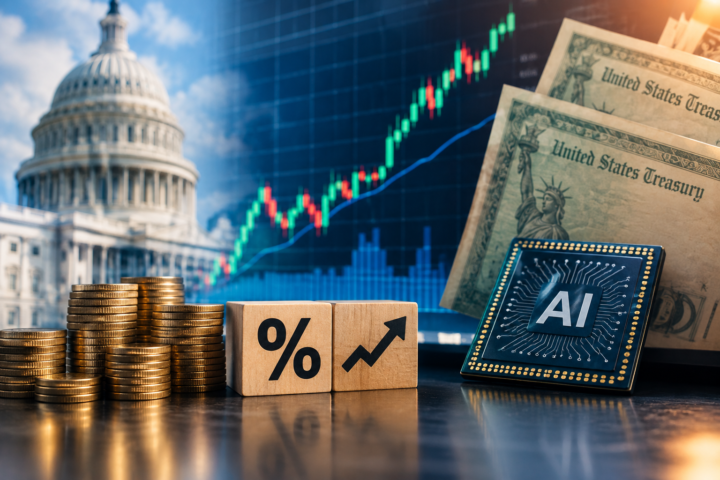
The market’s first-half strength shows investors still trust the artificial-intelligence capital cycle, but the second half may reward discipline more than enthusiasm.
The most dangerous point in a bull market is not when investors are euphoric. It is when they can make a reasonable case for being euphoric. That is roughly where U.S. equities stand as the second half of 2026 begins. The S&P 500 finished June near record territory, the Nasdaq has continued to draw power from chipmakers and cloud-computing companies, and the artificial-intelligence trade remains the clearest narrative in global markets. Nvidia (NVDA), Advanced Micro Devices (AMD), Microsoft (MSFT), Amazon.com (AMZN), Alphabet (GOOGL) and other AI-linked leaders are no longer merely beneficiaries of optimism. They are central to capital spending plans, earnings forecasts and the market’s broader valuation structure.
That is precisely why investors should be more selective, not less. The AI boom has moved beyond speculation about consumer chatbots and into a massive infrastructure buildout involving semiconductors, data centers, power equipment, networking hardware and cloud services. That makes the cycle more durable than a simple software fad. It also makes it more capital-intensive, more dependent on financing conditions and more exposed to a future debate over returns on investment. Companies can spend aggressively on AI for several years and still disappoint shareholders if the spending fails to produce enough incremental revenue, productivity or pricing power.
The strongest argument for staying invested is that earnings, not just multiple expansion, have supported much of the advance. Large technology companies have generally remained profitable while funding AI investment from formidable cash-flow bases. That distinguishes today’s market from earlier episodes in which futuristic narratives floated far above weak business models. Microsoft (MSFT), for example, has a direct route from AI spending to cloud demand, enterprise software adoption and productivity tools. Nvidia (NVDA) has become a critical supplier to the buildout itself. These are not marginal businesses hoping for relevance. They are dominant companies selling products customers are already buying.
Yet investors should not confuse a real trend with an unlimited price. The stock market has a habit of turning sound stories into fragile trades once too much money crowds into the same conclusion. AI may transform corporate productivity, but it will not repeal the cost of capital. The Federal Reserve’s current policy stance still matters. With rates held in a 3.50% to 3.75% range and officials divided over whether the next move should be a hike, hold or cut, equity valuations cannot rely on a simple assumption that money will become steadily cheaper.
That tension is visible across asset classes. High-yield savings accounts are still offering rates far above traditional bank accounts, which reminds households that cash is no longer a zero-return asset. For retail investors, that raises the hurdle rate for owning expensive equities. A stock priced for years of flawless growth must compete not only with other stocks, but with cash, Treasury bills and bond funds that offer meaningful income without the same volatility.
The better way to think about AI exposure is not as a single trade, but as a hierarchy of risk. At the top are companies with direct pricing power and visible demand, including leading chip designers and cloud platforms. Below them are suppliers of power equipment, cooling systems, data-center real estate and networking tools, many of which may benefit from the physical expansion of computing capacity. Further down are firms adding “AI” to investor presentations without a clear path to higher margins. The first group may justify premium valuations. The second may offer cyclical upside. The third deserves skepticism.
Investors should also recognize that the AI trade has become a macro trade. Data centers require electricity. Electricity requires grid investment, generation capacity and regulatory approval. Semiconductor supply chains remain exposed to geopolitics. Cloud spending depends on corporate confidence. A slowdown in enterprise budgets, a rise in funding costs or a delay in monetization could quickly change the market’s tone. None of those risks invalidates the AI thesis. They simply argue against treating it as immune from normal economic gravity.
The broader market’s reliance on a relatively narrow group of winners is another reason for caution. A strong index can hide uneven participation beneath the surface. If semiconductor shares and mega-cap technology stocks carry most of the gains, the index may look healthier than the average portfolio feels. That does not mean a downturn is imminent. It does mean investors should be wary of assuming that buying the benchmark at any price is the same as buying broad economic strength. The SPDR S&P 500 ETF Trust (SPY) offers diversified exposure, but its performance is increasingly shaped by the largest technology constituents.
The most constructive outcome for the second half would be a gradual broadening of leadership. If industrials, financials, health care, energy infrastructure and smaller companies begin to participate more meaningfully, the rally would look less dependent on one theme. That would be healthier for markets and easier for investors to trust. If, instead, the indexes keep climbing mainly because a handful of AI stocks keep getting more expensive, the margin for error will shrink.
For now, the lesson is balance. Investors do not need to abandon AI leaders simply because they have performed well. Selling every winner in a structural growth cycle can be as damaging as buying every story stock near its peak. But they should ask harder questions. Which companies can translate AI demand into durable earnings? Which firms are spending because customers are paying, and which are spending because competitors are spending? Which valuations still allow for disappointment?
The AI boom is real. The market has largely been right to recognize it. But the next phase will be less forgiving than the first. In the early stage of a powerful theme, investors often get paid for identifying the direction of travel. In the mature stage, they get paid for distinguishing leaders from passengers. That distinction may define returns through the rest of 2026.