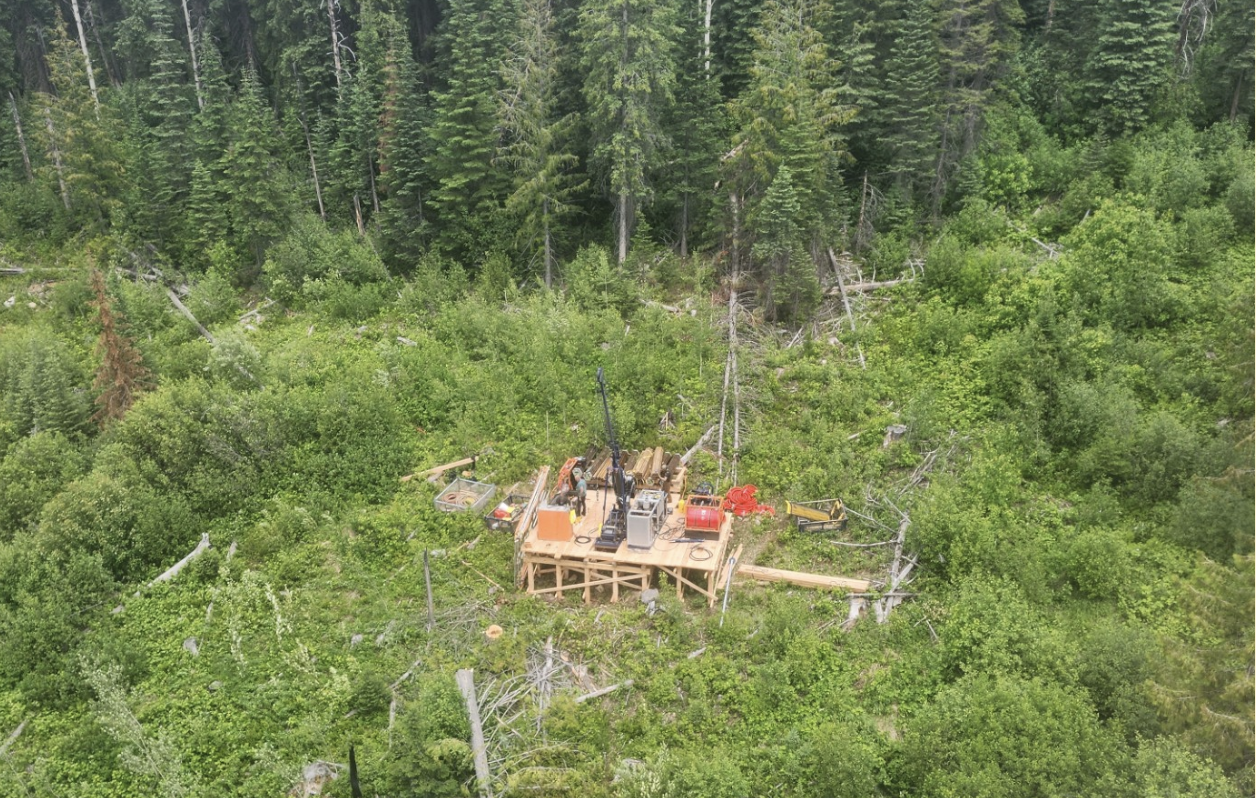
Photo: Fox Tungsten drilling underway at August showing in June 2026
CEO Steve Gray on the fully funded 20,000-metre campaign at the Fox project, a planned 2027 resource update and PEA, and the strategic case for North American tungsten.
Fox Tungsten Ltd. (TSXV: FOXT; OTC: FOXTF) has begun what management describes as the largest exploration campaign in its history: a fully funded 20,000-metre drill program at its Fox project in south-central British Columbia.
In an interview on The Midday Bell, President and Chief Executive Officer Steve Gray framed 2026 as a potential turning point for the company, one he hopes will mark a transition from an exploration story to a development story.
Gray pointed to a sharp rise in tungsten prices over the past year, which he attributed to a structural supply deficit and trade tensions between China and the United States. According to Gray, China produces roughly 80% of the world’s tungsten, and there are currently no producing tungsten mines in North America, a combination he argued strengthens the case for developing Western sources of supply.
The company has said about 60% of this year’s drilling is directed at growing the existing resource, with work focused around the BN, RC and BK zones. Gray explained that past drilling was concentrated at the three existing resource zones largely because that is where the deposit happens to outcrop, and that the 2026 program will take a “more systematic, broader approach” aimed at testing whether the three areas can be connected into a single, larger zone. That resource growth, he said, is intended to form the basis for an updated mineral resource estimate and PEA targeted for the first half of 2027.
Gray was candid about the trade-offs in allocating drill metres. With roughly 60% of the program tied to resource definition, about 40% is reserved for broader exploration targets across the property — work he described as “walking and chewing gum at the same time.” The harder decisions, he said, are about what not to drill given budget limits, even as the company tries to preserve longer-term discovery potential alongside near-term resource and engineering progress.
On the nearby Silver Boss property, which Gray said surrounds Glencore’s past-producing Boss Mountain molybdenum mine, the company plans to drill-test a possible extension of historical molybdenum mineralization as well as a large copper soil anomaly several kilometres across. He characterized both as early-stage targets aimed at building a longer-term pipeline rather than near-term resource additions.
The company recently completed a new exploration camp and mobilized its first two drill rigs. Gray called the upgraded infrastructure “absolutely necessary” to support an expanded team and drilling season, and said it would serve as the base for operations over the next several years. Alongside drilling, the company is conducting metallurgical testing, mapping and geochemical sampling. On metallurgy, Gray said test work to date indicates the RC zone can produce a high-grade concentrate of roughly 60% tungsten at about 75% recovery using a gravity circuit, with further flow-sheet refinement planned to support the PEA.
Looking further out, Gray said a positive resource update and PEA would shift the company’s focus toward permitting, infrastructure and development — “less of an exploration focus and more of an engineering focus.” He cautioned that tungsten is a niche commodity unfamiliar to many investors, and said economic studies would help put the project’s grade and scale into context. Readers should note that the PEA, resource update, production aspirations and commodity-market views described here are forward-looking and subject to significant risks and uncertainties, as set out at the end of this article.
The Interview
The following Q&A has been edited and condensed for clarity. Questions were posed by The Midday Bell; answers are those of Fox Tungsten President and CEO Stephen Gray. Fox Tungsten trades on the TSX Venture Exchange under the symbol FOXT and on the OTC Pink Market under the symbol FOXTF.
Midday Bell: Fox Tungsten has just launched a fully funded 20,000-metre drill program, which you describe as the largest exploration campaign in the company’s history. What gives management the confidence to undertake a program of this scale at this stage of the project’s development?
Stephen Gray: We’ve always known that Fox Tungsten has a lot of exploration potential. Our resource zones are open in every direction, and we have a 400-square-kilometre land package that is prospective, with a lot of exciting early-stage targets. So the issue for us isn’t finding places to drill — we actually have too many places to drill. What’s changed is the strategic landscape for tungsten and critical minerals. Tungsten prices have risen sharply over the past year, and in my view that’s on the back of two things: a fundamental supply deficit in the market, and the trade tensions between China and the United States. China produces about 80% of the world’s tungsten, and there are zero producing mines in North America. In that context, I think it’s important that Canada, the United States and the West in-source tungsten production as much and as quickly as possible. That’s why we’re moving aggressively with the biggest drill program Fox Tungsten has ever done.
Midday Bell: Roughly 60% of this year’s drilling is focused on growing the existing resource. Can you walk us through the significance of the BN, RC and BK zones and what success would look like as you test continuity between these areas?
Stephen Gray: Our resource has three different zones. The reason there are three is simply that’s where the deposit happens to outcrop. The exploration strategy to date has been to start at the outcrop and incrementally step back. This summer we’ll take a more systematic, broader approach — trying to turn our three smaller zones into one larger zone. Based on the expression of the host rocks at surface, we believe that should be possible, but of course we need to drill to confirm it. The first piece of that, over the short term, will be growing the inferred resource, and that will be the basis for the PEA we’re planning to start this year.
Midday Bell: You’ve indicated that this work is intended to support an updated mineral resource estimate and a PEA in early 2027. How important is this year’s drill program in potentially influencing the size, confidence and economics of the future project?
Stephen Gray: We expect this to be a transformational year for the company. It’s the biggest drill program we’ve ever done, but it’s also a chance to change the story — from an exploration story to a development story. Being able to talk not just in terms of tonnes and grade, but in terms of mine plans, dollars and costs, will be important for putting the project in context for investors. Tungsten is a niche commodity that not everyone is familiar with. When we say our deposit is about 1% tungsten, that is, in my view, an incredibly high grade — I’d put it on the order of roughly 20 grams per tonne gold or about 25% copper. Having a PEA with economics wrapped around it will help us explain that to the market.
Midday Bell: That makes up about 70% of the program, with roughly 30% allocated to broader exploration targets across the property. How do you balance resource expansion around known mineralization versus pursuing entirely new discoveries?
Stephen Gray: It’s challenging, and there’s no obvious right answer. We’re trying to advance the project toward a PEA and ultimately toward production as soon as possible, but we also recognize we have a large land package and haven’t finished exploring. So it’s a matter of walking and chewing gum at the same time. The hard part is deciding what we aren’t going to drill, because there are lots of things I’d love to drill this summer that we simply don’t have the budget for. We’re trying to maintain that balance — progressing the technical work, the PEA and the resource, while keeping the long-term vision alive. We’re fortunate to have a program and budget large enough to do both, but there will always be targets we want to drill and can’t yet fund.
Midday Bell: Investors may be less familiar with the Silver Boss property. What strategic role does it play, and why are the copper and molybdenum targets worth allocating drill metres to this season?
Stephen Gray: Our Silver Boss property surrounds Glencore’s Bull Mountain molybdenum mine, which operated roughly from the 1960s through the 1980s. It was a high-grade producing molybdenum mine that has since been reclaimed. We see evidence that the mineralization from that mine extends onto our property, and that’s something we’ll drill-test this summer, following up geophysics we ran last year. We’ll also be drilling a copper soil anomaly that is several kilometres across, where we don’t yet understand what’s happening below surface. These are early-stage targets, with the goal of growing our long-term pipeline.
Midday Bell: The company recently completed a new exploration camp and mobilized its first two drill rigs. How does this upgraded infrastructure support a larger program?
Stephen Gray: It was absolutely necessary. This is the biggest drill program we’ve ever done, and we needed our infrastructure to match. Over the past couple of weeks we pulled the old camp and put in a brand-new camp that’s fit for purpose for our expanded team and drilling season. That will form the base of our operations for the next couple of years. It’s an important milestone, and something we’ll be able to build on.
Midday Bell: Beyond drilling, the company is conducting metallurgical testing, mapping, geochemical sampling and other field work. How does this fit into the broader path toward development?
Stephen Gray: There are really two parts. One is the early-stage field program — soil sampling, prospecting and the like — which is about building the long-term pipeline and making sure we have targets to drill three years from now. The other end of the spectrum is metallurgical testing, which we need in support of the PEA. We’ve done met testing and know the metallurgy at RC fundamentally works using a gravity circuit. We can produce a high-grade concentrate of about 60% tungsten at roughly 75% recovery, which we view as favorable. We still have work to do refining that flow sheet, and that will support the PEA we expect next year.
Midday Bell: As assay results begin to come in, what milestones should investors watch for between now and the planned resource update and PEA in 2027?
Stephen Gray: We’ll release drill results as they become available over the next couple of months. We expect drilling to run until late October, so we’ll be periodically releasing assay results as we have them. Then, in the first quarter of next year, we expect to release an updated resource followed by the PEA. By this time next year, we should have a much better handle on exactly what we have at Fox Tungsten.
Midday Bell: Were there any specific lessons from the 2025 drill program that shaped the design of the 2026 program?
Stephen Gray: I think the 2025 program was a success. We incrementally extended mineralization and demonstrated that RC and BN still have a lot of room to grow. It may not have fundamentally changed our understanding of the deposit, but it was an encouraging signal of incremental growth, and we’ll continue to build on it this year.
Midday Bell: Looking beyond 2027, what is management’s long-term vision for the Fox Tungsten district as a potential North American tungsten producer?
Stephen Gray: This should be the year we transition from exploration to development. This year’s program will feed into the resource update and the PEA. Once we have those, the focus of the company will need to shift — we’ll start talking about permitting, infrastructure and impact-benefit agreements. It becomes less of an exploration focus and more of an engineering focus.
About Fox Tungsten Ltd.
Fox Tungsten Ltd. (formerly Happy Creek Minerals Ltd.) is a Vancouver-based mineral exploration and development company. Its flagship Fox Project is located in south-central British Columbia. The company trades on the TSX Venture Exchange under the symbol FOXT and on the OTC Pink Market under the symbol FOXTF (changed from HPYCF in June 2026). Readers interested in learning more should review the company’s website and its public filings on SEDAR+ (sedarplus.ca).
Paid Disclosure
Compensation. StockMarket-News.com and/or its operator (“the Publisher”) has been compensated to produce and distribute this interview and article. Fox Tungsten Ltd. paid the Publisher CAD $2,500 + GST for the production and dissemination of this content. Because the Publisher is being compensated, this material should be regarded as a paid advertisement / sponsored commercial communication, and readers should not assume it is objective or independent reporting.
Holdings and conflicts. As of the date of publication, the Publisher and its principals own 100,000 stock options of Fox Tungsten Ltd. and have no intention to buy or sell within the next 30 days. The Publisher and its principals may buy or sell securities of the company at any time, which may be contrary to views expressed in this article. The company reviewed the factual accuracy of statements attributed to its CEO but did not control the editorial commentary.
Not investment advice. Nothing in this article is a recommendation to buy, sell or hold any security. The Publisher is not registered as an investment adviser or dealer in any jurisdiction. Microcap and junior mining securities are highly speculative, may be illiquid, and can result in the total loss of invested capital. Readers should consult a registered investment professional and conduct independent due diligence.
Cautionary Note Regarding Forward-Looking Statements
This article contains “forward-looking information” and “forward-looking statements” within the meaning of applicable Canadian securities laws and the United States Private Securities Litigation Reform Act of 1995. Forward-looking statements include, but are not limited to, statements regarding the planned 20,000-metre drill program and its timing and scope; the allocation of drilling between resource expansion and exploration; expectations that the three resource zones may be connected; anticipated drill, assay and metallurgical results; the expected timing and outcome of an updated mineral resource estimate and preliminary economic assessment in the first quarter of 2027; potential metallurgical recoveries and concentrate grades; the potential transition from an explorer to a developer; future permitting, infrastructure and impact-benefit activities; and statements regarding tungsten supply, demand, pricing and the strategic importance of North American production.
Forward-looking statements are based on assumptions and are subject to known and unknown risks and uncertainties that may cause actual results to differ materially, including risks relating to exploration and development, the uncertainty of mineral resource and economic estimates, commodity price volatility, financing and capital requirements, permitting, environmental and Indigenous-engagement matters, and general market conditions. A preliminary economic assessment, if completed, would be preliminary in nature and there is no certainty it will be realized. Readers are cautioned not to place undue reliance on forward-looking statements, which speak only as of the date made. Except as required by law, neither the company nor the Publisher undertakes any obligation to update them. Readers should refer to the company’s public filings on SEDAR+ for a full discussion of risk factors.