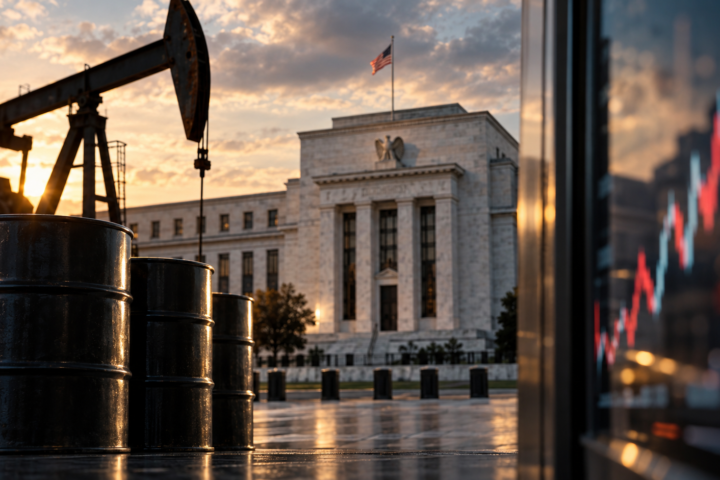
Global financial markets entered September under renewed pressure as a sharp rise in oil prices collided with a broad government bond selloff, pushing investors to reassess inflation, interest-rate and geopolitical risks. The latest escalation in U.S.–Iran hostilities sent crude prices to five-week highs while government bond yields climbed across major economies, creating a difficult backdrop for both fixed-income and equity investors.
The market reaction was particularly notable because higher energy prices can feed directly into inflation expectations. That, in turn, can reduce expectations for monetary easing or increase the possibility of tighter policy, raising borrowing costs across the economy.
For investors, the September 1 market move highlighted a critical question: how persistent will the energy shock be, and how much additional pressure will it place on global interest rates and asset valuations?
Oil Shock Puts Inflation Back in Focus
Oil was at the center of the market’s latest repricing.
According to Reuters, Brent crude settled at $94.65 a barrel on September 1, up 4.6%, while U.S. West Texas Intermediate crude gained 5.2% to $90.22. Both benchmarks reached their highest closing levels since July as renewed U.S.–Iran fighting raised concerns about additional disruptions to Middle Eastern oil supplies.
The Strait of Hormuz was a particular concern for traders because of its importance to global energy transportation. Reuters reported that Iran had effectively closed the waterway to shipping amid the renewed hostilities and warned that Tehran could prevent Gulf oil exports.
The significance for markets extends beyond the price of gasoline or crude itself. Sustained energy inflation can increase transportation, manufacturing and consumer costs, potentially keeping headline inflation elevated even if other parts of the economy begin to cool.
That creates a difficult environment for central banks. Policymakers must balance inflation risks against the possibility that higher borrowing costs eventually weaken economic activity.
Global Bond Markets Send a Warning
The bond market provided another major signal on September 1.
The U.S. Treasury’s official yield-curve data show the 10-year Treasury yield at 4.79% on September 1, while the 30-year yield stood at 5.27%. The long end of the Treasury curve remained particularly elevated, reflecting investor concerns surrounding inflation, fiscal borrowing and longer-term interest-rate risks.
Reuters separately reported that government borrowing costs were rising across major economies, with Japan’s 10-year government bond yield reaching 3% for the first time since 1996. Yields also climbed in Germany, the United Kingdom and the United States.
This broad-based move matters because it indicates that the pressure was not limited to one country’s fiscal outlook. Investors were simultaneously dealing with geopolitical uncertainty, higher energy prices, inflation concerns and heavy government borrowing.
Reuters Breakingviews also highlighted concerns about U.S. fiscal conditions, noting that the country’s projected 2026 budget deficit was around $2.1 trillion and that higher defense spending associated with the Iran conflict could add to fiscal pressures.
For bond investors, rising yields mean falling prices for existing bonds. For equity investors, the implications can be broader.
Why Higher Yields Matter for Stocks
Higher Treasury yields can influence equity markets through several channels.
First, they increase the discount rate investors use when valuing future corporate earnings. Growth companies whose valuations depend heavily on profits expected many years into the future can therefore become more sensitive to changes in long-term yields.
Second, higher government bond yields can make fixed-income investments relatively more attractive compared with riskier assets.
Third, elevated borrowing costs can affect companies directly. Businesses refinancing debt at higher rates may face increased interest expenses, while consumers may face higher mortgage, auto-loan and credit costs.
Those dynamics were visible in U.S. equity trading on September 1. Reuters reported that the Dow Jones Industrial Average fell 0.79%, the S&P 500 declined 0.71%, and the Nasdaq Composite dropped 1.03% as investors reacted to higher yields, rising oil prices and renewed geopolitical uncertainty.
The market response suggests that investors were not treating the oil increase as an isolated commodity-market event. Instead, the move was being incorporated into expectations for inflation, monetary policy and corporate valuations.
A Broader Fiscal and Monetary Policy Problem
The September 1 bond selloff also exposed a more complicated issue: markets are increasingly sensitive to the interaction between government borrowing and monetary policy.
When governments run large deficits, they generally need to issue more debt. If investors demand higher compensation for holding longer-duration bonds, yields can rise even without an immediate change in central-bank policy.
At the same time, higher oil prices can push inflation higher. If inflation remains persistent, central banks may have less room to reduce interest rates.
That creates a potentially difficult combination for markets: higher fiscal borrowing + higher energy prices + elevated inflation expectations + higher bond yields.
Reuters reported that investors were already pricing increased concerns about rate hikes as the global bond selloff intensified.
The Federal Reserve therefore remained one of the most important variables for investors watching the next stage of the market reaction.
What Investors Should Watch Next
The next phase of the market will depend heavily on whether the oil shock proves temporary or persistent.
1. Crude oil prices
Investors should monitor Brent and WTI closely. A sustained move higher could increase inflation expectations and put additional pressure on interest-rate-sensitive assets.
2. The U.S. 10-year Treasury yield
The 10-year Treasury remains one of the most important global financial benchmarks. A continued rise would increase borrowing costs and potentially place additional pressure on equity valuations.
3. Inflation data
Upcoming U.S. inflation readings will be particularly important. Investors should distinguish between temporary energy-driven increases and broader inflationary pressure across goods and services.
4. Federal Reserve policy
Any shift in expectations for future Fed policy could quickly affect bonds, stocks, currencies and commodities. The market will be watching policymakers’ language as closely as the headline interest-rate decision.
5. Developments around the Strait of Hormuz
The geopolitical situation remains a major variable for the oil market. Any indication of an easing or worsening of supply disruptions could produce rapid moves in crude and risk assets.
Investment Implications: Where the Risks and Opportunities Are
The September 1 market environment argues for close attention to interest-rate sensitivity, energy exposure and balance-sheet strength rather than relying solely on broad market direction.
Energy producers can benefit from higher crude prices if elevated prices persist, although geopolitical developments can also create significant volatility. Conversely, companies with high energy consumption or substantial refinancing needs could face greater cost pressures.
High-quality bonds also deserve attention as yields rise, particularly for investors with longer-term horizons. However, investors should recognize that longer-duration bonds remain sensitive to further increases in yields.
Equity investors may also want to monitor companies with strong cash generation and relatively low leverage. These businesses may be better positioned to absorb higher financing and operating costs than highly indebted companies, although individual company fundamentals remain decisive.
Importantly, none of these developments guarantees a particular market outcome. The direction of oil prices, inflation and monetary policy will determine whether the September selloff becomes a temporary volatility event or part of a longer repricing of global assets.
The Bottom Line
September began with investors confronting three interconnected forces: geopolitical risk, higher energy prices and rising global borrowing costs.
Brent crude’s move to $94.65, the U.S. 10-year Treasury yield near 4.8%, Japan’s 10-year yield reaching 3% and declines across major U.S. stock indexes underscored how quickly developments in the Middle East can transmit into global financial markets.
For investors, the most important signals to monitor are not simply daily stock-market movements. Oil prices, Treasury yields, inflation expectations, central-bank policy and developments around key energy-supply routes could determine the next major market trend.
Stay with Stockmarket-news for daily coverage of the global developments, market signals and investment trends shaping the financial markets.