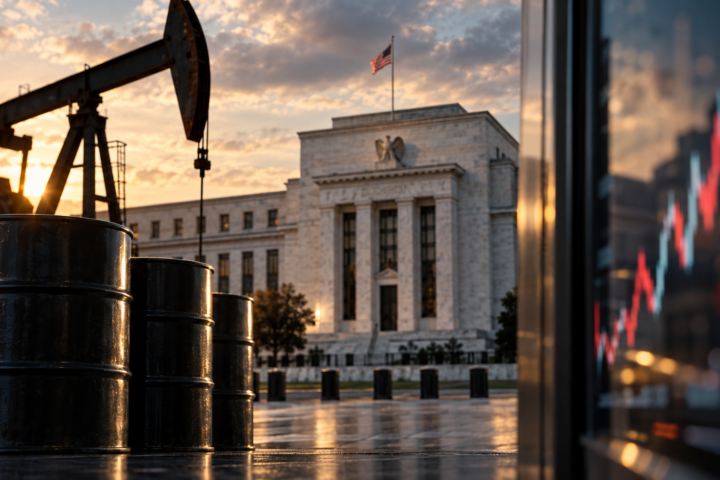
U.S. companies are heading into a crucial earnings season with an increasingly difficult combination confronting investors: oil prices above $104 a barrel, the 10-year Treasury yield near 5.3%, and renewed concerns that inflation could remain stubbornly high. The pressure is emerging just as markets are demanding strong corporate earnings to justify elevated equity valuations.
On Thursday, October 8, U.S. stocks retreated as rising energy prices and higher Treasury yields revived inflation concerns. According to Reuters, Brent crude jumped more than 4% to above $104 a barrel, while the 10-year Treasury yield reached around 5.3%, close to its highest level in more than two decades. The S&P 500, Dow Jones Industrial Average and Nasdaq Composite all moved lower as investors reassessed the outlook for corporate profits and interest rates.
For investors, the immediate question is no longer simply whether companies can grow revenue. It is whether businesses can protect profit margins when energy, transportation and financing costs are all moving higher at the same time.
Why Oil Above $104 Matters for Corporate America
Energy prices have a broad impact on the U.S. economy because oil is embedded in transportation, manufacturing, chemicals, logistics, aviation and consumer goods.
Brent crude climbed to approximately $104.08 a barrel on Thursday, according to the Associated Press, as geopolitical uncertainty surrounding the Middle East increased concerns about global supply. Reuters also reported that hurricane-related disruptions to U.S. energy production were contributing to the market’s concerns.
A sustained increase in crude prices can create a chain reaction across corporate America.
Airlines face higher jet-fuel costs. Trucking and logistics companies face higher diesel expenses. Manufacturers can see higher costs for transportation and petroleum-based inputs. Chemical producers can face increased feedstock costs, while consumer companies may encounter higher packaging and distribution expenses.
Companies with strong pricing power may be able to pass some of these increases on to customers. Businesses operating in highly competitive markets, however, may have less flexibility.
That makes margin guidance one of the most important areas for investors to monitor during the upcoming earnings season.
Higher Treasury Yields Add a Second Layer of Pressure
Oil is only half of the equation.
The U.S. 10-year Treasury yield climbed to roughly 5.3% on October 8, according to Reuters, while the AP reported the yield around 5.26%. The benchmark yield is particularly important because it influences borrowing costs throughout the economy, including corporate debt, mortgages and other forms of long-term financing.
Higher yields can affect businesses in several ways.
Companies refinancing existing debt may have to pay more interest. Businesses planning acquisitions or capital expenditures may find financing less attractive. Highly leveraged companies can see a larger portion of operating cash flow absorbed by interest expenses.
Higher bond yields can also affect stock valuations. When investors can obtain relatively attractive returns from government bonds, the premium they demand for taking equity risk can increase.
This is particularly significant for growth companies whose valuations depend heavily on earnings expected many years into the future.
Inflation and the Federal Reserve Remain Central to the Story
The bond-market move is also influencing expectations for Federal Reserve policy.
Minutes from the Federal Reserve’s September meeting showed that most policymakers expected another interest-rate increase later this year as officials continued to worry about inflation remaining above the central bank’s 2% objective. Core consumer prices were still running at approximately 3% year over year in August.
The combination of elevated oil prices and higher long-term Treasury yields therefore creates a difficult scenario for investors.
If higher energy costs push inflation higher, the Federal Reserve could have less room to ease monetary policy. At the same time, higher borrowing costs can slow economic activity.
That creates the possibility of a margin squeeze from both directions: companies may face higher costs while customers become more sensitive to prices and financing becomes more expensive.
Earnings Season Could Provide the Next Major Market Test
Investors are entering the third-quarter earnings season with expectations already elevated.
The Associated Press reported that analysts were forecasting roughly 30% earnings growth for S&P 500 companies, creating a high hurdle for businesses to clear. Strong earnings may reassure investors that corporate America can absorb higher costs, while disappointing margins or cautious guidance could trigger sharper reactions.
Recent company reactions illustrate the challenge.
PepsiCo, for example, delivered stronger results but lowered its profit outlook, highlighting the difficulty consumer companies face when balancing demand, costs and margins. Other major corporations are also being judged not only on quarterly earnings but on what management teams say about future costs and consumer behavior.
For investors, this means the headline earnings-per-share number may not tell the entire story.
Management commentary on energy expenses, wage costs, financing costs, pricing power and full-year guidance could become equally important.
Which Sectors Are Most Exposed?
Several areas of the market deserve particular attention.
Transportation: Airlines, trucking companies and logistics businesses are vulnerable to higher fuel prices. Companies without strong pricing mechanisms may experience immediate margin pressure.
Manufacturing and chemicals: Energy and petroleum-based inputs can represent significant operating expenses. Investors should examine whether producers can pass higher costs through to customers.
Consumer companies: Higher energy costs can eventually filter through to retail prices. This creates a difficult balance between maintaining margins and protecting consumer demand.
Banks and financial companies: Higher yields can support certain areas of banking profitability, but persistently elevated rates can also increase funding costs and weaken demand for loans and other financial products.
Highly leveraged companies: Businesses carrying significant debt are particularly exposed to refinancing risk as older, cheaper debt matures.
Energy producers: The equation is different for oil and gas companies. Higher crude prices can increase revenue and cash flow, potentially making energy one of the relative beneficiaries of the current environment.
The Market Is Also Watching the Housing and Credit Effects
The increase in Treasury yields is already feeding into other borrowing costs.
Reuters reported on October 8 that the average U.S. 30-year fixed mortgage rate had risen to 7.40%, its highest level since November 2023, compared with 7.28% the previous week. The increase reflects the close relationship between mortgage rates and long-term Treasury yields.
That creates additional risks for housing-related businesses and consumers.
Higher mortgage rates can discourage home purchases and refinancing, while elevated borrowing costs can reduce household flexibility. For businesses, the same principle applies: expensive credit can delay investment decisions, acquisitions and expansion plans.
The broader economic effect will depend on how long yields remain elevated.
What Investors Should Watch Next
The most important signal may be whether today’s cost pressures prove temporary or become embedded in corporate expectations.
Investors should closely monitor:
- Brent crude and U.S. oil prices
- The 10-year Treasury yield
- Federal Reserve policy expectations
- Corporate gross and operating margins
- Management guidance for 2027
- Corporate refinancing activity
- Consumer spending and pricing sensitivity
- Energy and transportation costs
- Credit spreads and corporate borrowing conditions
Reuters reported that a survey of nearly 60 fixed-income strategists expected the 10-year Treasury yield to decline toward 5% by year-end and further over the following year. However, strategists have repeatedly underestimated the pace of this year’s yield increases, meaning investors should not assume that rates will quickly return to lower levels.
Key Investment Insight
The current environment favors quality over leverage.
Investors may want to pay particular attention to companies with strong balance sheets, manageable debt maturities, recurring cash flow and the ability to raise prices without significantly damaging demand.
Energy producers could benefit from sustained crude prices, while businesses with high energy consumption, weak pricing power or substantial refinancing requirements face greater risks.
The bigger issue is duration. A brief spike in oil prices may be manageable for many companies. But if crude remains above $100 while Treasury yields stay near multi-decade highs, the pressure could increasingly appear in corporate earnings, consumer spending and investment decisions.
For investors, the October market move is therefore more than a one-day reaction. It is a warning that inflation, energy prices and financing costs are once again becoming central drivers of corporate profitability.
As earnings season accelerates, investors should look beyond headline revenue and earnings figures and focus on whether companies can defend their margins in a higher-cost economy.
Stay with Stockmarket-news for daily market-moving developments, corporate earnings analysis and investor-focused insights across the U.S. and Canadian markets.