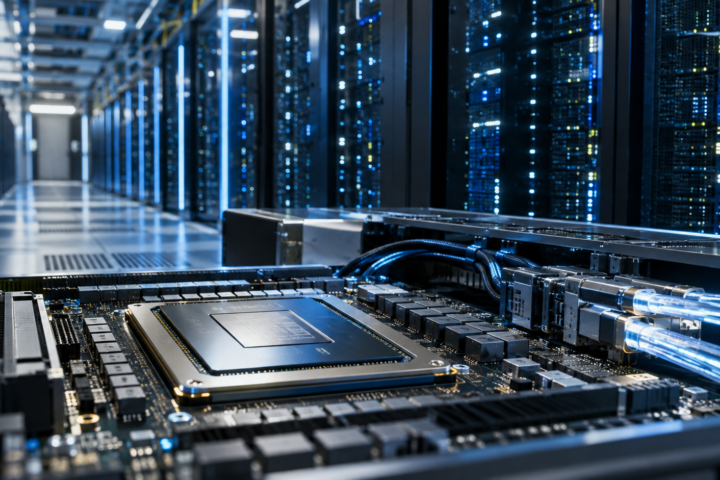
Microsoft and Meta earnings will test whether surging artificial-intelligence investment is producing returns fast enough to support technology valuations.
The artificial-intelligence trade is entering a more demanding phase, as investors shift their attention from the scale of Big Tech’s infrastructure ambitions to the financial returns those projects can generate.
Microsoft (MSFT) and Meta Platforms (META) are scheduled to report quarterly results after the US market closes on Wednesday, placing two of the world’s largest technology companies at the centre of a widening debate over AI spending. Both businesses are expected to deliver strong revenue growth. The more consequential question is whether expanding data-centre budgets are translating into sufficiently rapid gains in cloud computing, digital advertising and enterprise software.
That distinction matters because investors have become less willing to reward capital expenditure simply because it is associated with AI. Technology companies have committed tens of billions of dollars to processors, networking equipment, power capacity and specialised facilities. Those investments have supported Nvidia (NVDA), memory-chip manufacturers and data-centre suppliers, while helping propel major equity indices towards record levels.
Yet the market’s recent behaviour suggests the burden of proof is rising. Semiconductor shares have weakened during July, with the Philadelphia Semiconductor Index falling sharply from recent highs as investors reassess valuations and the durability of demand. Concerns intensified after Alphabet (GOOGL) indicated that spending would remain elevated, reinforcing fears that infrastructure costs may be increasing faster than near-term AI revenue.
Microsoft offers one of the clearest tests of AI monetisation. Its Azure cloud platform sells computing capacity to companies training and operating AI models, while Copilot products attempt to convert generative AI into recurring subscription revenue across workplace software, programming tools and cybersecurity services.
Analysts expect Microsoft to report quarterly revenue of roughly $87.6 billion. Investors will be particularly sensitive to Azure’s growth rate, the contribution from AI services and management’s capital-spending outlook for the new financial year. Strong headline earnings may not be enough if cloud expansion slows or if infrastructure commitments rise substantially without evidence of improving utilisation.
The challenge is partly structural. Building AI capacity requires spending well before customer demand becomes visible in reported revenue. Data centres take time to construct, electrical connections are increasingly constrained, and advanced chips must be ordered months in advance. Microsoft therefore risks disappointing investors whether it spends too aggressively or too cautiously. Excess capacity could weaken returns, but insufficient capacity could allow Amazon.com (AMZN), Alphabet or specialised cloud providers to capture demand.
Meta presents a different investment case. The company is not primarily selling cloud capacity. Instead, it is deploying AI to improve the effectiveness of advertising, content recommendations and user engagement across Facebook, Instagram and WhatsApp. Its spending can be justified if better recommendation systems increase the time users spend on its platforms or if automated advertising tools help businesses achieve stronger returns.
That model may make Meta’s AI benefits easier to see in operating results. Improvements in ad targeting, pricing and engagement can flow relatively quickly into revenue. However, Meta is also financing ambitious model development, computing infrastructure and next-generation products whose commercial value remains uncertain.
Consensus expectations place Meta’s quarterly revenue near $60.2 billion. Investors will examine advertising growth and margins, but guidance on capital expenditure could dominate the market reaction. A meaningful spending increase may be accepted if management can demonstrate that AI is expanding advertising demand. The same increase could be punished if revenue guidance suggests that returns are becoming more distant.
The scrutiny extends well beyond Microsoft and Meta. Weakness in semiconductor shares reflects concern that hyperscale cloud operators may eventually moderate orders after an extraordinary investment cycle. Nvidia remains the central supplier of accelerators used to train and run advanced models, but the wider ecosystem includes memory, storage, networking and power-management companies.
Seagate Technology (STX) offered evidence that demand remains substantial. The data-storage company reported quarterly revenue of $3.6 billion, an increase of 48% from a year earlier, and forecast continued strength from cloud data centres. Its results underline an important point: AI infrastructure demand is spreading beyond graphics processors into storage systems capable of retaining the vast quantities of data required by modern computing workloads.
Still, strong supplier earnings do not eliminate the risk of overinvestment. Cloud companies may continue purchasing equipment even as the economics of individual AI services remain unclear. Competition could also lower prices before utilisation reaches optimal levels, extending the period required to earn acceptable returns.
China is adding another source of uncertainty. Advances by Chinese semiconductor and memory producers have renewed questions about the pricing power of established manufacturers. Local technology companies are also becoming more efficient at developing AI systems with restricted or less advanced hardware, potentially reducing the effectiveness of US export controls and creating competing technology ecosystems. Nvidia and Advanced Micro Devices (AMD) face the dual challenge of regulatory limits on sales to China and growing competition from domestic suppliers such as Huawei.
For investors, the technology sector’s next stage may be defined less by enthusiasm for AI adoption than by financial discipline. Companies that can connect infrastructure spending to measurable revenue, stronger margins or deeper customer retention are likely to retain premium valuations. Those relying primarily on long-term promises may encounter a more sceptical market.
Microsoft and Meta do not need to prove that every AI investment is already profitable. They do, however, need to demonstrate that demand is developing quickly enough to justify the extraordinary scale of their commitments. Their results will therefore serve as a broader verdict on whether the AI boom is progressing from technological possibility to sustainable corporate returns.