The record U.S. debut gives investors direct access to a critical Nvidia supplier while raising fresh questions about valuation, capacity spending and semiconductor-cycle risk.
SK Hynix entered the U.S. stock market on Friday in a landmark listing that captures both the scale and the growing complexity of the artificial-intelligence investment boom. The South Korean memory-chip producer raised about $26.5 billion by selling 177.9 million American depositary receipts at $149 each, making the transaction the largest U.S. share offering by a foreign company. The securities began trading on Nasdaq as investors weighed soaring demand for advanced memory against increasingly volatile valuations across the semiconductor sector.
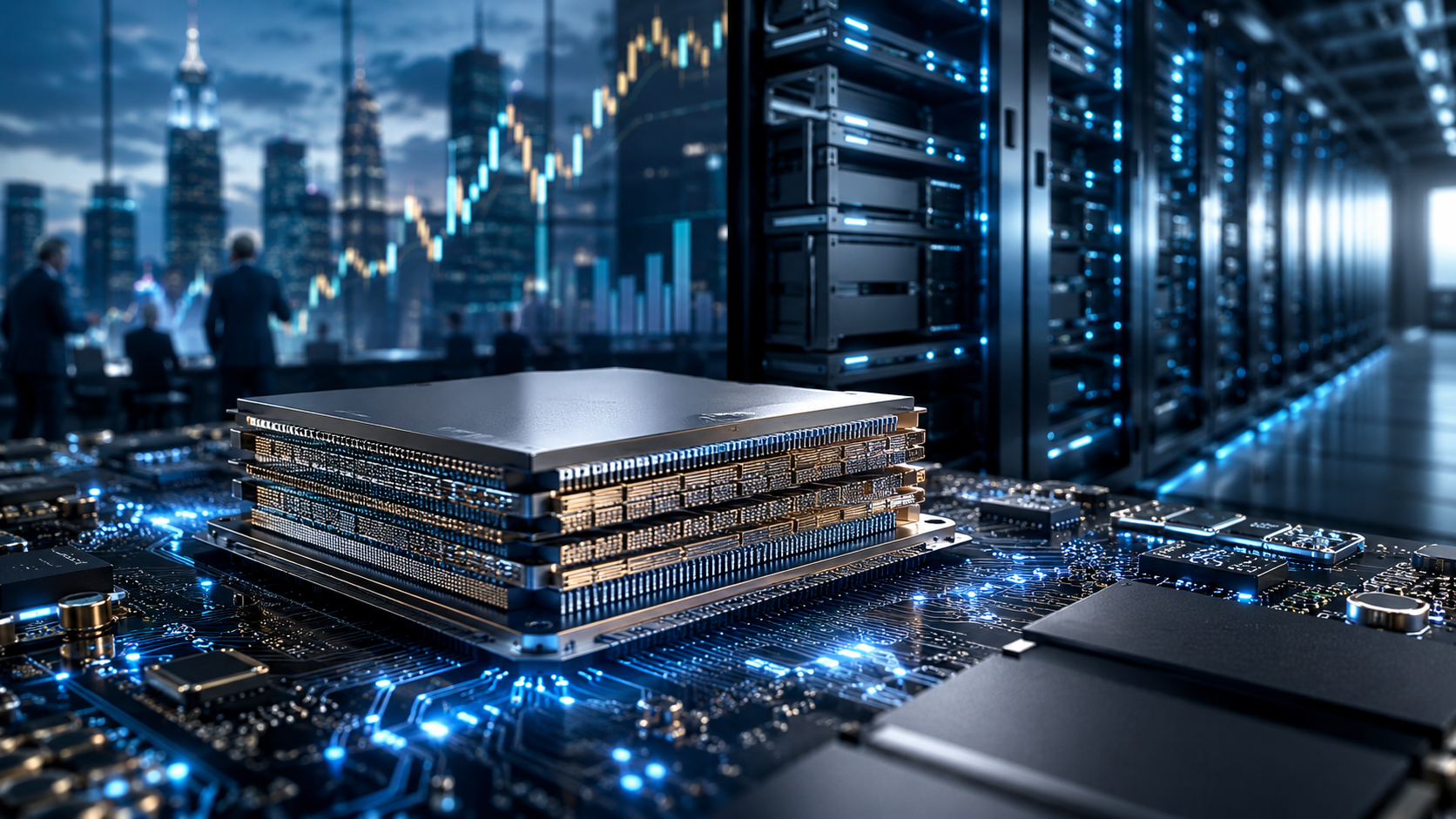
The offering gives U.S. investors a more direct route into one of the most strategically important parts of the AI supply chain. SK Hynix is a leading producer of high-bandwidth memory, or HBM, the specialized technology used alongside graphics processors in AI servers. Its chips help accelerators process large volumes of data quickly while limiting bottlenecks between computing and memory. That role has made the company a key supplier to Nvidia (NVDA), whose processors remain central to the global buildout of generative-AI infrastructure.
The timing is significant. Semiconductor shares have powered much of the equity market’s recent advance, but the sector has also become prone to sharp reversals as investors debate whether earnings can keep pace with the capital flowing into factories, data centers and advanced packaging. Nasdaq 100 futures declined about 0.5% before Friday’s session, suggesting some profit-taking after a technology-led rally the previous day. The broader market reaction was cautious rather than euphoric, reflecting a growing distinction between confidence in long-term AI demand and concern about the price investors are being asked to pay for that growth.
SK Hynix arrives with unusually strong financial momentum. The company generated nearly $65 billion in revenue during 2025, while profit approximately doubled to $28 billion as demand for AI memory tightened supply and lifted pricing. The U.S. accounted for nearly 69% of revenue, underscoring how closely its fortunes are connected to American cloud-computing companies, chip designers and data-center operators. Its South Korean shares had already risen sharply before the U.S. transaction, meaning the Nasdaq listing offers access to a proven growth story but not necessarily an inexpensive one.
The listing also highlights how the economics of artificial intelligence are broadening beyond graphics processors. Nvidia remains the most visible beneficiary, reporting record fiscal first-quarter revenue of $81.6 billion, an 85% increase from a year earlier. Data-center revenue reached $75.2 billion, up 92%, demonstrating that spending by cloud providers, governments and technology companies remains concentrated on computing infrastructure. Yet a powerful AI system requires more than accelerators. It also depends on memory, networking equipment, cooling systems, power supplies, storage and semiconductor manufacturing capacity. SK Hynix allows investors to target one of those adjacent bottlenecks.
That exposure could be valuable because HBM is technically difficult to manufacture and requires sophisticated packaging. Supply cannot be expanded as quickly as demand can emerge, supporting higher margins when orders accelerate. Memory producers have historically operated in a deeply cyclical industry, however. Periods of shortage encourage aggressive capital spending, which can eventually create excess supply and falling prices. The central question for SK Hynix investors is whether AI has permanently improved the structure of the memory business or merely extended the latest upward phase of the cycle.
Management and industry partners appear to be preparing for sustained demand. SK Hynix has announced plans for its first U.S. production facility in Indiana and is participating with Samsung Electronics and the South Korean government in a vast semiconductor-manufacturing initiative at home. These investments reflect the geopolitical importance of chip supply chains as the United States, Europe and Asian governments seek greater control over critical technologies. They also introduce execution risk. New facilities require large upfront spending, skilled labor and long construction timelines, while rapid advances in chip architecture can make older production lines less competitive.
The scale of the offering may itself influence the market. A $26.5 billion transaction absorbs substantial investor capital and creates a new benchmark for valuing global AI suppliers. Strong post-listing demand could support related shares, including Micron Technology (MU), the largest U.S. memory-chip producer. A weak debut would have the opposite effect, suggesting that investors are becoming less willing to finance semiconductor expansion at elevated valuations.
Signs of caution are already visible. Analysts have pointed to unusually large price swings in South Korean and U.S. chip shares, with volatility rising even as many companies trade near record levels. SK Hynix’s Seoul-listed shares had advanced severalfold over the preceding year, while semiconductor indexes recorded frequent daily moves that would normally be associated with periods of market stress. High volatility does not prove that a bubble is forming, but it indicates that expectations are becoming less stable and that small changes in demand forecasts can trigger outsized share-price reactions.
For Nvidia, the emergence of a liquid U.S.-traded supplier could help investors evaluate the strength of the wider ecosystem supporting its growth. Rising HBM orders would reinforce the case that shipments of advanced AI systems remain robust. Slower memory demand, falling prices or inventory accumulation could serve as an early warning that customers are moderating infrastructure purchases. SK Hynix may therefore become not only an investment vehicle but also an important market indicator for the AI spending cycle.
The offering ultimately marks a transition in the AI trade. Investors are moving beyond a narrow group of chip designers and searching for opportunities throughout the infrastructure stack. That expansion can produce durable winners, but it also increases the risk that capital is deployed faster than end-user revenue develops. SK Hynix enters Nasdaq with scarce technology, powerful customers and exceptional earnings growth. Its performance will help determine whether the next phase of the AI boom belongs to a wider group of suppliers or whether semiconductor enthusiasm has already outrun the industry’s capacity to deliver.