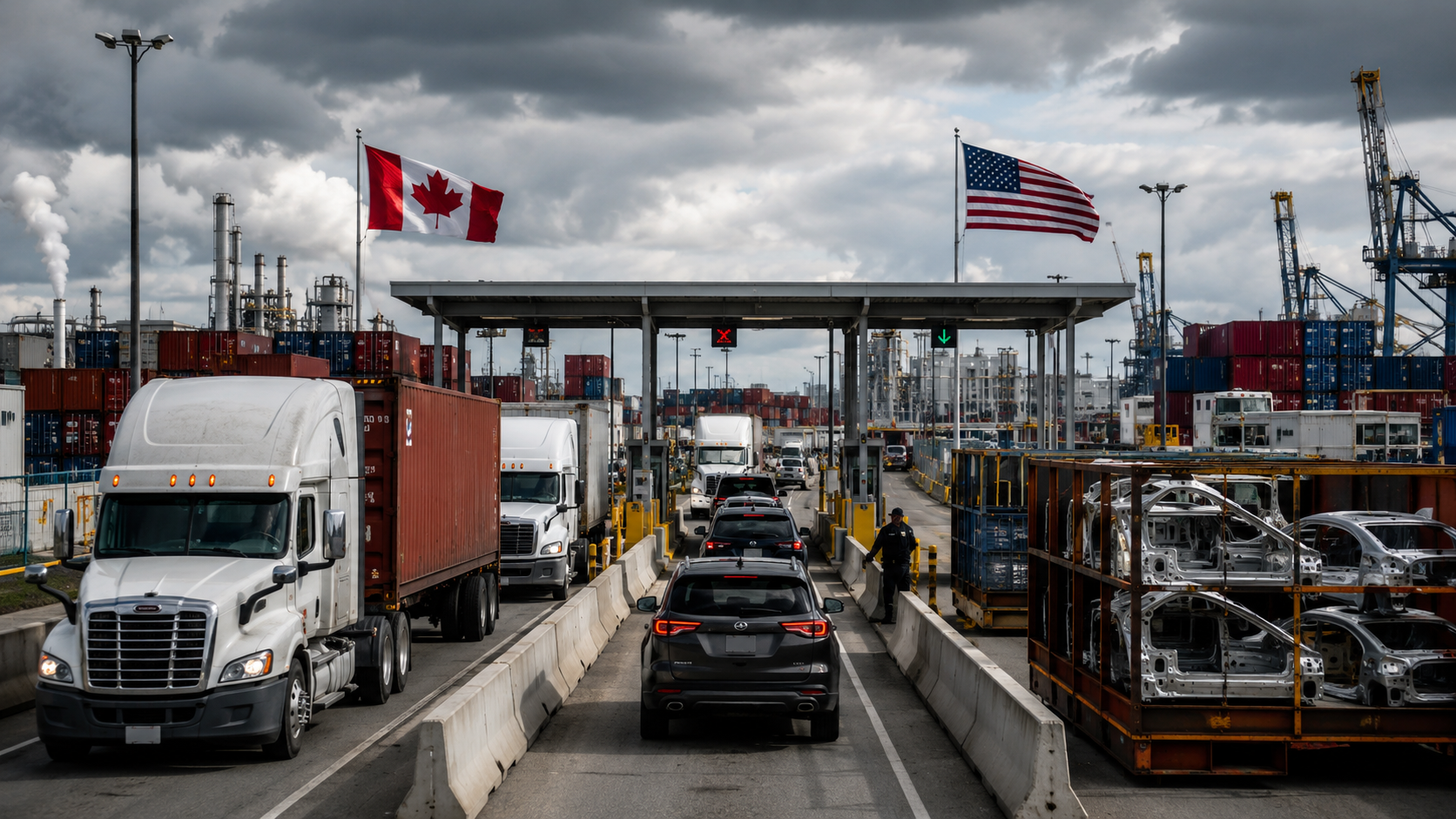
Washington’s new duties on selected Canadian goods raise inflation, investment and growth risks across one of the world’s most integrated trading relationships.
The United States has opened a more disruptive phase in its trade confrontation with Canada, announcing tariffs of 50% on selected Canadian imports and placing businesses on both sides of the border on notice that decades of regional integration can no longer be treated as permanent.
The duties, scheduled to take effect on August 19, cover categories including automobiles, dairy products, alcohol and furniture, while exempting strategically important Canadian exports such as energy, potash, fish and critical minerals. The targeted structure limits the immediate shock to commodity markets, but it concentrates pressure on politically sensitive industries with supply chains that repeatedly cross the border before finished products reach consumers.
For investors, the central issue is not simply the tariff rate. It is the possibility that trade policy is becoming a recurring source of uncertainty for corporate planning, inflation expectations and economic growth. Canada and the United States exchange vast quantities of intermediate goods, particularly in manufacturing. A tariff imposed at one stage of production can therefore raise costs several times as components move between factories.
The automotive industry is especially exposed. Vehicles assembled in North America often contain engines, electronics, metals and other parts sourced from facilities across the region. General Motors (GM), Ford Motor (F) and Stellantis (STLA) operate production networks designed around relatively frictionless trade under the United States-Mexico-Canada Agreement. Applying steep tariffs even to some qualifying Canadian goods would undermine the economics of those networks and force manufacturers to choose among absorbing higher costs, raising prices or reorganizing production.
None of those options is painless. Absorbing the duties would weaken margins at a time when automakers are already investing heavily in electric vehicles, software and battery capacity. Passing the cost to buyers would make new vehicles less affordable and could further extend replacement cycles. Moving production would require years of capital spending and could create inefficiencies if companies rebuild capacity primarily to respond to policies that may later change.
The dispute also presents a monetary-policy challenge. Tariffs typically produce a one-time increase in prices rather than continuing inflation by themselves. Yet the distinction becomes less useful when new trade restrictions arrive repeatedly, affect a widening range of products or prompt retaliation. Businesses may begin treating tariffs as a lasting operating expense, while workers could seek higher wages to compensate for increased living costs.
That dynamic would complicate the work of the Federal Reserve and the Bank of Canada. Both institutions must distinguish between temporary price shocks and evidence that inflation is becoming embedded. A renewed increase in goods prices could reduce their flexibility to lower interest rates, even if weaker trade and investment begin slowing economic activity.
The risk is particularly acute for Canada, whose economy is more dependent on exports to the United States than the U.S. economy is on Canadian demand. A prolonged dispute could weaken Canadian manufacturing, business investment and employment while placing downward pressure on the Canadian dollar. Currency depreciation might cushion exporters outside the tariffed sectors, but it would also make imported goods more expensive and reinforce inflationary pressure.
The exemptions for energy and critical materials show that the United States is attempting to preserve access to products that are difficult or costly to replace. Canada is an important supplier of crude oil, electricity, potash, uranium and minerals used in advanced manufacturing. Broad restrictions on those products could quickly raise costs for American refiners, farmers, utilities and technology companies.
The selective approach may therefore reflect both political and economic calculation. By targeting recognizable consumer and industrial products while protecting strategic inputs, Washington can intensify pressure on Canadian policymakers without immediately disrupting parts of the U.S. economy that rely heavily on Canadian resources. The approach, however, may prove difficult to contain if Canada responds with duties aimed at politically important American exports.
Retaliation would deepen the market consequences. Canadian measures could target U.S. agricultural products, manufactured goods or consumer brands, creating localized pain for companies and regions that depend on cross-border sales. Even before formal retaliation, businesses may delay orders or build inventories ahead of the August implementation date, producing temporary distortions in trade data and transportation demand.
The escalation comes as Washington prepares additional tariff measures against a wider group of trading partners. The administration is seeking alternative legal mechanisms after earlier tariff actions faced judicial constraints, increasing the likelihood that trade policy will remain fluid rather than settle into a predictable framework. Reports indicate that new duties could affect dozens of countries as an existing 10% global tariff approaches expiration.
That broader context matters for Europe and Asia. Companies might normally respond to a bilateral U.S.-Canada dispute by shifting sourcing to other countries, but a wider tariff campaign could reduce the number of reliable alternatives. Manufacturers would then face a choice between maintaining efficient global supply chains and paying higher duties, or creating more expensive regional systems designed to reduce political exposure.
The International Monetary Fund expects global growth of 3.0% in 2026, but it has warned that disinflation has stalled and that renewed conflict or financial repricing could weaken the outlook. Additional trade barriers would add another obstacle by reducing investment visibility and raising costs for economies already dealing with volatile energy prices and constrained public finances.
Equity markets may initially treat the Canadian measures as a sector-specific event, particularly because key energy and mineral flows are exempt. That interpretation could prove too narrow. The greater risk is cumulative: each new tariff, exemption and retaliatory threat increases the cost of managing international operations and reduces confidence in established trade rules.
For households, the effects would appear through higher prices, fewer product choices and potentially weaker employment in export-dependent industries. Vehicle buyers could be among the first to notice, but the indirect consequences may spread into insurance, transportation, construction and consumer credit.
The dispute does not guarantee a full-scale North American trade war. The 30-day period before implementation leaves room for negotiation, exemptions or a narrower settlement. Still, companies and investors can no longer assume that the depth of U.S.-Canadian economic integration will protect the relationship from sharp policy shifts. The tariff announcement has turned what was once considered one of the world’s most stable commercial partnerships into another source of global market risk.